
Last verified by Harry Etminan — 27 October 2026.
Editorial research updated: 26 October 2026. This is a purpose-based selection, not a paid ranking. Operating hours, animal encounters, admissions and venue openings should be checked with the operator before travel.
The best zoos and aquariums in Australia are not necessarily the biggest, most photographed or most expensive. A visitor with only two hours in Sydney needs a different experience from a family spending a full day near Adelaide, or someone travelling to Queensland specifically to understand reef ecology. A good recommendation begins with what the visitor hopes to learn, how much time they have and whether the facility’s programmes suit their interests.
Australia’s wildlife institutions range from open-range safari parks to compact urban aquariums that focus on a specific marine coastline. Their animal collections and conservation programmes change, too. An older guide may still describe a venue that is under redevelopment or promise encounters that are no longer offered. This article uses current operator and government information and avoids unsupported claims about record visitor numbers or which facility is universally ‘number one’.
Start by choosing the kind of visit
For an iconic harbour setting and a broad zoo experience: Taronga Zoo Sydney offers varied animal habitats and keeper presentations on the north side of Sydney Harbour. The operator’s visitor guide lists presentations, itineraries and special experiences.
For a large open-range safari day: Monarto Safari Park near Adelaide requires more time and a little more planning. It is best treated as its own day’s excursion rather than a short stop between city attractions.
For marine ecosystems rather than land animals: Cairns Aquarium and the Aquarium of Western Australia (AQWA) have geographically focused collections. One interprets Tropical North Queensland’s freshwater-to-reef journey; the other takes visitors along Western Australia’s very different coasts.
For an animal-show programme: Australia Zoo in Queensland offers a published series of keeper talks and conservation demonstrations, including its Wildlife Warriors show. Check the daily programme rather than assuming a particular animal appears in every session.
Those choices are genuinely different products. A simple top-ten list can conceal the most important practical information: travel distance, visit length, accessibility, weather exposure and whether premium encounters cost extra.
Taronga Zoo Sydney: wildlife with a harbour perspective
Taronga’s setting is famous, but the views are only part of the experience. For first-time international visitors, its Australian wildlife precinct can be a useful way to learn about koalas, kangaroos, dingoes and nocturnal species before encountering them in the wild. The zoo publishes a dedicated Australian-wildlife itinerary that allocates roughly four to five hours.
The key strength of Taronga is that it makes education part of a conventional city visit. The operator’s keeper-talk schedule includes daily presentations, but exact times may vary. Visitors who prefer guided learning can arrange a paid encounter; these have conditions and may be restricted by animal welfare and availability, as the animal-encounters page explains.
Taronga is especially suitable if you are already staying in Sydney without a car. The zoo is in Mosman and can be reached by ferry or bus; consult Taronga’s transport and visitor information for the current options. If time is very limited, a three-hour visit is possible, but expect to make choices. Racing through every habitat misses the value of stopping to read the interpretation or listen to keepers.
Who may find it less suitable? Travellers with limited mobility should review the site’s terrain and accessible transport carefully; an iconic harbour location is not the same as a completely flat route. Families should also confirm the cost of any additional encounter rather than assuming it is included in standard admission.
Monarto Safari Park: build your day around the landscape
Monarto is not a conventional city zoo with densely spaced enclosures. Situated roughly an hour’s drive from Adelaide, it covers a very large open-range landscape. The park’s official visitor information recommends allowing at least four to five hours and describes the included Zu-loop bus linking wildlife-viewing areas.
The larger scale is the attraction. Rather than rushing between signs, visitors can see animals across broad habitats and hear about the conservation work of Zoos SA. Guided presentations and keeper talks help interpret what would otherwise be a distant view of animals across open country. This is an excellent format for people who want a safari-style experience but is not the best choice for a quick two-hour trip.
Logistics are especially important. Non-members are normally required to book a date-specific entry ticket. Some viewing platforms or walking tracks may have separate access conditions, and the shuttle cannot accommodate every kind of stroller. In hot weather, exposure and water needs can determine how enjoyable the trip is.
Monarto’s website states that it is managed by the conservation charity Zoos SA. Visitors interested in whether an admission fee supports conservation can consult the operator’s public programme rather than assuming that each animal encounter directly funds a particular field project.
Australia Zoo: a full-day programme with strong public presentation
Australia Zoo, associated with the Irwin family, combines an extensive collection with keeper talks and the Wildlife Warriors show. The site’s current plan-your-day timetable includes separate presentations featuring reptiles, birds, tigers and other animals, with the Crocoseum show a central experience.
For some families, this planned programme is the appeal. It is easier to structure a visit around an engaging demonstration than to move through a huge collection without knowing which exhibit is worth prioritising. The operator also provides ticket inclusions and conditions, which should be checked for children’s ages, concessions and extras.
But a show-centred visit is not for everyone. Visitors mainly interested in quiet interpretation, long observation of animal behaviour or aquarium exhibits may prefer a different venue. When evaluating any animal performance, ask what conservation message is being communicated and look for information about the facility’s animal-care standards rather than treating spectacle alone as proof of educational value.
If your schedule is flexible, compare the actual day’s programme and travel time before reserving. A theme of this guide is that quality depends as much on matching a venue to a visitor as it does on the size of its grounds.
Cairns Aquarium: follow water from the rainforest to the reef
Cairns Aquarium offers a very different form of environmental education. Its exhibits trace a water journey from freshwater streams through the Wet Tropics rainforest and coastal mangroves to the Great Barrier Reef and Coral Sea. The operator’s habitats guide explains how fish, reptiles and invertebrates move between connected ecosystems.
That sequence is valuable if you are visiting North Queensland but cannot snorkel, if the weather disrupts a reef tour, or if you want to understand the ecology of the region before entering the ocean. Instead of presenting marine creatures as unrelated attractions, the aquarium explains why a young fish may use mangroves and then move towards the reef as it develops.
Cairns Aquarium is relatively accessible to people staying in central Cairns; its visitor-information page gives directions, opening times and accessibility details. It is an indoor experience and therefore useful during wet or very hot weather. Presentations and supervised touch-pool opportunities may be included with general admission, according to the current daily presentations page.
Do not assume that any particular turtle in rehabilitation or premium behind-the-scenes tour is available on the day. These experiences have separate operating conditions, and the care of the animal must come before a tourist’s schedule.
AQWA in Perth: one state, several very different seas
The Aquarium of Western Australia, known as AQWA, works particularly well as a geographically organised marine visit. Its exhibits move from Perth’s metropolitan coastal waters to the Shipwreck Coast, the Great Southern and the state’s tropical north. The AQWA exhibits overview explains those different ecological zones and the animals associated with them.
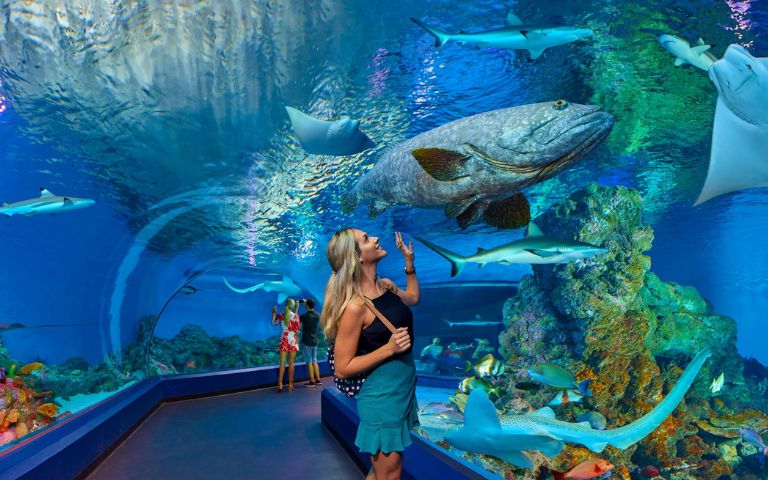
A highlight is the large Shipwreck Coast aquarium and its underwater viewing tunnel. The operator emphasises that its displays focus on Western Australian marine life, rather than attempting to show species from every ocean in the world. The venue’s main website lists Ocean Guide talks, marine displays and bookable experiences; some activities carry additional fees.
For a Perth family, AQWA may be an easier half-day option than a long excursion. It is at Hillarys Boat Harbour, so the wider day’s plan can include the harbour and the surrounding coast. But visitors expecting tropical reef species exclusively should remember that Western Australia spans climates and habitats from cool southern waters to the tropical north.
Where supervised touch experiences are offered, follow the venue’s animal-handling instructions. Educational interaction should never involve lifting creatures out of water for a photograph.
Sydney’s SEA LIFE Aquarium and the wider zoo network
An urban marine aquarium can be an excellent alternative to an all-day zoo when visitors have limited time or poor weather. SEA LIFE Sydney Aquarium, located in Darling Harbour, is often chosen for its underwater exhibits and ease of access from the city centre. The Tourism Australia guide to wildlife experiences includes it among Sydney’s noteworthy attractions.
In Victoria, do not collapse Melbourne Zoo, Healesville Sanctuary and Werribee Open Range Zoo into one interchangeable stop. They are different types of experience with different transport and scheduling implications. A traveller particularly interested in native wildlife may choose a different venue from someone seeking broad international exhibits or an open-range experience.
This is why a national list needs honest limits: no meaningful comparison can say that every one of these facilities is ideal for every family. Instead, check what habitats, interpretation and transport fit the actual visit.
Important 2026 correction: Reef HQ is not open for general visits
Some older Australian aquarium lists still recommend Reef HQ Aquarium in Townsville as though it were an operating attraction or say it would reopen in 2026. That advice is out of date.
The Great Barrier Reef Marine Park Authority now calls the project the Great Barrier Reef Aquarium and states that its redevelopment is on track for an opening in 2029. The Reef Authority’s official project page should take precedence over stale travel directories. Its 2025 redevelopment update describes the relocation and care of marine animals during the project.
A traveller visiting Townsville in 2026 should therefore not place Reef HQ on a same-day ticketed aquarium itinerary. This one correction makes a practical difference: it avoids wasted travel time and prevents a disappointment caused by a guide’s failure to distinguish a future project from a currently operating venue.
How to compare wildlife venues ethically
Educational interpretation matters more than an enormous species count. Does the organisation describe threats facing the animals? Do staff explain the link between breeding programmes, habitat conservation and wider ecology? Are premium encounters limited when animal welfare requires it? Transparent conservation information and clear visitor instructions are useful signs; adjectives such as ‘ethical’ or ‘world-leading’ are not substitutes for evidence.
The wildlife experience you choose should also fit the people travelling with you. Children may engage better with short talks and a play break than with hours of walking. A keen wildlife photographer may prefer a quieter encounter and fewer crowds. A visitor who cannot stand for long should assess route length, seating and accessible transport rather than choosing a venue from photographs.
For marine animals, consider whether you want to observe reef ecosystems, explore deeper coastal waters or see freshwater habitats. The strength of Cairns Aquarium’s linked ecosystem journey and AQWA’s Western Australian coastline approach is that each tells a coherent regional story rather than simply collecting unusual animals.
A practical booking checklist
Before paying, check the operator’s official site on six points: the correct opening date and location; the recommended time needed; whether bookings are compulsory; the full price and any add-ons; accessibility, age or supervision restrictions; and the current list of shows or encounters. School holidays, animal welfare requirements and weather can affect availability.
If the choice is between two well-regarded institutions, choose the one that matches your actual day. Monarto rewards time and travel planning. Taronga fits a broader Sydney sightseeing itinerary. Cairns Aquarium is ideal for a region-focused indoor marine experience. AQWA highlights the diversity of Western Australian seas. Australia Zoo emphasises a full day’s public wildlife programme. There is no need to invent a national winner.
The best zoos and aquariums in Australia are those that leave visitors with more than photographs: a realistic understanding of animals, habitats, conservation challenges and the limits of what any one facility can show.