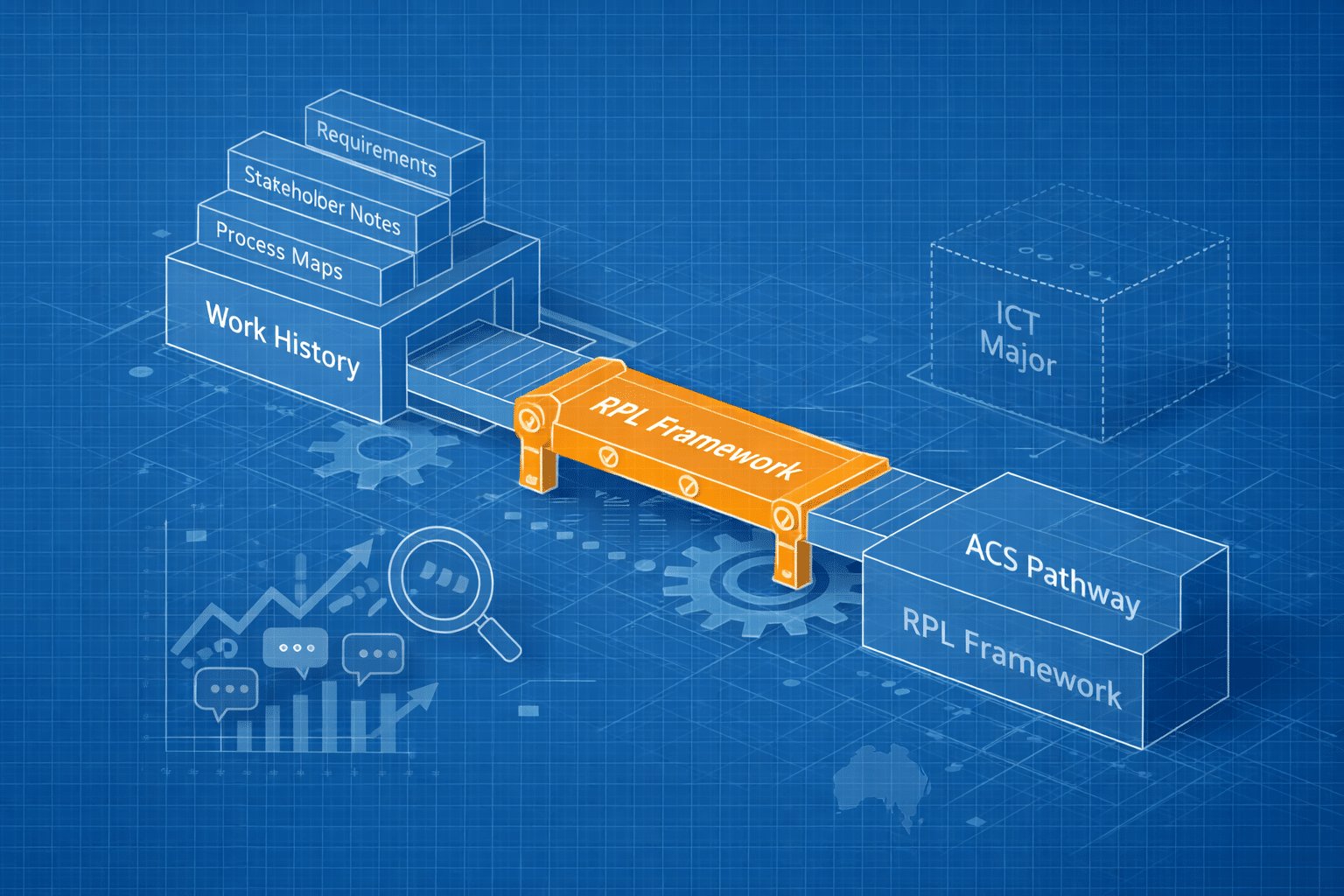

RPL without degree ICT Business Analyst is a common pathway people explore when they have strong industry experience but do not have a formal ICT qualification that fits ACS requirements. If you have been working in business analysis for years, delivering tech-focused outcomes, you may still be able to demonstrate your competency through the ACS Recognition of Prior Learning route.
If you are new to this topic, start by understanding the overall idea of RPL for ACS skills assessment and how it fits into a skills assessment process for migration purposes. Many applicants feel confused at first because RPL is not “a shortcut” and it is not the same as simply having job experience on a resume.
◆ Sydney-based Australian Pathways RPL and ACS writing team can best help with tailored RPL reports and documents, based on your actual background and evidence.
What RPL Means In The ACS Skills Assessment Context
In the ACS setting, RPL (Recognition of Prior Learning) is a formal way to show that your practical ICT knowledge and professional capability are equivalent to what would normally be gained through relevant ICT study. It is mainly used when you:
- Have no degree at all, or your degree is not recognised as ICT-relevant
- Have a degree, but it is in a non-ICT field and does not meet the ICT content expectations
- Have incomplete qualifications, short courses, or mixed learning pathways
- Have strong ICT-related work history and can prove skills through evidence and structured writing
The key point is that ACS is assessing skills and knowledge, not just job titles. Even if you have “Business Analyst” on your contract, ACS will focus on whether your work demonstrates ICT depth, structured analysis, and professional practice aligned with the nominated occupation.
For official updates, policies, and general guidance, applicants typically start with the Australian Computer Society homepage at acs.org.au.
Who Is An ICT Business Analyst (ANZSCO 261111)?
An ICT Business Analyst (ANZSCO 261111) is generally a professional who helps organisations identify business needs and translate them into technology requirements, functional specifications, and solution outcomes. While the role involves people, processes, and strategy, it is also closely linked to ICT delivery.
Common ICT Business Analyst work areas include:
- Requirements Elicitation And Stakeholder Workshops
- Business Process Analysis And Process Modelling
- Functional Requirements, User Stories, And Acceptance Criteria
- Data Flow, Integration Needs, And System Impacts
- Supporting Solution Design With Clear Documentation
- Working With Developers, Testers, Product Owners, And Project Managers
- Change Impact Analysis And Implementation Support
In Australia’s occupation framework, ANZSCO definitions are used as a reference point for many migration-related assessments. For broader official statistical context around ANZSCO and Australian occupational classifications, many people refer to the Australian Bureau of Statistics at abs.gov.au.
RPL Without Degree ICT Business Analyst: Who This Usually Fits
RPL without degree ICT Business Analyst is most relevant when your background is experience-heavy and qualification-light. That might look like:
- You learned on the job and progressed from support, admin, or operations into business analysis
- You studied something like management, finance, engineering, or science, then moved into ICT projects
- You have vendor training (Agile, Scrum, CRM platforms, ERP tools) but not a formal ICT degree
- Your work is clearly tied to ICT systems, platforms, data, and technology-driven change
What matters most is whether you can show a consistent record of ICT-related work, supported by credible employment evidence and well-structured written explanations of what you did and what you learned.
High-Level ACS Skills Assessment Steps For Non-ICT Or No Degree Pathways
While each case differs, the overall flow is usually similar:
- Choose The Right Occupation
Make sure ICT Business Analyst is the best match for your actual duties, not just your title. - Check Core Eligibility
RPL is typically used where formal ICT qualifications are missing or not sufficient, and you rely on professional experience plus a structured RPL submission. - Prepare Employment Evidence
Gather documents that prove who employed you, when, in what capacity, and what you actually did. - Prepare RPL Writing Requirements
RPL requires structured writing to demonstrate knowledge and project involvement. This is where many applicants struggle, because the writing must be specific, consistent, and evidence-based—without being copied or generic. - Submit And Wait For Outcome
You lodge your application through the ACS process and receive an assessment outcome, which you can then use for migration steps if successful.
If your longer-term goal is a visa pathway, it is also important to cross-check the visa and skills assessment relationship through Australia’s Department of Home Affairs at immi.homeaffairs.gov.au.
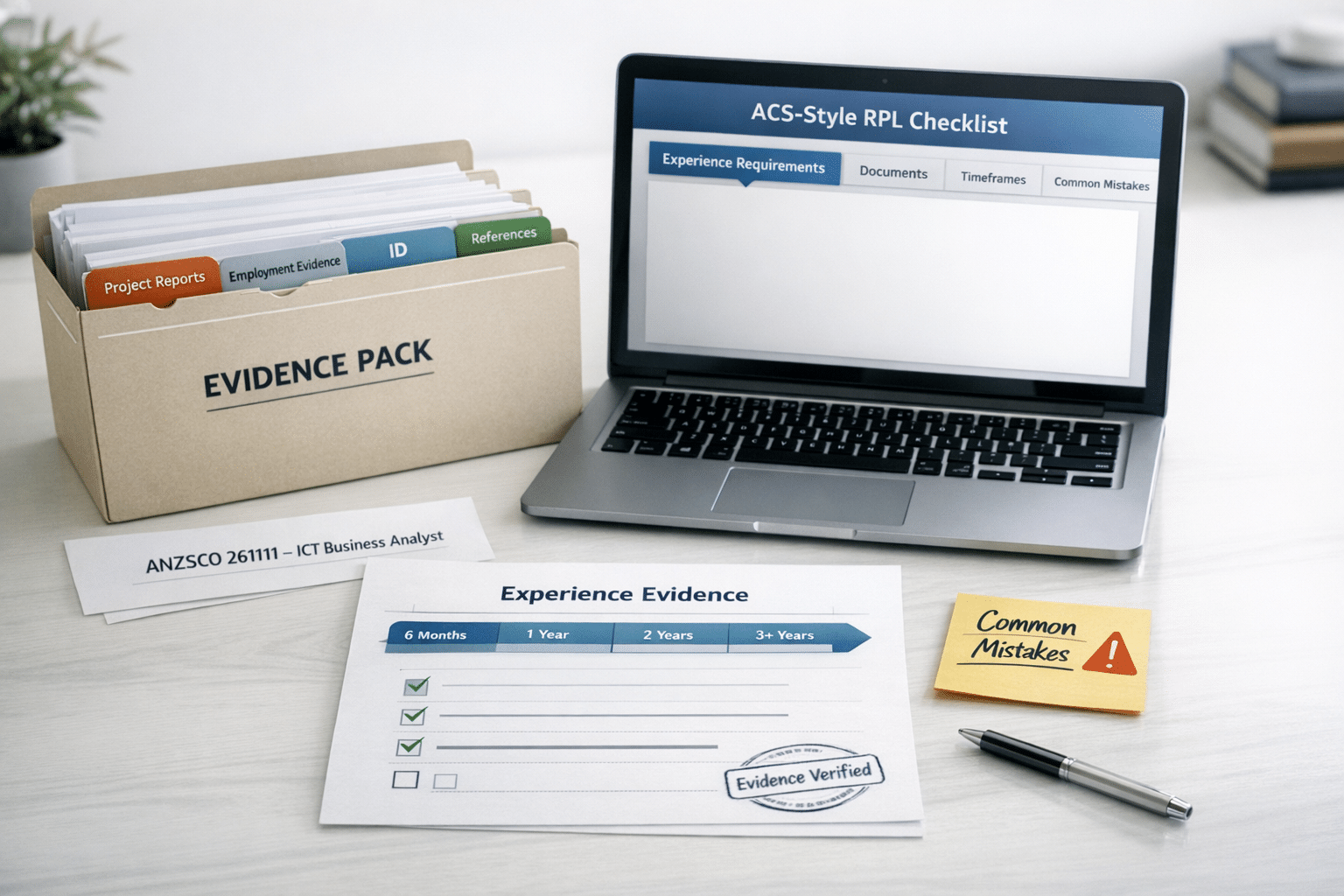
RPL Documents And Evidence: What You Typically Need
ACS applications tend to fail more often because of weak evidence than because of a lack of experience. While the exact list depends on your circumstances, common document types include:
Identity And Background
- Passport Bio Page (And Any Required Identity Documents)
- CV/Resume With Clear Dates And Role Descriptions
Employment Evidence
- Reference Letters On Company Letterhead (Signed, Dated, With Contact Details)
- Contracts Or Appointment Letters (Where Available)
- Payslips, Tax Records, Or Bank Statements (If Needed To Support Employment Claims)
- Organisational Charts Or Role Descriptions (Helpful In Some Cases)
RPL-Specific Components (High-Level)
- Written explanations of your learning and skills development
- Project-based writing showing your involvement in ICT-relevant initiatives
A key warning: avoid copying text from the internet or using “one-size-fits-all” wording. ACS writing is assessed for authenticity and relevance to your exact work environment.
RPL Without Degree ICT Business Analyst: How To Think About Your Project Evidence
RPL without degree ICT Business Analyst applications often succeed when the applicant can clearly show that their work was not purely administrative, generic, or non-technical. Your projects should demonstrate ICT context, such as systems implementation, platform changes, data-related work, integration, testing support, or structured requirements documentation.
Helpful project indicators (conceptual, not a template) include:
- The project had a defined ICT system, platform, or application involved
- You had responsibility for translating business needs into documented requirements
- You worked with technical teams and influenced solution outcomes
- You dealt with constraints like security, data quality, integration, or performance
- You supported testing, releases, user acceptance, or change management linked to a system
This does not mean you must be a developer. But it does mean your BA work should be visibly connected to ICT delivery, not only business policy or HR-type tasks.
Typical Timeframes: What To Expect (General Only)
Processing times can change based on demand, document quality, and whether further clarification is required. In general, applicants should plan for:
- Preparation time: often several weeks (sometimes longer) to collect evidence and write properly
- Assessment time: commonly several weeks to a few months depending on current processing queues
- Extra time if documents are inconsistent, unclear, or require follow-up
Because timeframes and requirements can change, it is wise to check official sources regularly, including ACS. If you are considering study as a parallel or alternative pathway for formal qualification outcomes, government-backed education information is often found at studyinaustralia.gov.au.
Common Mistakes That Cause Problems In RPL Submissions
Many applicants have genuine experience, but their submission does not make it easy for an assessor to verify and understand. Common issues include:
1) Selecting The Wrong Occupation
- Calling yourself a Business Analyst, but describing duties closer to admin, sales, or general management
- Mixing responsibilities from multiple roles without clarity
2) Generic Or Over-Polished Writing
- Using wording that sounds copied, templated, or not connected to real projects
- Writing that reads like marketing instead of professional evidence
3) Missing Or Weak Employment References
- Letters without proper dates, signatures, or contact details
- Vague duty statements with no project context
- Inconsistency between CV, references, and claimed employment dates
4) Confusing “Business Analysis” With “ICT Business Analysis”
- Focusing only on business strategy and omitting the system, data, or technology side
- Not explaining how your work influenced ICT requirements and delivery
5) Inconsistent Timelines
- Different months/years across documents
- Overlapping full-time roles without explanation
6) Forgetting The Assessor’s Perspective
- The assessor does not know your company, acronyms, or internal systems
- If your writing does not explain context clearly, it can look weaker than it really is
How To Keep Your Explanation Strong Without Turning It Into A Copy-Paste Template
Many people ask, “How exactly should I write my RPL project reports as an ICT Business Analyst?” The safest and most credible approach is to keep your content specific to your real situation while remaining professional and structured.
At a conceptual level, strong RPL writing usually has:
- Clear project scope and business problem (in plain language)
- Your personal responsibilities (not the team’s responsibilities)
- The ICT environment (system type, stakeholders, constraints)
- The outcome and what you learned (skills growth over time)
- Consistency with evidence (references, CV, dates, and role level)
Because every person’s background, employer documentation, and project complexity differs, there is no single “perfect wording” that fits everyone. Overly standard language can actually increase risk, especially if it looks reused or disconnected from your genuine experience.
RPL Without Degree ICT Business Analyst: What If Your Experience Is “Mostly Functional”?
A common concern is: “My BA work is functional, not technical—does that hurt me?” Not necessarily. Functional business analysis can still be strongly ICT-related if it is tied to:
- System modules and platform capabilities
- Data definitions, reporting requirements, and validation rules
- Process flows that depend on system behaviour
- Testing support and acceptance criteria linked to system outcomes
- Integration needs between tools or departments
The key is that your work should sit inside the lifecycle of an ICT solution, even if you are not writing code. If your work is mainly operational management with little connection to systems, you may need to reassess the nominated occupation or strengthen how you present the ICT side of your work (truthfully and with evidence).
Practical Misconceptions About RPL (Clearing Confusion)
Here are some common misunderstandings that cause stress:
- “RPL means I don’t need documents.”
You still need strong evidence. RPL usually requires more careful documentation, not less. - “If I have experience, ACS will automatically accept me.”
Experience must be clearly demonstrated and aligned with the occupation. - “I can just describe the company project and that’s enough.”
Assessors look for your individual contribution and your learning, not only the project story. - “Any Business Analyst role counts.”
ACS is focused on ICT context. Business analysis in non-ICT settings may not fit.
What Happens After A Positive Skills Assessment?
After a positive assessment outcome, the next steps depend on your broader migration plan. Some people use the outcome for skilled migration pathways, employer-sponsored pathways, or state opportunities (depending on eligibility and current programs).
Visa processes and requirements can change, so the most reliable place to confirm the official position is always the Department of Home Affairs. Make sure you treat a skills assessment as one major part of the pathway, not the entire pathway.
Getting Help Without Losing Control Of Your Case
Many applicants want help but still want to stay involved. That is a sensible approach. A good support process typically focuses on:
- Helping you understand what evidence is strong and what is risky
- Making sure your documents are consistent and professionally presented
- Improving clarity in writing while keeping it truthful and unique to you
- Reducing the chance of avoidable refusal due to preventable mistakes
The goal is not to “decorate” your experience. The goal is to present your real experience in a way that is credible, coherent, and aligned with assessment expectations.
◆ Sydney-based Australian Pathways RPL and ACS writing team can best help with tailored RPL reports and documents, based on your case and your evidence set.
FAQ: RPL And ACS For ICT Business Analyst
1) Is RPL without degree ICT Business Analyst realistically possible?
Yes, in many cases it can be possible if you have substantial ICT-relevant business analysis experience and can support it with solid employment evidence and credible RPL writing. The key is alignment with the ICT Business Analyst occupation and consistency across all documents.
2) Do I need to be “technical” to pass an ACS assessment as an ICT Business Analyst?
You do not need to be a programmer. However, your work should clearly connect to ICT systems, platforms, data, and solution delivery. Purely operational or non-ICT business roles may not meet the expectations for this occupation.
3) What are the most common reasons ACS RPL applications get refused?
Common reasons include weak or vague employer references, inconsistent dates, overly generic writing, choosing the wrong occupation, and failing to demonstrate a clear ICT context in the projects and duties.
4) How long does an ACS RPL assessment take?
Timeframes vary. Preparation often takes weeks because applicants must gather evidence and write carefully. Processing can take several weeks to a few months depending on current queues and whether further clarification is needed.
5) Can I use the same RPL content as someone else if we worked on the same project?
That is risky. Even if two people worked on the same project, their responsibilities and learning will differ. Reused or overly similar content can create credibility concerns. Your RPL writing should reflect your unique role and evidence.