Partner visa refusal reasons and appeal: How to avoid costly evidence mistakes in 2026

Partner visa refusal reasons and appeal is not just a legal topic; it is a practical evidence problem that can affect whether a couple stays together, waits longer, or has to rebuild an application under pressure.
Answer first: what this guide helps you decide
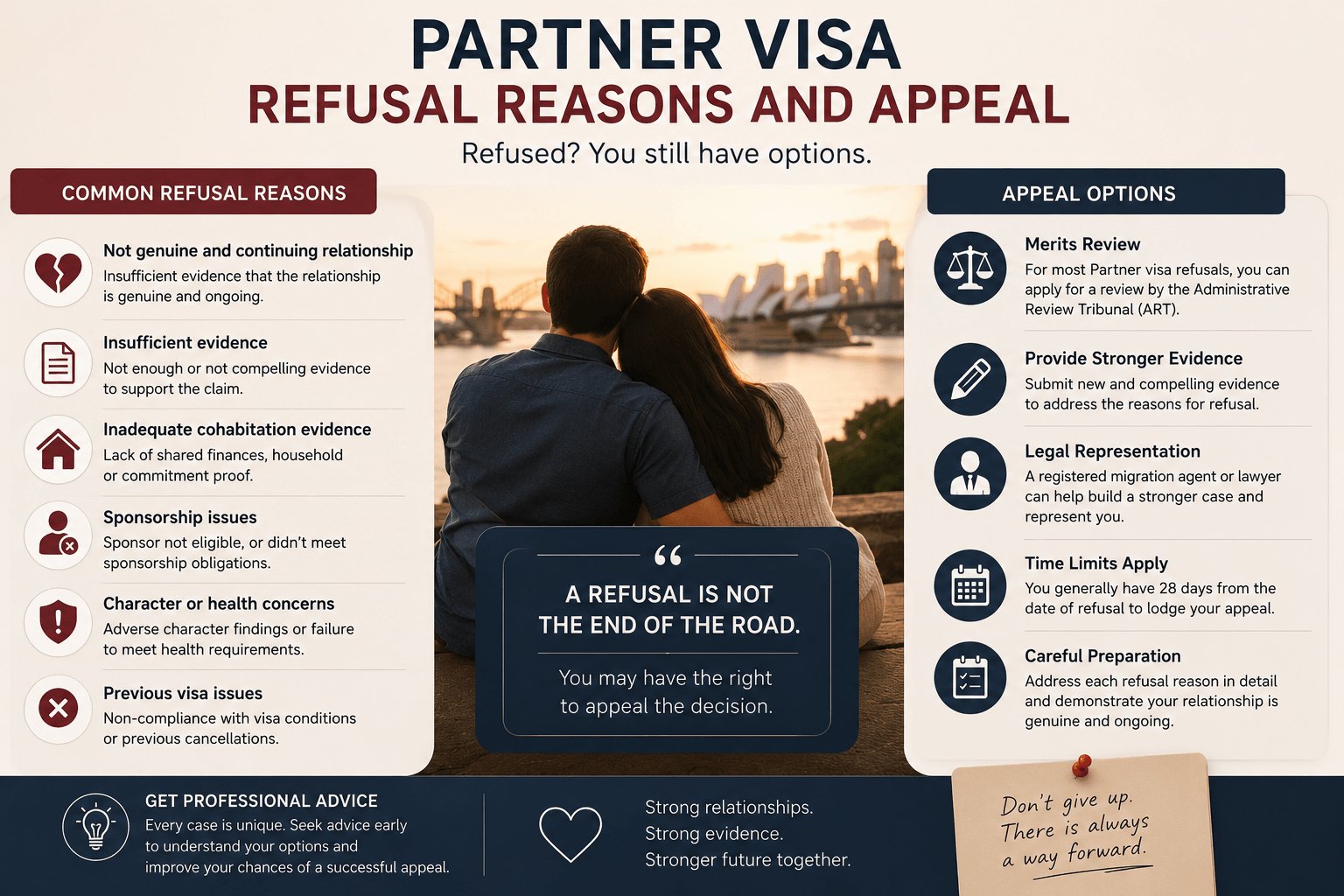
partner visa refusal reasons and appeal usually comes down to whether the Department was satisfied that the relationship met the legal and evidentiary test, whether identity, character, sponsorship, or document issues created doubt, and whether a review pathway exists through the Administrative Review Tribunal.
This guide is for couples dealing with an Australian partner visa refusal, couples preparing a stronger fresh application after a weak file, and sponsors who need to understand what the refusal letter is really saying. It is not for people looking for a guaranteed outcome, because review rights, deadlines, evidence weight, and procedural options depend on the actual refusal notice.
If your refusal letter mentions inconsistent relationship history, thin financial evidence, separation, character issues, missing documents, or failure to respond to a request, early review helps because every next move should be built around the actual refusal reasons rather than panic. For a scenario-based review of your options, Contact Us before you lodge another application or miss a review deadline.
Table of contents
- Why partner visa refusals happen
- Refusal, review, fresh application, and court pathway compared
- Evidence gaps that weaken partner visa cases
- Scenario matrix for safer next steps
- Copy-friendly action and document checklists
- Common mistakes and practical fixes
- Verification workflow before acting
- How to approach an appeal strategy
- FAQs
- Conclusion and next steps
At Australia Pathways, the safest starting point is to treat a refusal as a diagnosis document. The refusal notice often reveals whether the problem is a missing evidence category, a credibility concern, a sponsorship issue, a character concern, a failure to satisfy a legal criterion, or a procedural deadline that now controls everything.
Why partner visa refusals happen
partner visa refusal reasons and appeal should be understood through the decision-maker’s lens. The Department of Home Affairs must be satisfied that the claimed partner relationship meets the relevant visa criteria, and the official partner visa pages explain that applicants must provide evidence of their relationship with a spouse or de facto partner, depending on the stream and subclass being pursued through Home Affairs partner visa information.
The most common refusal pattern is not that a couple has no relationship. The more common problem is that the file does not prove the relationship in the way migration decision-makers need to see it. A marriage certificate, photographs, travel records, and affectionate messages can help, but they may not be enough if the application lacks coherent evidence across financial, household, social, and commitment factors.
Another common issue is inconsistency. Dates in statements, forms, social media evidence, travel history, separation periods, previous marriages, addresses, and sponsor declarations must tell one consistent story. A case officer may view contradictions as credibility issues, even when the couple sees them as harmless memory gaps.
Some refusals arise because applicants do not respond properly to requests for more information. If the Department asks for updated police checks, medicals, identity evidence, divorce documents, translations, or relationship evidence, a late or incomplete response can damage the application. The Department also warns applicants about providing accurate information, bogus documents, and false or misleading information through its accurate information guidance.
Character and sponsorship issues can also become decisive. A partner visa is not assessed only on romance; the applicant must satisfy identity, health, character, and visa-specific requirements, while the sponsor may also need to meet sponsorship expectations. Home Affairs explains that character requirements can affect visa grant, refusal, or cancellation in its character requirements guidance.
Refusal, review, fresh application, and court pathway compared
partner visa refusal reasons and appeal becomes easier to manage when you separate four different pathways: internal evidence repair, merits review, a new application, and court review. They are not the same, and choosing the wrong pathway can waste time, money, and emotional energy.
| Pathway | What it is | Best suited for | Key risk | Where to verify |
|---|---|---|---|---|
| Administrative Review Tribunal review | A merits review of a reviewable migration decision where the Tribunal can reassess the case under the applicable law. | Applicants with review rights in the refusal letter and a realistic plan to address the refusal reasons. | Strict deadlines, weak evidence, or assuming the Tribunal will fix an incomplete file automatically. | ART immigration and citizenship reviews |
| Fresh partner visa application | A new application built with stronger evidence, corrected statements, and updated relationship documentation. | Couples whose circumstances have improved or who do not have a practical review pathway. | Repeating the same weakness that caused the first refusal. | Home Affairs partner visa FAQs |
| Court review | A legal review focused on jurisdictional or legal error, not a general second assessment of the relationship evidence. | Cases where the concern is legal error rather than simply insufficient documents. | Confusing court review with a merits appeal. | Independent legal advice before filing |
| No immediate action | A pause while the couple gathers the refusal letter, deadline, visa status, and evidence map. | Only very short diagnostic periods where no deadline is at risk. | Missing a strict review deadline or breaching visa conditions. | VEVO visa conditions check |
A refusal letter should be read line by line before any action is taken. It should say whether the decision is reviewable, where to apply for review, and what time limit applies. Home Affairs states that reviewable refusal notifications tell applicants how to apply to the Administrative Review Tribunal, and ART also states that migration review time limits are strict and are included in the decision letter.
Evidence gaps that weaken partner visa cases
partner visa refusal reasons and appeal often turns on evidence categories rather than emotional truth. A couple may know their relationship is genuine, but the application must show that genuineness through documents, statements, chronology, and independent support.
Financial evidence is often misunderstood. Couples do not always need identical financial habits, but they should explain how they share responsibility. Joint bank statements, shared rent, utility bills, transfers, insurance, household purchases, beneficiary records, and financial planning can all help when they are consistent with the couple’s real life.
Household evidence should show how the couple lives, or why they cannot live together. Lease documents, mail to the same address, joint responsibility for children, household bills, shared chores, travel between cities, and statements explaining separation periods can matter. Home Affairs lists examples of relationship evidence across financial, household, social, and commitment areas in its relationship evidence guidance.
Social evidence should show that the relationship is known to others. This may include invitations, travel with friends or family, joint events, community recognition, photos with context, and supporting statements. Form 888 can be important because it allows eligible people who know the couple to give structured supporting statements, and the official Form 888 explains its purpose and who can complete it.
Commitment evidence is broader than romantic language. It may include long-term plans, family knowledge, care during illness, communication during separation, shared decisions, wills, emergency contacts, fertility or parenting plans, relocation planning, and evidence that the couple has continued the relationship despite practical pressure.
Important warning before lodging anything
Do not submit rushed statements that try to explain every problem emotionally but fail to correct the evidence structure. A strong response should identify the legal concern, match it with documentary proof, explain any unavoidable gap, and remove contradictions before lodgement.
Scenario matrix for safer next steps
partner visa refusal reasons and appeal should be assessed by scenario, because the safest next move for a couple with thin social evidence is different from the safest move for a couple facing character concerns, non-disclosure, or an expired review deadline.
| Scenario | Risk level | Safer next move | Verify before acting | Common mistake |
|---|---|---|---|---|
| Refusal says the relationship was not proven as genuine and continuing | High | Build an evidence matrix around financial, household, social, and commitment factors. | Exact findings in the refusal letter and whether review rights exist. | Submitting more photos without fixing the missing evidence category. |
| Refusal follows missed document requests | High | Identify what was requested, why it was missed, and whether the missing documents now exist. | Request dates, response deadline, upload records, and email history. | Blaming the system without proving the document trail. |
| Long-distance relationship with limited cohabitation | Medium to high | Explain separation clearly and prove communication, visits, financial support, and future plans. | Travel records, call logs, visa history, work obligations, and family circumstances. | Assuming love messages alone prove commitment. |
| Character or police clearance issue | Very high | Get precise advice and prepare full disclosure, rehabilitation evidence, and official records. | Conviction details, charges, police certificates, court documents, and refusal ground. | Trying to minimise or hide the issue. |
| Inconsistent statements between applicant and sponsor | High | Create a corrected chronology and explain honest differences before adding new evidence. | All forms, statements, interview notes, dates, addresses, and prior visa records. | Writing a new story that conflicts with the old one. |
Copy-friendly action and document checklists
partner visa refusal reasons and appeal work best when the couple separates urgent actions from evidence collection. The action list protects deadlines; the document list strengthens the substance of the case.
Immediate action checklist
- Read the refusal letter completely: Identify the exact criterion, the factual findings, the review rights, and the deadline.
- Check visa status: Use VEVO and review current visa conditions before making travel, work, or study decisions.
- Save all correspondence: Keep Department emails, ImmiAccount upload receipts, requests for information, and refusal attachments.
- Map the refusal reasons: Create a short table showing each refusal concern, the evidence already submitted, the gap, and the proposed fix.
- Avoid rushed re-lodgement: Do not file a new application until the previous weaknesses are understood.
- Review deadline pressure: Treat the time limit in the refusal letter as controlling unless qualified advice confirms otherwise.
Document checklist for relationship evidence
- Financial documents: Joint accounts, shared bills, lease payments, remittances, major purchases, insurance, and evidence of shared responsibility.
- Household documents: Lease, mortgage, mail to the same address, household bills, childcare records, and evidence explaining periods apart.
- Social documents: Invitations, photos with dates and context, travel evidence, family events, community recognition, and supporting statements.
- Commitment documents: Communication records during separation, long-term plans, wills, emergency contacts, parenting plans, and evidence of care.
- Identity and status documents: Passports, birth certificates, divorce certificates, name change documents, translations, and citizenship or permanent residence evidence for the sponsor.
- Character documents: Police certificates, court records, explanations, rehabilitation evidence, and any required disclosures.
Need a refusal-file review before your next move?
If your partner visa has already been refused, the most useful first step is not writing a longer love story. It is building a refusal-response map that connects each negative finding to stronger documents, corrected chronology, and a realistic review or reapplication strategy.
Common mistakes and practical fixes
partner visa refusal reasons and appeal cases are often weakened by avoidable mistakes. The fix is usually not more volume; it is better evidence selection, better chronology, and better alignment with the refusal findings.
| Mistake | Why it hurts | Practical fix |
|---|---|---|
| Submitting hundreds of screenshots without structure | The officer or Tribunal may not see the legal point each document is meant to prove. | Use labelled evidence bundles tied to financial, household, social, and commitment factors. |
| Ignoring contradictions in dates | Inconsistent timelines can create credibility concerns. | Prepare a single relationship chronology and reconcile forms, statements, and travel records. |
| Relying only on marriage | Marriage can prove legal status but may not prove the relationship is genuine and continuing. | Add evidence of shared life, public recognition, domestic arrangements, and long-term commitment. |
| Giving generic Form 888 statements | Generic support may carry less weight because it does not show direct knowledge. | Ask witnesses to describe what they personally observed, with dates, events, and relationship context. |
| Submitting documents in another language without proper translation | The evidence may not be usable or persuasive if it cannot be assessed properly. | Check translation requirements and provide clear certified or accepted translations where needed. |
| Missing the review deadline | Review rights can be lost even where the relationship is genuine. | Confirm the deadline in the refusal letter immediately and act before evidence perfection delays lodgement. |
Verification workflow before acting
partner visa refusal reasons and appeal should follow a verification workflow before any new submission, review application, or statement is prepared. This prevents emotional urgency from producing a legally weak response.
- Confirm the decision type: Identify the refused subclass, application location, applicant status, and whether the decision is reviewable.
- Confirm the deadline: Use the refusal letter as the primary source for the review time limit and do not rely on general internet summaries.
- Confirm current visa conditions: Check whether the applicant is on a bridging visa, another substantive visa, or outside Australia.
- Extract each refusal reason: Copy the factual findings into a working document and separate relationship evidence issues from identity, character, health, sponsorship, or procedural issues.
- Build an evidence response map: For every negative finding, identify documents already submitted, stronger documents now available, and explanations needed.
- Audit consistency: Compare applicant statements, sponsor statements, Form 888 statements, address history, travel records, and previous visa records.
- Decide the pathway: Choose review, reapplication, legal advice about court review, or a combined strategy only after the above checks are complete.
How to approach an appeal strategy
partner visa refusal reasons and appeal strategy should not be built around anger at the refusal. It should be built around what the Tribunal or decision-maker can lawfully consider, what evidence is now available, and which weaknesses must be explained rather than hidden.
The Administrative Review Tribunal is the key review body for many reviewable migration decisions. ART explains migration and citizenship review processes on its official website, and Home Affairs also directs applicants to the Tribunal where a refusal is reviewable. Applicants should also check ART information on current processing expectations through its processing times page, while remembering that published processing information is not a personal guarantee.
A good appeal file usually has three layers. The first layer is legal and procedural: deadline, standing, correct applicant, correct decision, correct Tribunal category, and current visa status. The second layer is evidentiary: documents that address the actual findings, not generic relationship material. The third layer is narrative: a clear, truthful, consistent explanation of how the relationship developed, how the couple manages daily life, and why any gaps exist.
For long-distance couples, the appeal strategy should explain why separation occurred and how the relationship continued despite distance. For couples with limited finances, the strategy should explain financial reality instead of pretending to have joint accounts that never existed. For couples with family opposition, religious barriers, cultural privacy, or previous marriages, the strategy should explain why social evidence may look different while still proving commitment.
For cases involving character, non-disclosure, or allegedly false documents, the strategy must be more careful. These cases may require specialised legal input because the consequences can extend beyond one partner visa application. A weak explanation can make the problem worse if it appears defensive, incomplete, or inconsistent with official records.
FAQs
Can every partner visa refusal be appealed?
No. Review rights depend on the decision, the applicant’s circumstances, and the wording of the refusal notice. The safest approach is to read the refusal letter immediately and verify whether it gives a right to apply to the Administrative Review Tribunal.
Is a partner visa appeal the same as lodging a new application?
No. A review asks the Tribunal to reconsider a reviewable refusal, while a new application starts a fresh process with the Department. The better option depends on deadline, visa status, evidence strength, and the reason the first application failed.
What is the biggest evidence mistake couples make?
The biggest mistake is submitting emotional evidence without a structure that matches the legal assessment. Photos and messages may help, but they should be supported by financial, household, social, and commitment evidence where possible.
Can new evidence be useful after refusal?
New evidence can be important, especially if it directly answers the refusal reasons. It should be organised carefully and should not create new contradictions with the original application.
Should we submit more Form 888 statements after a refusal?
Possibly, but quality matters more than quantity. Strong statements should come from people with direct knowledge of the relationship and should include specific observations rather than general praise.
What if we were living apart when the visa was refused?
Living apart does not automatically mean the relationship is not genuine, but it must be explained with evidence. Travel records, communication history, financial support, future plans, and reasons for separation can become very important.
Can a character issue cause a partner visa refusal?
Yes. Character issues, non-disclosure, police history, or inconsistent information can affect visa outcomes. These cases should be handled carefully because the explanation and supporting records may be as important as the relationship evidence.
How fast should we act after receiving a refusal?
Immediately. The refusal letter controls the review deadline and should be checked the same day it is received. Do not wait to gather perfect evidence if waiting risks missing a strict filing date.
Conclusion and next steps
partner visa refusal reasons and appeal should be approached with calm urgency. The urgent part is protecting deadlines and visa status. The calm part is refusing to respond with random documents, emotional statements, or a new application that repeats the same weaknesses.
The best next step is to create a refusal-response map. Start with the exact refusal findings, identify each missing or weak evidence area, correct the chronology, verify review rights, and decide whether a Tribunal review, fresh application, or legal advice pathway is more suitable. A strong partner visa strategy does not pretend the refusal did not happen; it uses the refusal to rebuild the case with better structure.
Before you act, gather the refusal letter, all Department correspondence, the original application, sponsor statements, Form 888 statements, police certificates, relationship evidence, and current visa status. Then compare the file against the specific legal and factual concerns raised in the decision. That is the difference between simply trying again and responding strategically.
For couples facing partner visa refusal, the goal is not only to prove love. The goal is to prove a legally relevant relationship through credible documents, coherent history, and careful procedural choices. That is how you avoid the most common mistakes and move forward with a cleaner, stronger plan.