Subclass 500 student visa documents checklist: Decision-ready evidence to avoid costly mistakes in 2026

Subclass 500 student visa documents checklist is not just a list of passport scans and school papers. It is a decision-readiness tool for proving that you have a real course, a lawful enrolment pathway, enough money, appropriate health cover, credible study intentions, and clean supporting evidence before you lodge through ImmiAccount.
For 2026 applicants, the safest approach is to treat every document as part of one coherent story: who you are, why this course is logical, how you can fund it, where you will live, and why the evidence is consistent with the answers in your application form.
Answer first: what documents do you normally need?
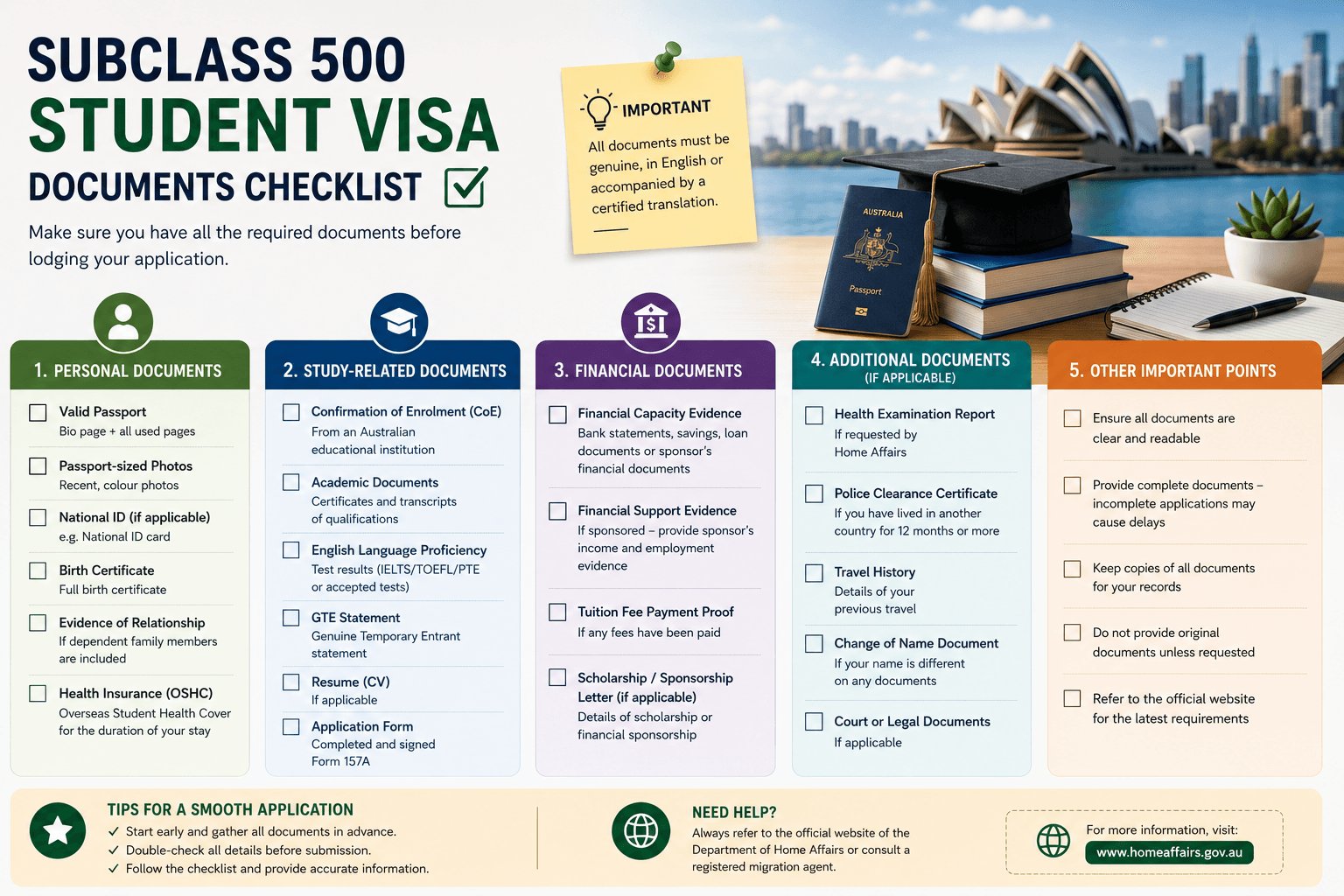
Direct answer: the subclass 500 student visa documents checklist normally starts with your passport, Confirmation of Enrolment, Genuine Student evidence, financial capacity evidence, Overseas Student Health Cover details, academic records, English evidence if required, identity records, health and character information, and any documents for family members or under-18 welfare arrangements.
Who this is for: international students preparing a first Student visa, extending study in Australia, packaging courses, changing education levels, or including dependants. Who it is not for: applicants who need a Student Guardian visa, employer-sponsored visa, partner visa, visitor visa, or permanent skilled migration strategy.
What you will learn: how to organise documents by risk, how to verify the official checklist, and how to reduce refusal, delay, and inconsistency risks before lodgement.
If your case includes a previous refusal, a long study gap, a sudden course change, unclear family sponsorship, or funds that moved recently, professional review helps because the problem is rarely one missing file; it is usually the way the whole evidence set fits together. Contact Us
Table of contents
Official starting point: do not use a generic list blindly
The subclass 500 student visa documents checklist must begin with the official Department of Home Affairs pathway, because required evidence can vary by passport country, education provider, course level, applicant history, family composition, and whether you apply inside or outside Australia. The Department says applicants should use the Document Checklist Tool and also review the document list generated inside ImmiAccount when lodging.
The general Student visa page confirms that applicants must apply online, be enrolled in a course of study in Australia, and hold a valid Confirmation of Enrolment when the application is decided. Use the official Student visa subclass 500 page as your baseline, then check course-specific, country-specific, and family-specific requirements before uploading anything.
At Australia Pathways, we recommend creating a master evidence folder before starting the online form. That folder should have clear subfolders for identity, enrolment, finances, Genuine Student evidence, health cover, English, previous study, employment, family, translations, and post-lodgement correspondence.
Core documents checklist: what most applicants should prepare
The subclass 500 student visa documents checklist should be structured around evidentiary purpose, not just file names. A passport proves identity, a CoE proves enrolment, a bank statement supports financial capacity, and a Genuine Student evidence bundle explains why the proposed study is credible in light of your background.
Most applicants should prepare a clear passport bio page, national identity documents where relevant, a current CoE for each course in a packaged program, offer letter, tuition payment receipt if available, OSHC details, academic transcripts, graduation certificates, curriculum vitae, employment evidence, English test evidence if required, and financial documents showing access to funds for tuition, living costs, travel, and dependants.
Non-English documents need careful handling. The Department’s student visa guidance says English translations should be provided for all non-English supporting documents, with translator details depending on whether the translator is in Australia or outside Australia. This is a common low-level error that can create high-level doubt about the reliability of the file set.
Comparison table: evidence type, purpose, and risk
The subclass 500 student visa documents checklist becomes easier to manage when each document is linked to the decision question it answers. Use the table below to separate mandatory, commonly required, and situation-dependent evidence.
| Evidence type | What it proves | Usually essential? | Risk if weak or missing | Practical preparation note |
|---|---|---|---|---|
| Passport and identity documents | Identity, nationality, and travel document validity | Yes | Application cannot be assessed properly | Scan clearly and check name consistency across all documents |
| Confirmation of Enrolment | Accepted enrolment in a registered Australian course | Yes | Student visa purpose may fail | Check dates, provider details, course level, and packaged course sequence |
| Genuine Student evidence | Study purpose, background, course logic, and personal circumstances | Yes | Credibility concerns or refusal risk | Match claims to transcripts, work records, career plan, and country ties |
| Financial capacity evidence | Ability to meet tuition, living, travel, and family costs | Often yes | Funds may be considered insufficient or poorly evidenced | Show source, availability, account history, and sponsor relationship if relevant |
| English evidence | Required language capacity where applicable | Depends on checklist and exemptions | Further information request or refusal risk | Check accepted tests, test dates, scores, and subclass-specific settings |
| OSHC details | Health cover for the stay period | Yes | Health cover issue or refusal risk | Confirm provider, policy dates, and policy number if arranged directly |
| Health and character documents | Health suitability and conduct history | Depends on circumstances | Delay, request for information, or adverse assessment | Answer declarations accurately and keep police or medical evidence ready |
Scenario matrix: risk-based document strategy
The subclass 500 student visa documents checklist should change when the applicant’s facts change. A low-risk applicant with a clean academic pathway needs a concise, complete file; a higher-risk applicant needs a stronger explanation supported by independent evidence.
| Scenario | Risk level | Safer next move | Verify before acting | Common mistake |
|---|---|---|---|---|
| First-time student, clear course progression, stable funds | Low to moderate | Prepare a clean core file and concise Genuine Student evidence | CoE, OSHC dates, English requirement, and financial evidence settings | Uploading too many irrelevant documents without a coherent structure |
| Course change from one field to another | Moderate to high | Explain the academic and career logic of the change with evidence | Course outcomes, prior study, employment history, and future plan | Calling the change a passion without proving practical relevance |
| Applicant has a previous refusal | High | Address the refusal reason directly and provide corrected evidence | Refusal record, new facts, current eligibility, and consistency of answers | Ignoring the refusal or giving a vague explanation |
| Family sponsor provides financial support | Moderate to high | Document relationship, source of funds, income, and genuine access | Sponsor identity, bank history, employment, tax or business records | Submitting only a bank balance without source or sponsor context |
| Under-18 student or included child | High if welfare evidence is incomplete | Prepare consent, custody, welfare, accommodation, and school documents early | Parental consent, legal guardianship, welfare arrangements, and translations | Assuming enrolment alone covers welfare and custody requirements |
Genuine Student, funds, English, health, and character
The subclass 500 student visa documents checklist is strongest when the Genuine Student narrative is supported by documents rather than left as a persuasive statement alone. The Department explains that it considers the applicant’s overall personal circumstances and encourages evidence about previous study, previous study in Australia, current employment, home country circumstances, economic circumstances, and knowledge of the proposed course and living arrangements through the Genuine Student requirement page.
For finances, use the official figure only as a starting point, not as your real-life budget. Study Australia states that international student visa applicants must provide proof of at least AUD 29,710, while also warning that living costs vary by location and may be higher than the visa benchmark. Check the current guidance on the official Study Australia visa application process page before preparing bank evidence.
English evidence should be checked against current Department settings. The English requirements page notes that approved tests changed from 7 August 2025 and lists accepted secure-centre tests for Australian visa purposes. Before relying on IELTS, PTE Academic, TOEFL iBT, OET, Cambridge C1 Advanced, CELPIP General, MET, or LANGUAGECERT evidence, verify timing, pathway, score, and subclass relevance on the official English language visa requirements page.
OSHC must also be treated as evidence, not an afterthought. The Document Checklist Tool explains that if you or your agent arranged OSHC, you need the provider name, policy start and finish dates, and policy number in the application form; if your provider arranged it, the provider name and dates may be enough. For health and character, answer the application questions accurately and prepare supporting documents if you have medical, police, military, name-change, custody, or prior immigration history that requires explanation.
Before you upload: get the file logic reviewed
A Student visa file can look complete but still be weak if the course choice, funds, study history, and career explanation do not support each other. This is especially important for applicants with dependants, recent deposits, previous refusals, course downgrades, long gaps, or inconsistent dates across documents.
For a practical review of your document logic before lodgement, Talk to Australia Pathways
Copy-friendly checklists: actions and documents
The subclass 500 student visa documents checklist works best when you separate actions from documents. Actions are the decisions you must make; documents are the evidence that proves those decisions are accurate.
Action checklist before lodgement
- Confirm that your education provider and course are registered for international students.
- Check whether your course package has clear academic progression and acceptable course gaps.
- Run the official Document Checklist Tool using your passport country and education provider details.
- Create a single evidence index before uploading files to ImmiAccount.
- Compare every application answer against your uploaded evidence.
- Check whether English evidence is required or whether an exemption applies.
- Confirm that OSHC dates cover the required period for your stay.
- Prepare certified translations for every non-English document.
- Save copies of every uploaded file because Home Affairs says supporting documents may not be accessible after upload.
- Set a monitoring routine for ImmiAccount messages after submission.
Document checklist for most applicants
- Passport bio page and identity documents.
- Confirmation of Enrolment for each course in the package.
- Offer letter, tuition receipt, or scholarship confirmation where relevant.
- Genuine Student evidence and supporting documents.
- Academic transcripts, certificates, and previous enrolment records.
- Employment letters, payslips, business records, or career evidence if relevant.
- Bank statements, income evidence, sponsor documents, or scholarship evidence.
- OSHC provider name, policy dates, and policy number where required.
- English test result or exemption evidence where required.
- Marriage, birth, custody, consent, or dependant documents where relevant.
- Health examination, police certificate, military service, or name-change evidence if requested or relevant.
Mistakes and fixes
The subclass 500 student visa documents checklist should reduce risk before submission, not create a false sense of safety. The table below focuses on common document mistakes that appear small but can damage credibility.
| Mistake | Why it matters | Better fix |
|---|---|---|
| Using a generic online checklist only | Student visa evidence can depend on country, provider, and personal history | Use the official tool, ImmiAccount prompts, and your own risk-based evidence index |
| Submitting a bank balance without source evidence | The officer may question whether funds are genuine, available, or stable | Show account history, income source, sponsor relationship, and access to funds |
| Writing a generic Genuine Student answer | Vague claims do not explain why this course fits your background | Connect course content, past study, career direction, and home-country circumstances |
| Ignoring past visa refusals or gaps | Undisclosed or unexplained issues can create credibility concerns | Address them directly with evidence, dates, and changed circumstances |
| Uploading unclear scans or mixed files | Decision-makers need readable evidence in the correct category | Use clear file names, full-colour scans where appropriate, and one logical PDF per category |
| Forgetting translations | Non-English evidence may not be usable without proper translation details | Translate every non-English document and include required translator information |
Important caution
Do not rely on old fee figures, old English-test rules, or outdated Genuine Temporary Entrant templates. The Student visa framework has changed, and the safer approach is to verify current requirements before paying, submitting, or changing a course plan.
Verification workflow before you submit
The subclass 500 student visa documents checklist should end with a verification workflow. This final review is where applicants often catch inconsistent dates, missing translations, weak sponsor explanations, or course-choice problems before they become formal issues.
- Open the official Document Checklist Tool and record the document categories it generates for your passport and provider profile.
- Open your ImmiAccount draft and compare every requested upload field with your evidence folder.
- Read the Department’s document attachment guidance, including the warning not to email documents and the need to keep your own copies, on the official Attach documents to your application page.
- Check all names, dates of birth, passport numbers, course dates, and address history for consistency.
- Review the Genuine Student answers against transcripts, employment records, and future career evidence.
- Confirm that funds are enough, available, explainable, and supported by source documents.
- Confirm English evidence, OSHC evidence, health declarations, character declarations, and dependant documents.
- Convert files into readable documents with clear names before upload.
- Save a final copy of the complete application and every uploaded document.
- Monitor ImmiAccount after submission and respond quickly if more information is requested.
FAQs
Do I need every document listed in a generic student visa checklist?
No. A generic list is useful for planning, but your actual evidence can depend on passport country, provider, course, age, family members, immigration history, and ImmiAccount prompts. Always verify against the official tool and your own application fields.
Is the Confirmation of Enrolment enough to prove I am a genuine student?
No. A CoE proves enrolment, but the Genuine Student assessment looks at broader personal circumstances, course logic, previous study, employment, finances, and future plans. Supporting evidence should make the course choice credible.
What financial documents are safest for a Student visa file?
There is no single safest document for every applicant. Strong financial evidence usually shows amount, availability, source, account history, sponsor relationship if relevant, and ability to cover tuition, living costs, travel, and family costs where applicable.
Do I need English test evidence for subclass 500?
It depends on your circumstances and the current Department settings. Some applicants must provide test evidence, while others may have an exemption or different evidence pathway. Check the official English language requirements and your ImmiAccount checklist before lodging.
Should I upload extra documents to make my application stronger?
Only upload extra documents when they answer a real evidentiary question. Too many unrelated files can make the application harder to assess and may distract from the key issues. A concise, well-indexed file is usually stronger than a large but unfocused bundle.
What if my documents are not in English?
Provide English translations for non-English supporting documents. Check the Department’s translator-detail requirements carefully, because the expected information differs depending on whether the translator is in Australia or outside Australia.
Can I fix missing documents after submitting?
Sometimes you may be able to attach further information, or the Department may request more information. However, you should not rely on a later request to repair a weak application. A decision-ready file at lodgement is safer.
Do family members change the document checklist?
Yes. Including a partner, child, or under-18 applicant can add identity, relationship, custody, consent, welfare, school, health, character, and financial evidence. Family documents should be prepared early because they often take longer to collect and translate.
Conclusion and next steps
The subclass 500 student visa documents checklist should be treated as a decision file, not a paperwork dump. Start with the official checklist, build a risk-based evidence index, make your Genuine Student explanation match the documents, verify funds and OSHC, translate non-English evidence, and keep a complete copy of every uploaded file. If your situation is straightforward, this process helps you lodge with confidence; if your facts are complex, it helps identify where professional review can prevent avoidable mistakes.
Your next step is simple: create your evidence folder, run the official checklist, compare it with your ImmiAccount prompts, and review every document for consistency before submission.