
Last verified by Nima Parham — 27 October 2026.
More than an afternoon with giant models
The National Dinosaur Museum in Canberra, located at 6 Gold Creek Road, Nicholls, is a manageable family outing because it combines spectacular dinosaur displays with the deeper question of what a fossil can actually tell us. A child may arrive wanting to see a Tyrannosaurus; an adult may leave thinking about geological time, changing ecosystems and the painstaking work of reconstructing an animal from fragments. That is a worthwhile difference between a themed attraction and an educational visit.
The museum's current admission page lists general opening hours of 10 am to 5 pm every day, with advertised prices of AUD25 for an adult, AUD15 for a child aged 4–16, AUD18 concession and AUD75 for a family ticket under its stated family combination. Children aged three and under in family groups are listed as free. These are observed prices in October 2026, not a guarantee about future tickets, special events or school-group arrangements. Check the booking page for your actual date.
What children will see—and what to ask them
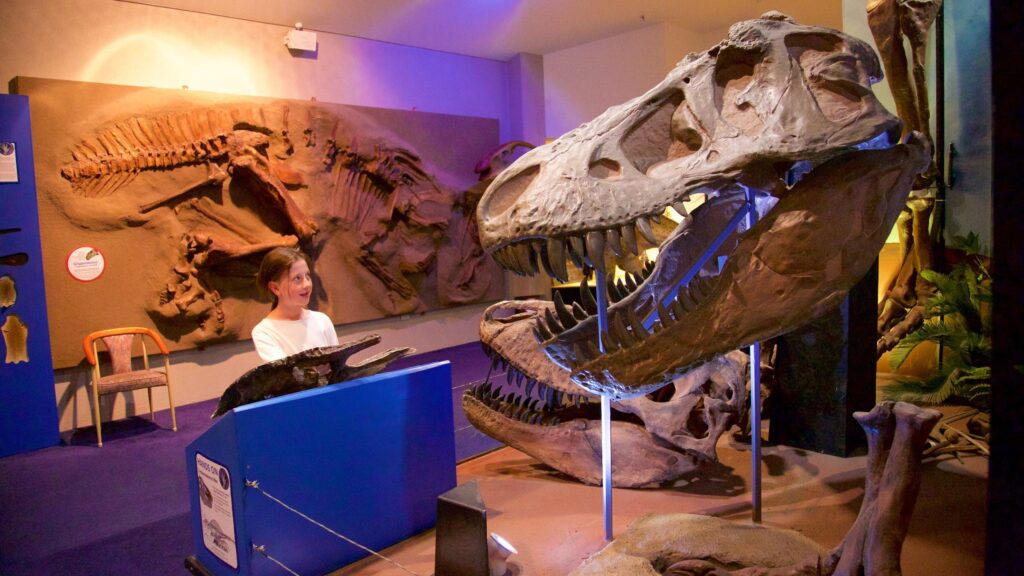
The museum describes a multilevel indoor gallery with full skeletons, fossil exhibits, dinosaur models and a garden containing a large animatronic T. rex. Its visitor information emphasizes an extensive collection of displays. Rather than treating every reconstruction as an exact photograph of a prehistoric animal, ask children which parts are known from fossils and which parts require scientific inference. How can bones indicate an animal's movement? What do teeth suggest about diet? Which details change when researchers discover new evidence?
Fossils preserve only some of the organism and its environment. Soft tissue, colour and behaviour are harder to infer. A realistic model may therefore be an excellent teaching object without being definitive proof of every feature it depicts. The same distinction matters when looking at colourful museum panels: labels should distinguish evidence, hypothesis and artistic interpretation.
A route through the museum for different ages
For preschoolers, prioritize a few visually interesting models, short explanations and time outdoors. Young children may find roaring animatronics exciting or overwhelming; give them a choice to step back. There is no benefit in forcing a child through every display simply to get value from a ticket. Children aged four to sixteen must be accompanied by an adult according to the museum's entry rules.
For primary-school children, make the visit a three-question investigation. Before entering, choose a favourite dinosaur. Find out whether the museum includes fossils or reconstructions of it. Then look for one surprising discovery about Australian prehistoric life. School-age visitors often gain more from comparing two displays carefully than from racing through hundreds of exhibits.
For teenagers and adults, focus on the history of palaeontology. Ask how scientists date rocks, distinguish species, infer habitats and revise family trees. An exhibit is a snapshot of current scientific knowledge, not a final answer. Compare the interpretive information with contemporary research or reputable natural-history institutions after the visit if a claim interests you.
Guided learning rather than passive viewing
The museum offers school-group programmes that discuss evolution, extinction and scientific methods, with a format described as roughly 60 minutes guided interpretation plus 30 minutes exploring interactive areas. This is a school programme description, not a promise that every general admission includes a guided tour. If you want a structured experience, ask the museum what tours or special programmes are available to ordinary visitors on your chosen date.
Its material also brings Australian prehistory into the story. That is helpful because children's books can make the dinosaur world seem dominated by animals from North America. The Australian fossil record has its own history of landscapes, species and scientific discoveries. Asking 'what is Australian about this exhibit?' makes a Canberra museum visit more geographically meaningful.
Tickets, accessibility and realistic timing
The museum is in the Gold Creek area of Canberra, so a trip may pair naturally with other nearby activities rather than central-city museums. Check public transport, driving and parking for the exact address. Indoor galleries and outdoor models create different weather needs. In summer, water, sun protection and shaded breaks matter outside; in cold weather, outdoor viewing may be shorter than planned.
Visitors with mobility or sensory requirements should consult the official museum site or contact staff rather than assuming that every multilevel exhibit is accessible in exactly the same way. Ask about step-free routes, rest spaces, noise, suitable tour formats and toilets. A comfortable 90-minute visit can be more rewarding than a long session that exhausts children or caregivers.
Ticket decisions depend on household composition. Compare individual admissions with the specified family-ticket eligibility; an adult with one child is not necessarily better served by a family package. The operator may change prices or event arrangements. If you're budgeting a Canberra family day, include travel and any optional activities rather than treating entry as the entire cost.
Build a two-hour science detective game
Make an informal field sheet with three columns: observation, inference and question. Under observation, write something directly visible in a displayed fossil or a clearly labelled image. Under inference, record what a scientist might conclude from it. Under question, note what evidence would be needed to be more certain. A fossil tooth might support a dietary hypothesis; it does not tell you exactly how an animal behaved every day. This game can be adapted for young children using drawings instead of text.
A second activity is to compare a reconstructed skeleton with a full-size model. Which details follow known bone structures and which appear to be artistic choices? Ask museum educators if a display includes original fossil material or a reproduction. Neither is inherently inferior: a replica can safely communicate important research, while an original specimen has a particular scientific and heritage value. Correct labelling makes the difference intelligible.
Plan rest and attention, not just admission
Children process information in bursts. Rather than planning to see every fossil, choose a learning goal before you arrive and take a break after a period of close looking. A family visiting Canberra for several days can pair this museum with outdoor time, reducing the pressure for every activity to deliver maximum novelty. If a child is frightened by an animatronic model, a quieter fossil case may be the most productive place to return. A visit should invite curiosity, never make a child feel tested for remembering every prehistoric name.
For families with several ages, ask the older child to explain a discovery to the younger one in plain language. It often reveals what both understood and what remains uncertain. The museum's education material offers ideas on evolution, extinction and geological time that can be discussed later at home, even when a family does not book a formal guided programme.
A small research project after the visit
A child who becomes fascinated with one species can search for another museum or research institution discussing it. Compare the dates and wording of the two descriptions. Do they agree about the animal’s size, habitat or period? If they differ, ask whether one resource is older or uses a different classification. The most valuable souvenir may be a question worth investigating, not another plastic dinosaur.
Helping children leave with a better question
Before leaving, ask each child to identify something the museum knows from physical evidence and something scientists are still investigating. A fossilized bone, a reconstruction and an animation are different ways of communicating history. Understanding that distinction is a skill children can carry into every future science museum and nature documentary.
Canberra's National Dinosaur Museum works best when treated as a gateway to questions, not just a collection of dramatic prehistoric shapes. Let curiosity lead the visit, use the museum's current admission details for logistics, and allow enough time to discuss what each display actually shows.