
Last verified by Nima Parham — 27 October 2026.
Editorial research check: 27 October 2026. Coffee terminology, prices and café menus vary by city and venue. Historical claims are attributed to documented collections rather than presented as a single origin myth.
Australian coffee culture is sometimes reduced to the flat white, a photograph of latte art and the claim that Melbourne invented café sophistication. The real story is richer: nineteenth-century temperance establishments, the transformation of cities by postwar migration, a dense independent café economy, and the daily social rituals that make a neighbourhood coffee counter feel like part of public life.
It is also a story with gaps and disagreement. The exact inventor of a drink may be disputed. Not all Australians drink coffee, and regional towns do not offer the same café infrastructure as central Melbourne. A useful guide should explain what has been documented, what depends on local practice and how a visitor can understand a menu without pretending there is a single national rule.
Before espresso: the coffee palace did not mean what you think
Melbourne’s relationship with coffee predates modern machines. The State Library Victoria history describes the grand coffee palaces of the 1880s as products of a temperance movement. These establishments provided alternatives to alcohol and embodied ideas about respectable recreation and public sociability. Their grand architecture and moral message are quite different from the casual espresso bar of today.
The library’s historical gallery displays nineteenth-century packaging and records, equipment and promotional material that trace changing attitudes to the drink. They are useful evidence precisely because they prevent an oversimplified history in which nothing happened before Italian migration.
In the early twentieth century, tea remained a major everyday drink. Instant coffee, commercial advertising and new styles of cafés later competed for household attention. Modern espresso arrived within an already changing urban environment. To describe the period accurately, separate the history of coffee consumption, the history of espresso machinery and the later growth of independent cafés.
Postwar migration changed the social institution, not just the beverage
After the Second World War, European migrants brought knowledge, equipment, business networks and new expectations about where people could meet. State Library Victoria’s account of the espresso era describes Italian entrepreneurial activity along Lygon Street and the commercial espresso-bar scene of the 1950s.
The machines mattered, but the social space mattered as much. An espresso bar provided migrants with familiar sounds, languages and habits. It also offered existing residents an alternative to the older hotel or tearoom. Café culture was not simply a product sold by one ethnic group to another; it became an evolving conversation about who belonged in a city.
The library’s Changing Face of Victoria exhibition notes the prominence of European migrants and the sophisticated identity associated with espresso machines. Importantly, that history includes exclusion and suspicion as well as success. Some newspaper coverage of cafés depicted migrant venues as threatening; reading such evidence carefully tells us about social change as well as coffee.
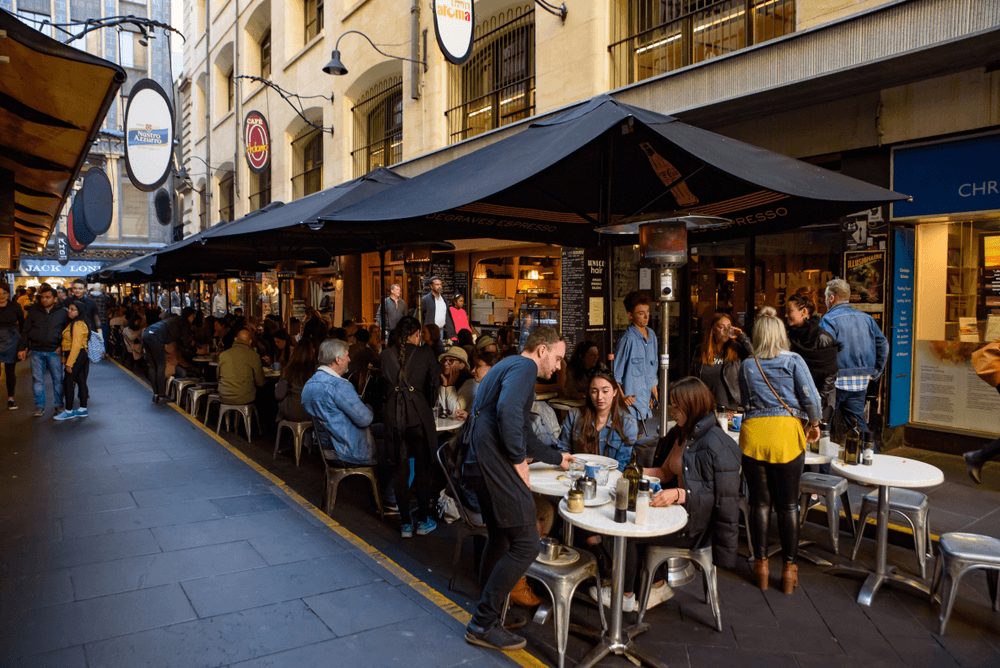
Today, a neighbourhood café can be a workplace, a third space, a meeting point for parents after school, or somewhere a person sits alone with a book. The meaning of a café shifts during the day. The mythology of coffee as permanent hustle misses these quieter functions.
What Australians mean when they order a coffee
A flat white, latte and cappuccino all normally involve espresso and milk, but differences in foam, texture and serving size can vary by barista and venue. The flat white is typically designed around a relatively smooth microfoam texture rather than a high dome of froth; a cappuccino often emphasises foam and cocoa dusting, while a latte generally has more milk in its common serving. These are descriptions of prevailing café practice, not enforceable standard recipes.
A long black usually pours espresso over hot water, retaining a different texture from a filter coffee. A short black refers to espresso. A piccolo is a small milk coffee, though glass size and espresso dose vary. An iced latte often means espresso with cold milk and ice; a cold brew is produced by steeping coffee in water over an extended period. Do not assume an iced coffee in every region means the same thing: some venues serve a dessert-style version with ice cream or cream.
If you dislike surprises, simply ask: ‘How do you make your iced coffee?’ or ‘Is your piccolo one or two shots?’ Asking is normal. Good baristas are accustomed to customers who prefer different strength, temperature and milk choices. The goal is to understand the café’s own recipe, not pass an imaginary national test.
Independent cafés and the geography of belonging
The State Library’s café collection argues that Melbourne’s independent scene became a defining part of local identity, and contrasts it with earlier efforts by international chains to dominate the market. The point should not be turned into the claim that chains do not exist or that every independent shop is superior. Instead, notice how a neighbourhood café can tailor its hours, service and offering to a specific street.
Cafés near offices often prioritise morning speed and predictable service; cafés near parks may have room for prams, dogs and people sitting longer. University precincts attract study sessions; regional cafés might be a critical stop on long journeys. The best café for espresso may not be the best venue for a relaxed family breakfast.
This local geography explains why ‘best coffee in Australia’ rankings are fragile. Taste is personal, staff change, beans rotate and a café can have excellent espresso but inaccessible seating. A more meaningful recommendation states what was evaluated: taste, service, milk preparation, hospitality, price transparency, sustainability practices and accessibility.
The craft behind the cup: extraction, milk and repetition
Espresso preparation is a practical process rather than a secret formula. Baristas manage grind size, dose, water contact, temperature and equipment cleanliness. The aim is repeatability under changing conditions: a new bag of beans, humid weather or a busy queue can change extraction. A visually attractive shot is not necessarily balanced, and a dramatically strong drink is not automatically better.
Milk texturing requires attention to temperature and air incorporation. Smooth microfoam helps a barista mix milk with espresso and draw shapes, but latte art is only an indicator of technique. A beautiful rosetta cannot correct stale beans or an excessively bitter extraction. If choosing a café, taste the drink rather than relying solely on social media photographs.
Many businesses serve dairy and non-dairy options. Oat, soy and almond alternatives differ in sweetness, protein composition and behaviour when steamed. A café may use different products for different drinks, and allergies deserve explicit confirmation rather than an assumption that equipment is always segregated.
A good order is specific without being fussy: ‘medium flat white, oat milk, not too hot’ or ‘single-shot long black’. The barista may ask whether you want takeaway or dine-in. Those choices influence cup size and sometimes the sensory experience of the coffee itself.
The economics of a café are not just beans
A coffee price reflects wages, rent, electricity, equipment, insurance, cups, payment costs and tax obligations as well as the beans. When a customer pays for a drink, they also fund the space, cleaning and service that made the transaction possible. Café businesses often rely on breakfast food, pastries or repeat traffic to make the operating model work.
Australia’s broad consumer-spending statistics do not directly measure the cost of producing an espresso. For example, the ABS August 2026 spending release reports changes across large spending categories; it does not prove the average café is making a given margin. Avoid online claims that a percentage of each $5 coffee is guaranteed profit. Without the particular lease and cost structure, that is guesswork.
Independent café owners face a genuine trade-off. Paying for skilled preparation and consistent service can raise costs, but cutting staff training or ingredient quality may undermine the very reason people return. Price comparisons should take drink size and included service into account.
Coffee and the environment: smaller claims are more credible
Café sustainability involves packaging, reusable cups, water use, energy, food waste and the upstream agricultural supply chain. No one choice automatically cancels all impacts. A reusable cup only delivers a benefit in the context of how often it is used and cleaned; ‘biodegradable’ packaging may require specific processing that is unavailable at the destination.
The Australian Competition and Consumer Commission’s guidance on environmental claims warns businesses against broad, unqualified promises. In a café, the useful questions are concrete: Is this cup accepted by a particular recycling service? Is coffee-ground waste collected separately? Does the business have evidence for the sourcing claim printed on the menu?
Some cafés emphasise fair-trade or direct relationships with producers. These are different arrangements and should be explained rather than bundled into a generic ‘ethical coffee’ label. Neither a rustic interior nor an expensive espresso is proof of responsible supply chains. Honest product information is preferable to a comforting slogan.
What visiting Australians and newcomers notice
A newcomer may be surprised by the speed of a suburban morning coffee queue, the variety of milk options, the routine use of first names or the expectation that customers know common menu terms. Yet the same city also has cafés where no one notices whether you have memorised a flat white’s foam profile. The more important social skill is politeness: be clear, respect queues and do not assume every worker can spend five minutes explaining their equipment during the morning rush.
Outside the major cities, cafés often double as meeting places for residents and travellers. They might close earlier than a tourist expects or operate seasonal hours. Search for the actual business hours on its own site, particularly in small towns and holiday destinations, rather than assuming metropolitan opening patterns.
Café design also communicates priorities. Benches facing the street invite short visits; communal tables can make conversation easier but may not suit focused work; dedicated laptop rules protect seating during busy periods. A guest should respect the business model rather than treating the purchase of a single espresso as a permanent desk reservation.
A short cultural itinerary, not a definitive ranking
To understand Australian coffee culture in Melbourne, visit a historic café precinct and then a newer residential strip. Compare the public space, customers and service rhythm rather than only the beans. Read the State Library’s history of coffee before the visit and notice how the present still carries features of migration history.
In any city, try three different formats: a quick stand-up espresso or takeaway, a relaxed seated breakfast and a venue serving filter or single-origin coffee. Ask about beans if the staff have time. Notice which format suits your actual routine, not your imagined identity as a coffee expert.
The most useful conclusion is modest. Australia did not invent coffee; no single city owns good coffee, and no recipe defines every café. But the combination of migration, independent enterprise and an everyday appetite for meeting in public helped build a distinctive café landscape. It is a culture best understood by paying attention to the people as well as the cup.