
Last verified by Nima Parham — 27 October 2026.
Research reviewed 26 October 2026. This is a guide to understanding and visiting natural rock openings, not a guarantee of track access. Check the relevant park authority before travelling.
A natural arch might be a window of sandstone above an inland gorge, a wave-worn hole in a limestone headland, or a rainforest roof through which a waterfall plunges. Natural arches in Australia cannot be understood as a single kind of attraction: the rocks, forces and safety conditions are different. That difference also determines what a visitor should expect. Queensland offers a damp rainforest cave; Victoria presents an exposed, rapidly changing ocean edge; Western Australia has both river-gorge and coastal formations; South Australia has a wind-carved coastal arch within a wildlife-rich national park.
Start with the science: an arch is a shape, not a rock type
The defining feature is a bridge or opening left standing in rock. The cause might be mechanical erosion by moving water, weathering along joints, chemical dissolution, or a combination of processes. The point is not that all arches are ‘millions of years old’—a common but unsupported blanket claim—but that rocks with different properties respond differently to stress. Limestone dissolves and fractures; sandstone erodes along bedding and weaknesses; basalt can be undercut where water concentrates its energy. Two photographs might look similar even when their geological histories are not.
A second distinction matters for travellers. An arch is not a promise of permanence. A hole in a headland can widen until its roof falls. That is part of the landscape’s natural history, not necessarily an infrastructure failure. In 2026 the authority managing Port Campbell National Park specifically warns that the viewing site at The Arch is temporarily closed because of unstable cliffs and track erosion; its official visitor notice should outrank itineraries written years earlier.
1. Natural Bridge, Springbrook: water through a rainforest roof
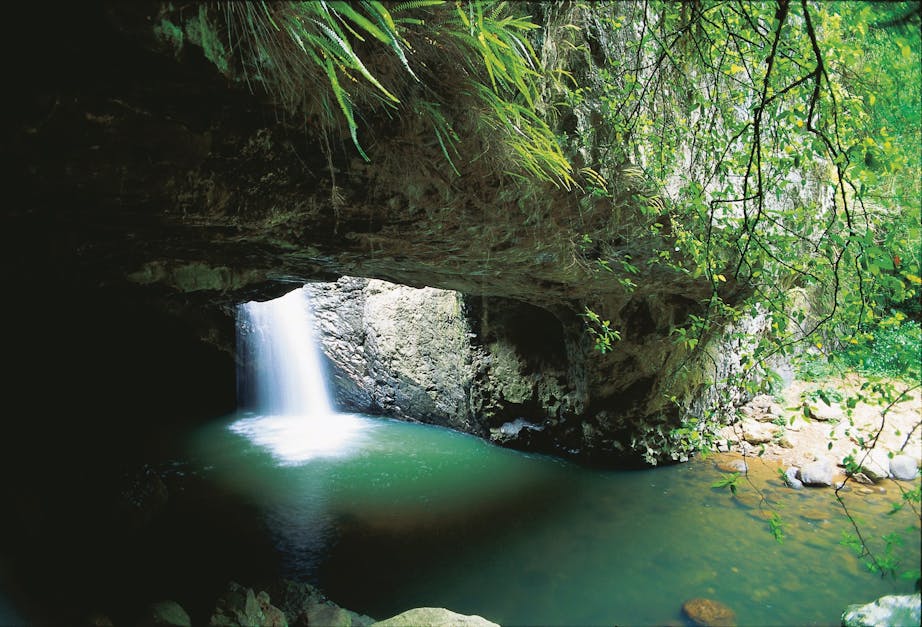
The Natural Bridge section of Springbrook National Park lies in the Numinbah Valley behind the Gold Coast. Its appeal is both geological and sensory: dense rainforest, a cave-like opening and Cave Creek dropping through rock. Queensland Parks describes the Natural Bridge circuit as a one-kilometre, grade-two loop, generally allowing around an hour and advising a clockwise direction because of the stairs. Its official track guide gives a more reliable starting point than unqualified descriptions of a quick roadside photo stop.
The daytime visit is about textures and contrasts. Bright creek water enters shadow; tree roots grip moist soil; the light changes as the path descends. The cave is also associated with glow-worms, whose night-time display is sensitive to disturbance. Never interpret the possibility of seeing them as permission to leave the formed path or approach the creek. The Queensland Parks safety rules prohibit swimming, entry to Cave Creek and access to the creek bank in the Natural Bridge section, including inside the cave. These restrictions protect both people and the fragile ecosystem.
Springbrook’s Natural Bridge should not be confused with other features called Natural Bridge around Australia. Nor should it be confused with the main Springbrook plateau trailheads; it is a separate park section, and the roads are winding. Use the official directions and safety information, particularly after heavy rain.
2. London Arch and The Arch: Victoria’s coast in motion
On the Shipwreck Coast, limestone arches are temporary stages in the erosion of a headland. The most instructive example is London Arch, historically known as London Bridge. In 1990 a section connecting its offshore mass to the mainland collapsed, leaving people stranded on the remaining formation. That event is documented by the Great Ocean Road Coast and Parks Authority, which now manages these park sites.
For a visitor, the story changes the emphasis. London Arch is not primarily a place to touch rocks; it is a viewpoint from which to understand waves, joints and coastal retreat. Nearby The Grotto presents another composition: a partly enclosed natural window framing the sea. The Arch is a distinct feature again, and its lookout closure noted in October 2026 means it should not be described as an automatically available stop. The operator’s notice explains the unstable cliff and track-erosion risk. Alternative viewpoints do not justify walking around closure signs.
The current management arrangements also matter: Parks Victoria confirms the staged transfer of major Great Ocean Road park management to the dedicated coastal authority. Check the current manager, rather than assuming an older page on another agency’s site is the most recent advice.
3. Western Australia: Nature’s Window and a coastal Natural Bridge
The famous Nature’s Window in Kalbarri National Park frames the Murchison River gorge through a small, sculpted sandstone opening. The WA Parks and Wildlife site describes the Loop Trail as a nine-kilometre walk, best undertaken in cooler months; summer temperatures inside the gorge can become extreme. Seeing the window itself and completing the full Loop are not the same outing. Treat them as two decisions with different levels of fitness, equipment and heat exposure.
There is also a coastal Natural Bridge in Kalbarri’s coastal precinct. The official Kalbarri visitor guide distinguishes the inland Nature’s Window from the coastal formation and describes the Bigurda coastal trail. This is an easy naming trap: an itinerary that sends a family to a gorge walk when they expected a clifftop lookout has misunderstood the place. Look at the actual trail and car-park map before choosing a route.
The land is Nanda Country, as the department’s park information acknowledges. When walking, stay on marked routes and do not treat spectacular rock ledges as props for precarious photographs. Park fees and conditions may apply; water and heat planning are particularly important away from the coast.
4. Admirals Arch, Kangaroo Island: rock and wildlife share the stage
On Kangaroo Island, Admirals Arch sits in Flinders Chase National Park near Cape du Couedic. This is not a simple ‘drive to the arch and step down’ attraction for every visitor. The South Australian National Parks guide explains that there is a boardwalk but also a steep section with steps approaching the arch. Visitors who cannot negotiate the descent can still enjoy viewpoints and scenery along the way.
The coastal setting adds another dimension. Visitors may see seal colonies from designated vantage points, along with the Cape du Couedic Lighthouse and Casuarina islets. Viewing wildlife from a public lookout is the point; entering breeding areas or chasing a better angle is not. The combination of exposed wind, steps and wet surfaces makes good footwear and measured pacing more valuable than an ambitious schedule.
How to choose an arch without turning the trip into a checklist
If you have a single morning near the Gold Coast, Springbrook’s short forest circuit is more realistic than a remote regional drive. If you are already exploring the Great Ocean Road, use current closure notices and prioritise legal clifftop viewpoints. In Kalbarri, separate a short Nature’s Window viewpoint visit from the far more demanding gorge Loop. On Kangaroo Island, fit Admirals Arch into a Flinders Chase itinerary, allowing for the boardwalk and local wildlife.
Photography should reflect those differences. Rainforest light rewards patience; limestone coasts are often bright and windy; inland red rock can be exceptionally harsh in midday sun. No photograph is worth crossing a safety rail. Rangers post closures precisely because viewpoints and formations change, sometimes faster than search engines update a travel article.
Field checklist before visiting
- Identify the exact arch and its park, not just a shared attraction name.
- Follow the current park authority for trail and lookout status; a travel blog may describe an access route that is no longer open.
- Distinguish a short formed viewpoint route from a long wilderness walk.
- Check heat, rainfall, tides or wind according to the environment.
- Respect Traditional Owners, wildlife habitats, fencing and restricted creek or cliff areas.
- Keep a fallback stop available; closure is sometimes the responsible way to protect visitors.
Natural arches in Australia are remarkable precisely because they record different histories. Reading the landscape—rather than collecting four nearly identical photographs—makes the journey more memorable and much safer.