
Update Address Immigration Australia: ImmiAccount Steps, 14-Day Rules, and Fallback Options

update address immigration australia is usually handled through ImmiAccount: if your residential or postal address changes while a visa or citizenship application is active, use the application’s “Update details” function rather than emailing the Department or relying on an old paper form. The practical rule is to update the Department promptly, keep proof of submission, and separately check whether your visa conditions impose their own notification deadline.
For most online applicants, the fastest way to update address immigration australia records is to sign in to ImmiAccount, expand the relevant application, choose Update details, select Change of address details, choose the applicant, identify whether the change is residential or postal, enter the new address, and submit. Home Affairs says ImmiAccount contact-detail changes update instantly. If you cannot use or import the application into ImmiAccount, use the Department’s official online Update contact details form.
A pending visa applicant who proposes to live at a different address for 14 days or more must tell the Minister under section 52(3B) of the Migration Act 1958.
Home Affairs says contact details changed through ImmiAccount are updated instantly.
Paper Form 929 for contact and passport changes was discontinued; current Home Affairs guidance directs users to online methods.
The Rule Depends on Whether You Are an Applicant or a Visa Holder
The phrase “change my immigration address” can refer to several different records. The most important distinction is whether you still have a visa application being processed, already hold a visa, have a citizenship application pending, or are acting as a sponsor. Home Affairs provides an online contact-details route for all of those groups, but the legal reason for updating can differ.
For a visa applicant with a pending application, the current Migration Act 1958 is unusually specific. Section 52(3A) requires a visa applicant to tell the Minister the address at which the applicant intends to live while the application is being dealt with. Section 52(3B) adds that if the applicant proposes to change that address for a period of 14 days or more, the applicant must tell the Minister the new address and the period of proposed residence.
The “14 days” point is not a general grace period to ignore every address change. Home Affairs’ operational guidance says to tell the Department if you will be living at a different residential address for more than 14 days, and to update a postal address when it changes. A separate visa condition may also impose its own deadline.
For an existing visa holder, check the conditions attached to the visa itself. Schedule 8 of the Migration Regulations contains condition 8578, which, where it is imposed, requires the holder to notify Immigration within 14 days after specified changes, including residential address, email, phone, passport details, employer address and the location of the position. Do not assume that condition 8578 applies to every visa. Use the Department’s VEVO service and your grant notice to see the conditions that actually apply to you.
How to Update Your Address in ImmiAccount
If the application appears in your ImmiAccount, use the built-in change-of-address function. Home Affairs’ current After you apply guidance gives the following sequence. This is the core update address immigration australia workflow for most online visa applicants.
For readers searching update address immigration australia because they have just moved, the first practical task is to decide whether the residential address, postal address, or both have changed.
Residential address and postal address are not interchangeable. Your residential address is where you actually live. Your postal address is where you want correspondence sent. If both changed, update both. If only your mailing address changed, do not replace an accurate residential address with a PO box or another mailing-only location.
After submitting, return to the application and review the stored details where available. Also check the “Messages” area in ImmiAccount regularly. Updating an address reduces the risk of postal correspondence going to the wrong place, but it does not replace your responsibility to monitor electronic requests and deadlines.
What If the Application Is Not in Your ImmiAccount?
Home Affairs says people who have not used ImmiAccount before can create one and may be able to import an application. The Department’s current application-management guidance explains that some online and paper applications can be imported using the main applicant’s application ID or Transaction Reference Number, date of birth, passport number and passport country.
Importing is not available for every case. Home Affairs lists exclusions including partner visa applications, Refugee and Humanitarian applications, organisation applications or nominations, some IRIS-number applications, unsubmitted applications and finalised paper applications. Each application can also only be imported a limited number of times. If your case falls outside the import route, do not waste time repeatedly trying to force it into a personal account.
Application Visible in ImmiAccount
Use “Update details” → “Change of address details”. This is the preferred route and Home Affairs says contact-detail changes update instantly.
Application Can Be Imported
Import it using the official ImmiAccount process, then use the relevant online change-of-details function.
Cannot Use or Import ImmiAccount
Use the Department’s official Update contact details web form for visa applicants, visa holders, citizenship applicants and sponsors.
The fallback web form is slower than an ImmiAccount update. Current Home Affairs pages are not perfectly aligned on the processing wording: the dedicated contact-details guidance says the Department will update details within 14 days if the web form is used, while the web-form page itself warns that submissions may take up to 30 days to process. The sensible approach is therefore to use ImmiAccount whenever it is available and, if you must use the web form, submit as early as possible and keep evidence.
Form 929 Is No Longer the Normal Address-Change Method
Older migration guides frequently tell applicants to complete Form 929, “Change of address and/or passport details”. That advice is now outdated for current contact-detail changes. Home Affairs’ Changes in your situation page states that, from 25 November 2024, paper Form 929 is no longer available to use and directs users to the current online processes for passport and personal details.
That is why older search results for update address immigration australia can be misleading: they may still surface Form 929 instructions that no longer match the Department’s current workflow.
This matters because using an archived form can create a false sense that you have notified the Department correctly. The safest update address immigration australia procedure is to use the live Home Affairs route shown for your case today: ImmiAccount first, then the official online contact-details form when ImmiAccount cannot be used.
Address Change vs Other Changes in Your Situation
An address change has its own specific pathway in ImmiAccount. Do not confuse it with a change in circumstances that alters substantive answers in your visa application. Home Affairs separately lists events such as marriage, separation, birth of a child, changes to work or study, and other changes that may affect an application. Those may require a different “Notification of changes in circumstances” workflow and supporting evidence.
Likewise, an incorrect answer in an already-submitted application is different from a later address change. Home Affairs provides a “Notification of incorrect answer(s)” function for mistakes. Choosing the right update type matters because it makes the change easier for the Department to identify and place against the correct part of your record.
Special Care for Visa Holders With Notification Conditions
If your visa is already granted, do not assume that updating your address is merely administrative housekeeping. Some visas can carry conditions requiring specified changes to be notified within a set period. Condition 8578 is the clearest example: where it applies, the holder must notify Immigration within 14 days after a change to specified details, including residential address.
Use VEVO’s visa-condition check to confirm your current in-effect visa and conditions, and compare that with your visa grant letter. VEVO does not show a bridging visa that is not yet in effect, so people with a substantive visa plus a future bridging visa should also retain and read the bridging grant notice.
For readers whose address change is happening while a skilled visa application is pending, Australia Pathways’ guide to 189 visa bridging visa options explains why the visa currently in effect—and its conditions—still matters while a permanent application is being processed.
What Else Should You Update After Moving?
Changing your Home Affairs record does not automatically update every Australian organisation that has your address. Treat immigration as one line in a broader moving checklist. Depending on your circumstances, you may also need to update your employer, bank, insurer, university or education provider, state or territory driver-licensing authority, Medicare or other Services Australia records, the Australian Taxation Office, electoral enrolment if applicable, and any state or territory migration nomination authority connected to your pathway.
This separation is particularly important for state-nominated or regional migrants. A Home Affairs address update is not a substitute for meeting a separate state or territory reporting requirement, nomination commitment or visa condition. If your move changes the region where you live or work, check the exact obligations attached to your visa and nomination rather than assuming that a successful ImmiAccount submission answers every agency’s requirements.
A Low-Risk Address-Change Checklist
- Confirm whether you are a pending visa applicant, visa holder, citizenship applicant or sponsor.
- Use ImmiAccount first if the relevant application is available there.
- Update residential and postal addresses separately and accurately.
- If you will live at a different address for 14 days or more while a visa application is being processed, treat the section 52 notification requirement seriously.
- Check your current visa grant notice and VEVO for any notification condition, including condition 8578 where applicable.
- Use the official online Update contact details form only when the ImmiAccount route is unavailable or cannot be used.
- Do not rely on old instructions telling you to submit paper Form 929.
- Save proof of the update: screenshots, confirmation numbers, downloaded records or correspondence.
- Continue monitoring ImmiAccount messages and email; an address change does not extend response deadlines.
- Update other agencies separately where your move affects their records or obligations.
If you are preparing a move to Australia rather than simply changing an existing address, the Australia Pathways moving-to-Australia guide covers the wider sequence of visa, housing, banking and arrival tasks. Skilled workers can also use the work visa step-by-step guide to place ImmiAccount updates within the broader application process.
Common Mistakes to Avoid
Waiting until the old address is inaccessible. If mail can no longer reach you, a simple administrative change becomes more risky. Update as soon as the move is known and the new details are reliable.
Changing only one family member. Because ImmiAccount asks you to select an applicant, check every person affected by the move rather than assuming one submission automatically rewrites all linked records.
Updating the email but not the address. Home Affairs separates address, telephone and email changes. Make each relevant change explicitly.
Using the wrong form type. A new address, an incorrect original answer and a later change in family circumstances are different events. Use the function designed for the event you are reporting.
Assuming an agent’s details replace your own obligations. If you have a migration agent or authorised recipient, keep your own residential and contact information accurate as required. Recipient arrangements concern where departmental communications may be sent; they do not make your personal address irrelevant.
Assuming a Home Affairs update changes your visa conditions. It does not. If moving location affects a regional, employer-linked or other condition, the compliance question is separate from the address-entry task.
When to Get Individual Advice
The update address immigration australia task is usually administrative, but the surrounding visa context can make it consequential.
Most address changes are routine. Individual advice becomes more valuable when the move may affect a visa condition, state nomination, employer sponsorship, regional residence requirement, a pending review, a deadline-sensitive request for information, or correspondence connected with a refusal or cancellation process. In those cases, the question is no longer just where to type the new address; it is whether the move changes another legal or procedural obligation.
For a straightforward update address immigration australia request, however, the decision tree is simple: use ImmiAccount if you can, use the official web form if you cannot, retain proof, and check whether any visa-specific notification condition applies. Home Affairs’ current online system has replaced the old paper Form 929 pathway for this task.
Related Australia Pathways Guides
Sources and Verification
- Department of Home Affairs — After you apply: current ImmiAccount steps for residential and postal address changes.
- Department of Home Affairs — Your contact details have changed: preferred ImmiAccount route, import option and fallback form.
- Department of Home Affairs — Changes in your situation: current notice that paper Form 929 ceased from 25 November 2024.
- Federal Register of Legislation — Migration Act 1958: current section 52 address-notification provisions for visa applicants.
- Federal Register of Legislation — Migration Regulations 1994: current visa-condition framework, including Schedule 8 conditions.
- Department of Home Affairs — VEVO: current in-effect visa details and conditions.
Verified: 7 September 2026. Immigration procedures and online forms can change; always use the current Department of Home Affairs page for the final submission route.
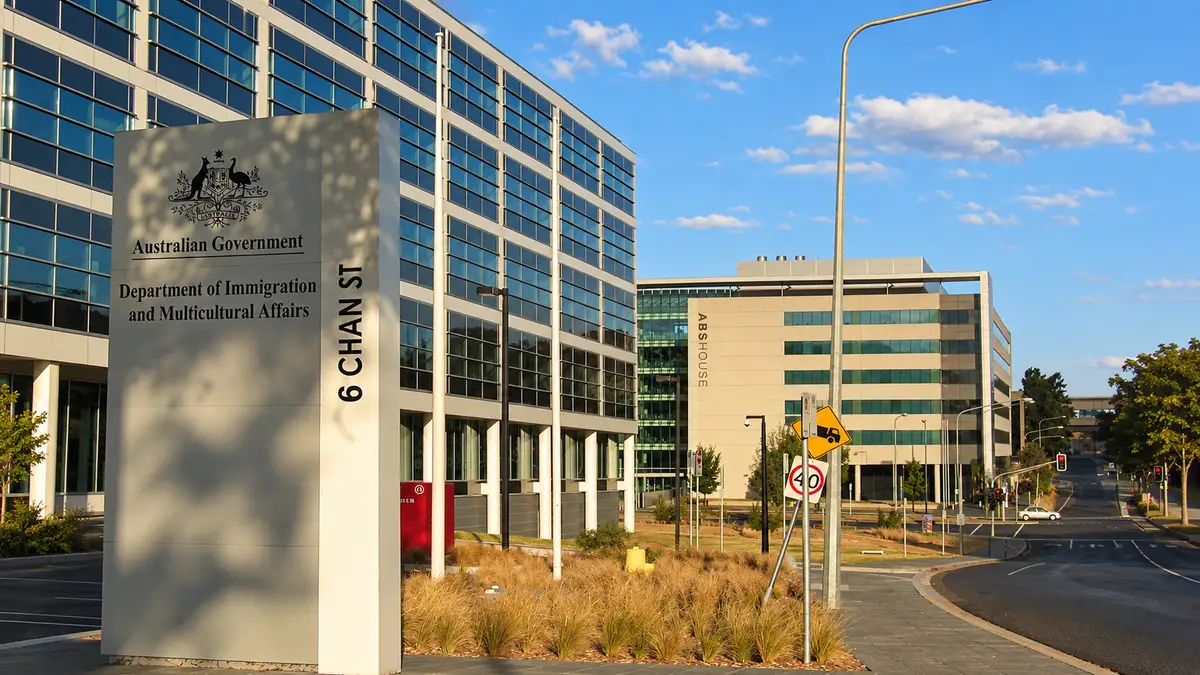
Photo credit: Adz, 27 December 2006 — Source: Wikimedia Commons — License: CC BY-SA 3.0