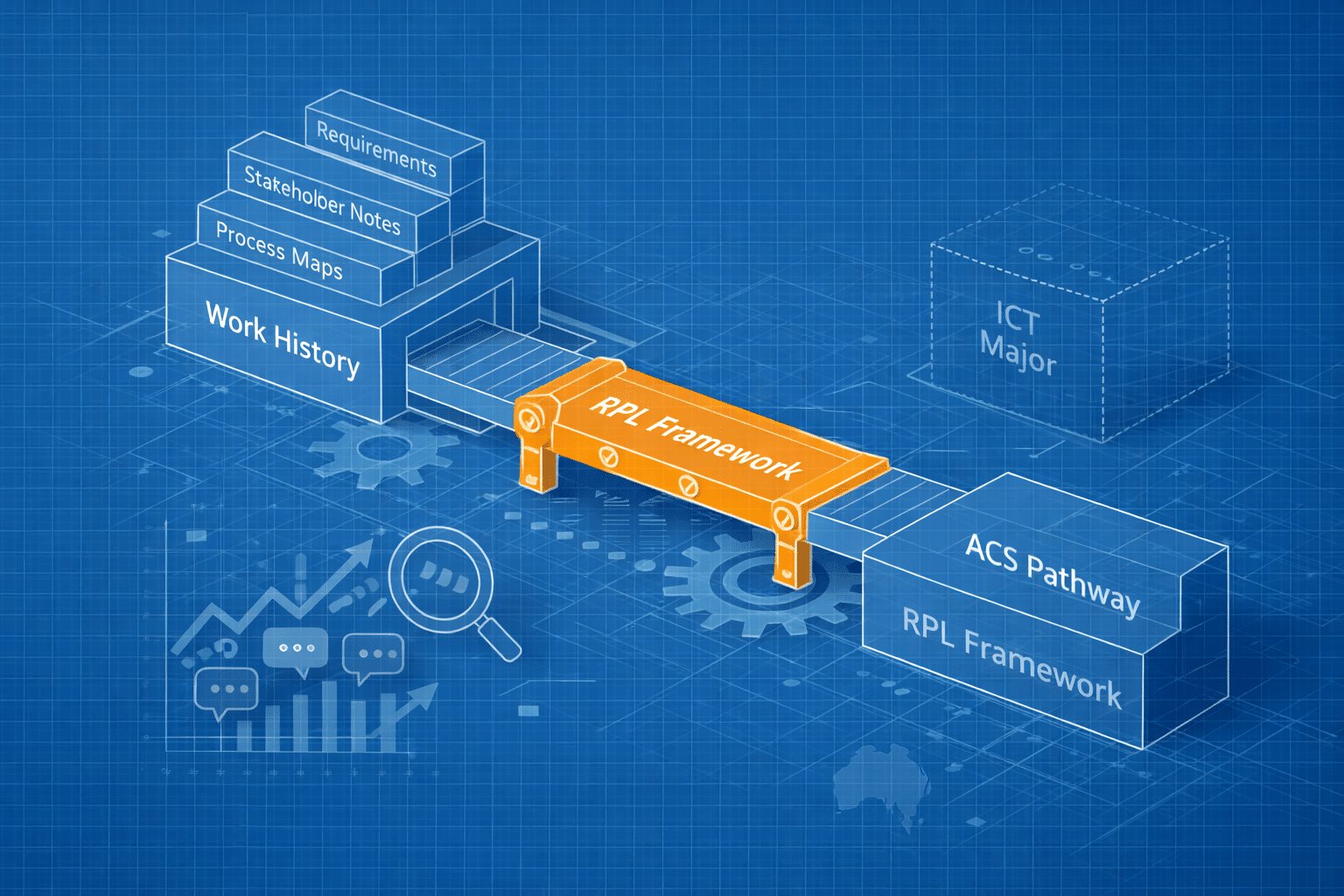


RPL eligibility for ICT Business Analyst is one of the most searched topics among international ICT professionals who have solid industry experience but do not have an Australian-recognised ICT qualification. If you are aiming for an ACS skills assessment under ANZSCO 261111, understanding what “RPL” means in the ACS context is essential, because it is not the same as a university credit transfer or a generic resume rewrite.
If you are still getting familiar with the basics, this guide complements what you’ll find on RPL for ACS skills assessment while focusing specifically on the ICT Business Analyst pathway and the most common eligibility questions.
◆ The Sydney-based Australian Pathways RPL and ACS writing team can best help with tailored RPL reports and supporting documents based on your exact background and evidence.
What “RPL” Means In The ACS Skills Assessment Context
In the ACS environment, RPL (Recognition of Prior Learning) is a formal pathway used when your qualifications are not closely aligned to ICT, or when your ICT qualification is considered insufficient for the occupation you are nominating.
ACS generally wants to see that you have developed ICT knowledge at a professional level. If your degree is in a non-ICT field (or your ICT study is limited), ACS may allow you to demonstrate equivalent learning through:
Demonstrated professional ICT work experience
Evidence of depth and progression (not just short tasks)
Clear, credible project-based work that shows applied ICT knowledge
This is why RPL eligibility for ICT Business Analyst is not simply about having “some IT work.” It is about showing that your work history can credibly stand in for missing or insufficient formal ICT education.
To understand the role of the assessing authority itself, it helps to refer to the official ACS site at acs.org.au.
Who Is An ICT Business Analyst (ANZSCO 261111)?
An ICT Business Analyst typically works at the intersection of business needs and technology solutions. In general terms, the role focuses on understanding problems, capturing requirements, and helping translate those requirements into functional outcomes for systems, platforms, or digital processes.
Common environments include:
Software Development And Product Teams
Enterprise Platforms (CRM, ERP, HRIS, Finance Systems)
Data And Reporting Projects
Process Improvement And Digital Transformation Programs
Typical responsibility themes include:
Requirements Elicitation And Documentation
Stakeholder Workshops And Communication
Process Mapping And Gap Analysis
Translating Business Rules Into Functional Requirements
Supporting Testing, UAT, Change, And Implementation
Importantly, ACS does not assess you based on job title alone. Many people have “Business Analyst” on paper, but their day-to-day work may be closer to operations, policy, or general consulting. Your evidence needs to show the ICT nature of your BA work.
RPL Eligibility For ICT Business Analyst: Who Usually Needs It?
RPL eligibility for ICT Business Analyst most often applies to applicants in one of these situations:
Non-ICT Degree, Strong ICT Experience
Example: Business, Accounting, Engineering (Non-ICT), Management, Social Sciences.ICT Study That Does Not Match The Nominated Occupation
Example: Partial ICT units, short diplomas, or unrelated ICT programs.No Tertiary Qualification, But Significant Professional ICT Experience
This is riskier and depends heavily on evidence quality and role alignment.Qualification Recognised, But Insufficient Depth
Even with some relevant study, ACS may still require proof of substantial ICT knowledge through work.
In all cases, you are essentially asking ACS to accept that your professional experience has built the core ICT knowledge expected for ANZSCO 261111.
High-Level ACS Skills Assessment Pathway For Non-ICT Backgrounds
While each person’s case is different, the ACS pathway for non-ICT or insufficient ICT qualifications usually follows a predictable structure.
Here is a high-level view (without turning it into a copy-and-paste DIY manual):
Confirm Your Nominated Occupation
Ensure ICT Business Analyst is the right fit compared with similar ICT roles.Review Qualification Relevance
Determine whether your degree is ICT, partially ICT, or non-ICT in ACS terms.Establish Experience Coverage
Your employment history must demonstrate suitable ICT business analysis work over time.Prepare An RPL Package (If Required)
This typically includes a structured demonstration of professional ICT learning.Submit And Await Outcome
Processing times vary, and the quality/clarity of the submission matters.
Because visa pathways and requirements can change over time, it’s smart to also keep an eye on official migration information at immi.homeaffairs.gov.au when you are planning next steps after an assessment.
What Evidence Usually Supports RPL For ICT Business Analyst?
When people ask about RPL eligibility for ICT Business Analyst, they often focus only on the “RPL report.” But eligibility is also about whether your supporting evidence creates a consistent, believable, and professionally documented story.
Common evidence categories include:
Identity And Core Documents
Passport Bio Page
Updated CV/Resume With Consistent Dates
Qualification Certificates And Transcripts (If Any)
Employment Evidence
Reference Letters That Clearly Describe Role, Dates, And Duties
Contracts, Promotion Letters, Or HR Verification (When Available)
Payslips Or Tax Evidence (To Support That Employment Is Genuine)
Project And Work Evidence (High-Level)
Project Summaries And Role Descriptions
Requirements Documents, User Stories, Or Functional Specs (Redacted If Needed)
Process Maps, Workshop Notes, Or Change Requests (Redacted)
Testing/UAT Materials (Where Your Contribution Is Clear)
Tooling Context (For Example: Jira/Confluence, CRM/ERP Platforms, BI Tools)
You do not need to expose confidential company data. But you do need to demonstrate your personal contribution and the ICT nature of the work in a credible way.
RPL Project Reports: What ACS Wants Conceptually (No Copy-Paste Formulas)
One of the biggest pain points in RPL eligibility for ICT Business Analyst is understanding how to present project-based learning without giving ACS something that looks generic, recycled, or overly “template-like.”
Conceptually, strong project reporting usually shows:
Context: What the organisation needed and why the project existed
Your Role: What you personally did (not what “the team” did)
Method: How you approached requirements, analysis, and solution alignment
ICT Depth: How the work relates to systems, data, integrations, workflows, or software delivery
Outcome: What changed because of the project (process, system capability, adoption)
Learning: How your ICT knowledge grew through the work
What to avoid:
Copying position descriptions and pasting them as “project work”
Writing only business outcomes with no ICT connection
Listing tools without explaining how you used them in analysis work
Using identical language across projects (it can look manufactured)
Each case is unique. Two ICT Business Analysts can work on the same platform and still need very different narratives depending on their responsibilities, seniority, and deliverables.
Typical Timeframes: Planning Your RPL Effort Realistically
A common misconception is that RPL is something you can produce quickly if you “just write faster.” In reality, most time is consumed by evidence gathering and consistency checks.
High-level timeframe considerations:
Document Collection: Often the slowest step (HR letters, old payslips, contracts)
Project Selection: Choosing projects that best demonstrate ICT BA depth
Drafting And Refinement: Making sure dates, duties, and project scope align
Final Review: Checking consistency across CV, references, and RPL content
ACS Processing Time: Varies depending on assessment type and volume
If you are planning visa timelines, also remember that policy settings can change. For broader policy and program context, the Department’s main site homeaffairs.gov.au is a useful official reference point.
Common Mistakes That Can Hurt RPL Eligibility For ICT Business Analyst
RPL eligibility for ICT Business Analyst is often lost not because the person lacks experience, but because the submission does not clearly prove the right kind of experience.
Here are frequent issues that create problems:
1) Role Mismatch (Business Analyst vs Non-ICT Analyst)
If your work is mostly policy writing, operational administration, or generic consulting with limited systems involvement, ACS may not see it as ICT Business Analyst work.
2) Vague Or Inflated Claims
Overstating responsibilities is risky. ACS looks for plausibility. If you claim to “design architecture” or “own solution design” while your reference letter suggests junior duties, the file can feel inconsistent.
3) Inconsistent Dates Across Documents
Small inconsistencies between CV, references, and project timelines can raise credibility concerns.
4) Project Descriptions That Don’t Show Your Contribution
ACS generally wants clarity on what you did personally. Overusing “we” language can weaken the evidence of your own skill.
5) Generic Content That Looks Reused
If your project narrative reads like a textbook BA description, it can feel non-specific. Strong submissions are concrete, grounded, and role-accurate—without exposing confidential details.
How To Align Your Work With ANZSCO Without Copying Wording
People often ask: “How exactly should I phrase my duties to match ANZSCO?” This is one of the most critical points, and it’s also where copy-paste wording can do real harm.
A safe, professional, conceptual approach is:
Identify your core BA responsibility areas (requirements, process, testing, stakeholder management)
Explain how you performed them in an ICT environment (systems, data, digital workflows)
Show your deliverables (what documents or outcomes you produced)
Demonstrate scope and complexity appropriate to your seniority level
Instead of trying to mirror official wording line-by-line, aim for role accuracy and evidence-backed clarity. Your best phrasing depends on your industry (banking, health, telco), delivery model (Agile vs Waterfall), and whether you worked on platforms, integrations, data, or process automation.
Choosing Projects That Best Demonstrate ICT Business Analysis
For RPL eligibility for ICT Business Analyst, project choice matters as much as writing quality. Some projects are naturally easier to justify as ICT BA work.
Projects that often support ICT BA alignment include:
System Implementation Or Replacement (CRM/ERP/Core Platforms)
Workflow Automation And Digital Process Redesign
Data Reporting Platforms And BI Dashboards
Customer-Facing App Or Web Platform Enhancements
Integration Projects (APIs, Middleware, Data Flows)
Projects that may need extra care to frame correctly:
Pure Business Strategy With No System Change
Compliance Documents With Minimal ICT Connection
General Operations Projects Without Tech Deliverables
This does not mean the second category can’t work. It means you must clearly demonstrate the ICT component and your direct involvement with system-facing requirements or solution delivery.
If You’re Not Eligible Yet: Practical Options To Build Toward Eligibility
Sometimes the honest answer is: you are not quite ready today, but you can build a stronger case over time.
Common pathways people consider:
Moving into projects with clearer ICT deliverables (systems, data, delivery teams)
Expanding responsibilities into requirements ownership, UAT coordination, or product backlog work
Completing relevant ICT study (short courses may help professionally, but eligibility depends on ACS rules and evidence)
Structuring your experience so it shows progression and depth
If formal study is part of your strategy, government-backed information can help you evaluate options and expectations at studyinaustralia.gov.au.
What A “Good” RPL Submission Looks Like At A High Level
Without giving you a reusable template, a strong submission usually feels like this:
Consistent Story: CV, references, and projects all tell the same timeline
Role Fit: Duties clearly sit within ICT Business Analyst scope
Evidence-Led: Claims are supported by documents and credible detail
Professional Tone: Clear, factual, not exaggerated, not overly generic
Confidentiality-Aware: Sensitive data is removed, but work contribution remains clear
If any one of these is weak, the whole submission can feel uncertain—even if you actually have the right experience.
◆ The Sydney-based Australian Pathways RPL and ACS writing team can best help by checking eligibility fit, strengthening consistency, and preparing RPL-aligned documents without generic wording.
FAQ: RPL Eligibility And ACS Skills Assessment For ICT Business Analyst
1) Does RPL eligibility for ICT Business Analyst depend only on years of experience?
No. Experience length matters, but ACS also looks at the quality, relevance, and ICT depth of your work. Your duties, projects, and evidence must align with ANZSCO 261111 and show credible professional ICT knowledge.
2) Can I use the same type of project twice if both were similar CRM upgrades?
It depends. If the projects are genuinely different in scope, stakeholders, deliverables, and your contribution, it may be possible. But repeating very similar narratives can look generic, so most applicants benefit from showing variety in systems, processes, or outcomes.
3) If my title was “Business Analyst” in a non-ICT department, can I still qualify?
Potentially, yes. ACS focuses more on what you actually did than the department name. You’ll need to show that your work was ICT-focused (systems, data, digital processes, delivery lifecycle) rather than purely operational or policy-focused.
4) Do I need to provide confidential documents like internal specifications or screenshots?
You should not expose sensitive company information. In many cases, redacted documents or high-level evidence can be used. The key is that your evidence must still clearly show your role and contribution.
5) What is the biggest misconception about ACS RPL for ICT Business Analyst?
That it is “just writing.” In reality, eligibility depends on the credibility of your overall submission: role fit, evidence strength, consistency across documents, and the clarity of your project-based professional ICT learning.