
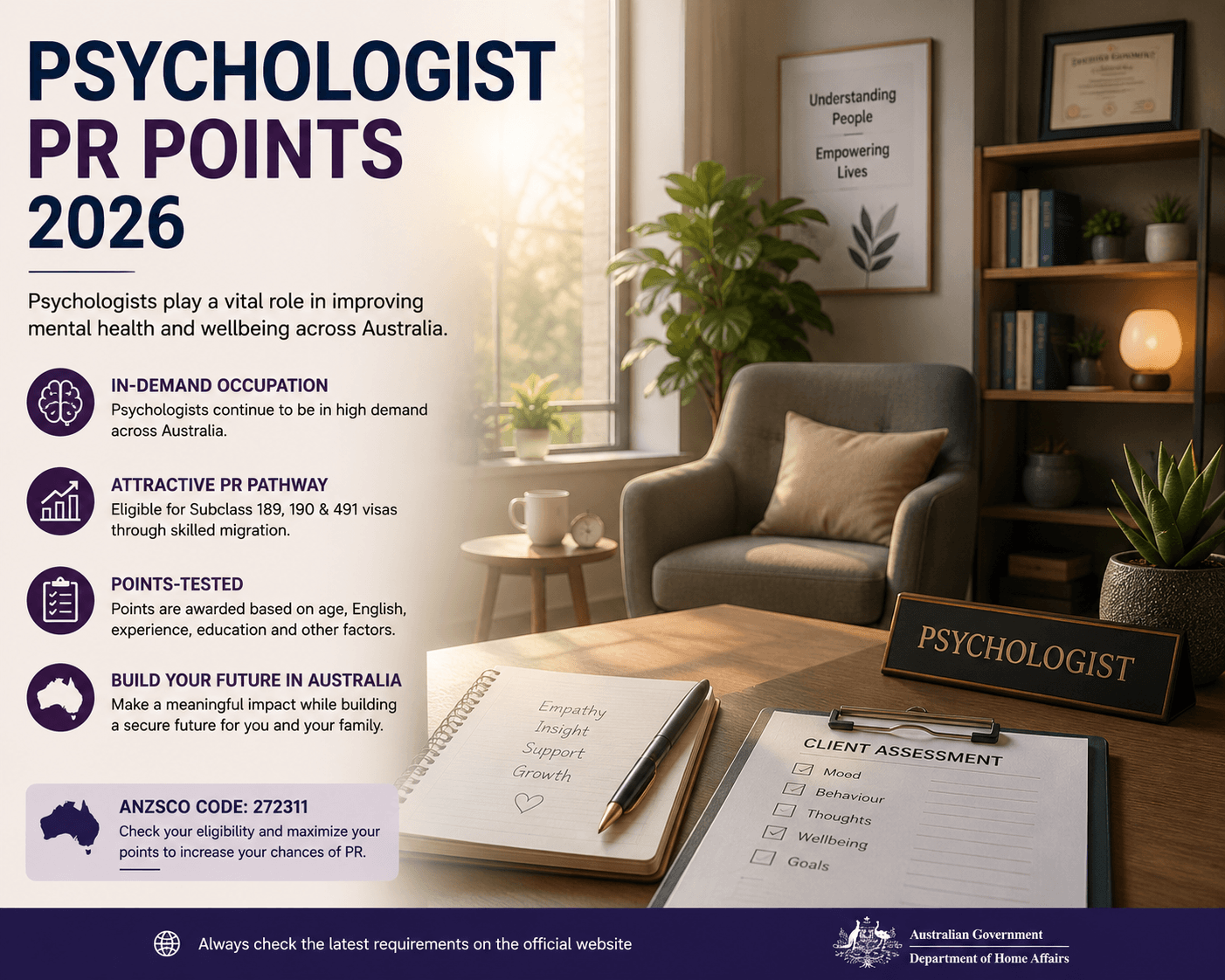
Psychologist pr points 2026: Build a safer Australian PR strategy and avoid costly mistakes

Psychologist pr points 2026 is best understood as a decision pathway, not just a number on a calculator. For psychologists, the real challenge is aligning the points test, the right visa subclass, the correct occupation pathway, skills assessment evidence, English results, state nomination strategy, and professional registration expectations before spending money or relying on a weak Expression of Interest.
The safest starting answer is this: you usually need at least 65 points to be eligible for key points-tested skilled visas, but eligibility is not the same as receiving an invitation. A psychologist with 65 points may still be too weak for competitive rounds, while another applicant with stronger English, state nomination, partner points, Australian study, or regional strategy may have a more realistic pathway.
If your degree, work history, registration status, or English score is not straightforward, getting advice early can prevent a costly mismatch between your nominated occupation and your evidence. A short review through Contact Us can help identify whether your profile should focus on a subclass 189, 190, 491, employer-linked route, further study, or a staged registration plan.
Answer first: psychologist pr points 2026 is not a fixed invitation score for all psychologists. It is a planning framework for checking whether your age, English level, qualification, employment history, partner profile, nomination options, and assessment evidence can reach a competitive migration position.
This guide is for overseas-trained psychologists, Australian psychology graduates, provisional or generally registered psychologists, and skilled applicants comparing the 189, 190, and 491 routes. It is not a guarantee of invitation, registration, or permanent residence, because occupation lists, invitation rounds, state criteria, and assessment rules can change.
You will learn how the points logic works, how psychologist-specific assessment issues affect strategy, what documents to prepare, and which mistakes usually weaken otherwise promising applications.
Need a profile check before you build your EOI? Psychology applications can fail quietly when the applicant has points on paper but weak proof for skills assessment, employment claims, registration, or state nomination. A structured review can help you decide whether to improve English, wait for more experience, target a state pathway, or correct your occupation strategy before submitting documents.
Table of contents
How psychologist pr points 2026 really works
psychologist pr points 2026 begins with the Australian points test, but the points test is only one part of the decision architecture. The Department of Home Affairs publishes the official points table for points-tested skilled visas, including age, English, skilled employment, educational qualifications, Australian study, specialist education, partner factors, and nomination-related points. Applicants should verify the current table directly through the official Home Affairs points table before relying on any article, consultant estimate, or online forum.
The usual planning mistake is to ask, “How many points do psychologists need?” The better question is, “Which points are legally claimable, evidence-backed, relevant to my nominated occupation, and competitive for the visa channel I am targeting?” A high estimate is useless if the applicant cannot prove employment dates, English results, partner eligibility, assessment relevance, or state nomination eligibility.
For most skilled applicants, age and English are the highest-impact variables. Strong English can transform a marginal profile, while losing points after a birthday can weaken an otherwise promising case. For psychologists, English also matters beyond migration points because professional practice, registration expectations, supervised pathways, and employability all depend on communication credibility.
Points should therefore be treated as a risk map. Your total score tells you whether you can enter the skilled migration competition; your evidence quality tells you whether your claim can survive assessment; your occupation strategy tells you whether the pathway is realistic; and your timing tells you whether the application should move now or after improvement.
psychologist pr points 2026 for visa pathways: 189, 190, and 491
psychologist pr points 2026 usually revolves around three major skilled pathways: the Skilled Independent visa, the Skilled Nominated visa, and the Skilled Work Regional pathway. The subclass 189 points-tested stream is independent and does not rely on state nomination, but it is often more competitive because the applicant must stand on points, occupation demand, and invitation ranking. The official subclass 189 page explains the points-tested skilled route for invited workers who can live and work permanently in Australia.
The subclass 190 pathway is state or territory nominated. It can be more strategic for psychologists if a state needs psychology professionals and the applicant can satisfy that state’s occupation, registration, employment, residence, or employability requirements. Home Affairs states that subclass 190 applicants must be able to obtain at least 65 points, and the official subclass 190 page should be checked before acting.
The subclass 491 pathway is regional and provisional, not immediate permanent residence. It can still be valuable because state or family nomination can add substantial points, and regional Australia may have stronger workforce demand in mental health, community services, hospitals, schools, disability support, and regional clinics. Applicants should read the official subclass 491 guidance carefully because the long-term plan may involve a later permanent residence step.
SkillSelect is the central platform for submitting an Expression of Interest. It is not a visa application by itself; it is a profile that may lead to an invitation if the applicant meets the relevant criteria and is competitive enough. The official SkillSelect page is the safest reference for understanding the EOI mechanism.
psychologist pr points 2026 and the psychology-specific assessment problem
psychologist pr points 2026 becomes more complex because migration assessment and professional registration are related but separate issues. For skilled migration, overseas-trained psychologists generally need a suitable skills assessment from the relevant assessing authority. The Australian Psychological Society states that it is the only national assessing authority approved to conduct skills assessments for overseas-trained psychologists, and applicants should verify current requirements on the official APS skilled migration assessment page.
Registration is a different layer. To practise as a psychologist in Australia, applicants must satisfy the Psychology Board of Australia and Ahpra registration framework. The Psychology Board explains that psychologists must be registered and meet registration standards in order to practise, so applicants should review the official Psychology Board registration guidance before assuming that a positive migration assessment automatically means practice rights.
This distinction is crucial. A person may be able to calculate points, prepare an EOI, and pursue a skilled pathway, yet still need a staged professional registration plan. Another person may be close to registration but may not have enough competitive migration points. The strongest strategy connects both systems instead of treating them as separate paperwork exercises.
For many applicants, the best order is to map the nominated occupation first, then check skills assessment, then calculate points, then test visa channel competitiveness, then examine registration and employability. Reversing this order can create expensive mistakes, especially if the applicant invests in English tests, translations, or state nomination documents before confirming the core assessment route.
psychologist pr points 2026 comparison table
psychologist pr points 2026 should be compared across visa channels because the same person can look weak under one route and much stronger under another. The table below gives a practical comparison for planning only; official rules must always be checked before lodging an EOI or visa application.
| Pathway | Typical role in strategy | Points impact | Psychologist-specific issue | Main caution |
|---|---|---|---|---|
| Subclass 189 | Independent skilled pathway for invited applicants. | No state nomination bonus, so the applicant depends heavily on core points. | Best suited to strong profiles with suitable assessment, strong English, and competitive total points. | Minimum eligibility does not mean invitation certainty. |
| Subclass 190 | State or territory nominated permanent pathway. | Nomination can improve the points position. | Useful when a state has demand for psychologists and the applicant meets state-specific criteria. | State lists and nomination rules can change quickly. |
| Subclass 491 | Regional provisional pathway with a later permanent residence plan. | Nomination or eligible family sponsorship can significantly lift the score. | May suit applicants open to regional practice, mental health services, schools, hospitals, or community settings. | It is not immediate permanent residence and requires long-term planning. |
| Employer-linked options | Alternative route where skilled visa points are not the main mechanism. | May reduce dependence on points-tested ranking. | Can be relevant if the applicant has registration progress, Australian experience, or a strong employer need. | Employer, occupation, salary, sponsorship, and registration constraints must be checked carefully. |
psychologist pr points 2026 scenario matrix
psychologist pr points 2026 becomes clearer when you classify your situation by risk. The aim is not to chase a perfect score immediately; the aim is to identify the safest next move before evidence expires, rules shift, or a weak EOI damages your planning discipline.
| Scenario | Risk level | Safer next move | Verify before acting | Common mistake |
|---|---|---|---|---|
| Overseas-trained psychologist with strong degree but no Australian registration plan. | Medium to high | Check APS skills assessment requirements and map registration implications separately. | Assessment authority, degree equivalence, supervised practice, English, and registration pathway. | Assuming migration assessment and practice registration are the same approval. |
| Australian psychology graduate with limited skilled employment. | Medium | Calculate points conservatively and test state nomination options before relying on employment points. | Graduate pathway, occupation list, English score, age, and state criteria. | Claiming employment that is not clearly skilled or occupation-relevant. |
| Applicant with 65 to 75 points and no nomination. | High | Improve English, explore 190 or 491, and review partner or study points. | Invitation history, state openings, document quality, and points evidence. | Treating minimum eligibility as a realistic invitation strategy. |
| Applicant near an age-point birthday. | High | Urgently calculate timing, document readiness, and whether improvement can happen before points drop. | Date of birth, EOI timing, test validity, assessment timing, and invitation risk. | Waiting for perfect documents while losing age points. |
| Applicant with superior English but unclear occupation match. | Medium | Confirm nominated occupation and assessment route before investing in state nomination paperwork. | ANZSCO fit, job duties, degree content, and assessment evidence. | Building the case around points before confirming occupation validity. |
psychologist pr points 2026 copy-friendly checklists
psychologist pr points 2026 planning should produce two practical outputs: a clear action list and a document list. If either list is incomplete, the points estimate should be treated as provisional.
Action checklist
- Identify the exact psychologist occupation pathway you intend to nominate.
- Confirm whether APS skills assessment is required for your selected route.
- Separate migration assessment from Psychology Board registration planning.
- Calculate age points using your current age and the date of your next birthday.
- Check whether improving English could add a meaningful points advantage.
- Review whether your skilled employment is occupation-relevant and documentable.
- Compare 189, 190, and 491 before committing to one pathway.
- Check state and territory criteria before assuming nomination is available.
- Prepare a conservative points calculation and a best-case calculation.
- Decide whether your next step is assessment, English improvement, state research, employer search, or further study.
Document checklist
- Passport identity page and civil status documents.
- Degree certificates, academic transcripts, and course descriptions where relevant.
- Evidence of psychology registration or licensing in countries where you have practised.
- Employment references with duties, dates, hours, title, and employer details.
- Payslips, tax records, contracts, or other evidence supporting employment claims.
- English test results from an accepted test provider.
- Skills assessment documents and outcome letter when available.
- Partner documents if claiming partner-related points.
- Australian study, regional study, or specialist education evidence if applicable.
- State nomination evidence and residence or employment proof if required by the state.
psychologist pr points 2026 mistakes and fixes
psychologist pr points 2026 applications often become risky because the applicant focuses on the headline score and ignores the proof behind it. The following table shows common mistakes and safer corrections.
| Mistake | Why it is risky | Better fix | Evidence to prepare |
|---|---|---|---|
| Counting every year of psychology-related work as skilled employment. | Not all work may be relevant, post-qualification, paid, sufficiently documented, or accepted for points. | Claim only work that can be supported with strong references and proof. | Reference letters, contracts, payslips, tax records, and duty statements. |
| Assuming 65 points is enough. | It may meet a threshold but still be uncompetitive. | Build a points improvement plan through English, nomination, partner points, or timing. | English results, nomination research, partner assessment, and EOI comparison. |
| Confusing APS assessment with registration to practise. | Migration suitability and professional registration are not identical decisions. | Plan both pathways separately and check each authority’s requirements. | APS outcome, Psychology Board guidance, qualifications, and registration history. |
| Submitting an EOI before checking state rules. | State criteria may require residence, employment, registration progress, or specific occupation demand. | Read current state criteria first and tailor the EOI accordingly. | State nomination criteria, occupation list evidence, and employability documents. |
| Using a generic occupation without matching duties. | A weak occupation match can undermine assessment and nomination logic. | Match duties, qualifications, registration, and career history to the nominated occupation. | Detailed duty statements, course content, and professional evidence. |
Verification workflow before submitting an EOI
A strong migration plan is built through verification, not hope. Use the following sequence before treating your points as reliable.
- Open the official Home Affairs points table and calculate only the points you can prove with documents.
- Check whether your intended visa subclass is 189, 190, 491, or another pathway.
- Confirm the correct psychologist occupation and whether it appears in the relevant visa or state context.
- Review APS skilled migration assessment requirements and identify missing qualification or work evidence.
- Review Psychology Board and Ahpra registration expectations if you intend to practise after arrival.
- Calculate a conservative points total, then calculate a realistic improvement scenario.
- Check whether your English score is the fastest and safest way to improve competitiveness.
- Review state nomination criteria before assuming nomination points are available.
- Prepare document evidence before making any points claim in the EOI.
- Recheck official sources immediately before submission because criteria can change.
Before you spend money on tests, translations, or assessments: psychology migration cases often need a staged strategy rather than a single application push. If your score depends on nomination, partner points, overseas employment, or unclear assessment evidence, a tailored review can help you avoid overclaiming points or choosing the wrong visa direction.
FAQs
How many points does a psychologist need for Australian PR?
The usual minimum for key points-tested skilled visas is 65 points, but that is not a guaranteed invitation score. Psychologists should treat 65 points as an entry threshold and then test whether their profile is competitive for the chosen visa, occupation, and state nomination route.
Is APS assessment the same as registration as a psychologist?
No. APS skilled migration assessment and Psychology Board registration are separate processes with different purposes. A migration assessment may help with a skilled visa application, while registration determines whether you can practise as a psychologist in Australia.
Is subclass 189 the best pathway for psychologists?
It can be attractive because it does not require state nomination, but it may also be more competitive. Many psychologists should compare subclass 189 with 190 and 491 before deciding because nomination or regional strategy can materially change the risk profile.
Can overseas psychology experience add points?
It may add points if it meets the relevant skilled employment criteria and is properly documented. Applicants should be cautious because job title alone is not enough; duties, dates, hours, qualification timing, payment records, and relevance to the nominated occupation all matter.
Should I improve English before submitting an EOI?
Often, yes, if a higher English band can add points or strengthen employability. The decision depends on your age timeline, current score, visa pathway, state nomination options, and whether waiting creates another risk.
Does subclass 491 give permanent residence immediately?
No. The subclass 491 is a provisional regional pathway and normally requires a later permanent residence step if the applicant meets the relevant conditions. It can still be strategically useful because nomination or eligible family sponsorship may improve the points position.
Can a psychology graduate in Australia apply without work experience?
Possibly, but the pathway depends on qualification level, assessment, English, age, state criteria, and registration direction. Lack of skilled employment can reduce points, so the applicant may need a stronger English score, nomination strategy, further training, or a staged plan.
Where should I check the most reliable information?
Use Home Affairs for visa and points rules, APS for skilled migration assessment, and the Psychology Board of Australia for registration guidance. Articles can help with strategy, but official sources should be checked before any application decision.
Conclusion and next steps
psychologist pr points 2026 should be treated as a structured migration project, not a quick score estimate. The strongest applicants do not simply add points; they prove each claim, match the right occupation, separate migration assessment from professional registration, and choose a visa pathway that fits their timing and evidence.
Your next step is to create a conservative points calculation, identify the weakest evidence area, and decide whether your priority is English improvement, APS assessment preparation, state nomination research, employment documentation, or registration planning. For more immigration planning resources and service guidance, visit Australia Pathways.
If your profile is straightforward, you may be able to move through the process with careful official-source checking. If your case includes overseas qualifications, mixed employment history, uncertain registration status, approaching birthday risk, or reliance on state nomination, professional guidance can protect time, money, and strategy.