
RPL India to Australia ICT Business Analyst is one of the most searched topics among Indian tech professionals who have strong experience but limited formal ICT qualifications. If you are exploring the RPL for ACS skills assessment pathway, it helps to understand what ACS is looking for, what “RPL” really means, and how your work history can be presented clearly and credibly.
Many applicants feel confident about their skills but get stuck on the paperwork, the terminology, and the fear of “saying the wrong thing.” The good news is that you do not need to be perfect. You do need to be consistent, truthful, and organised, because ACS assessments are evidence-based and details matter.
◆ The Sydney-based Australian Pathways RPL and ACS writing team can best help with tailored RPL reports and supporting documents.
What RPL Means In The ACS Context
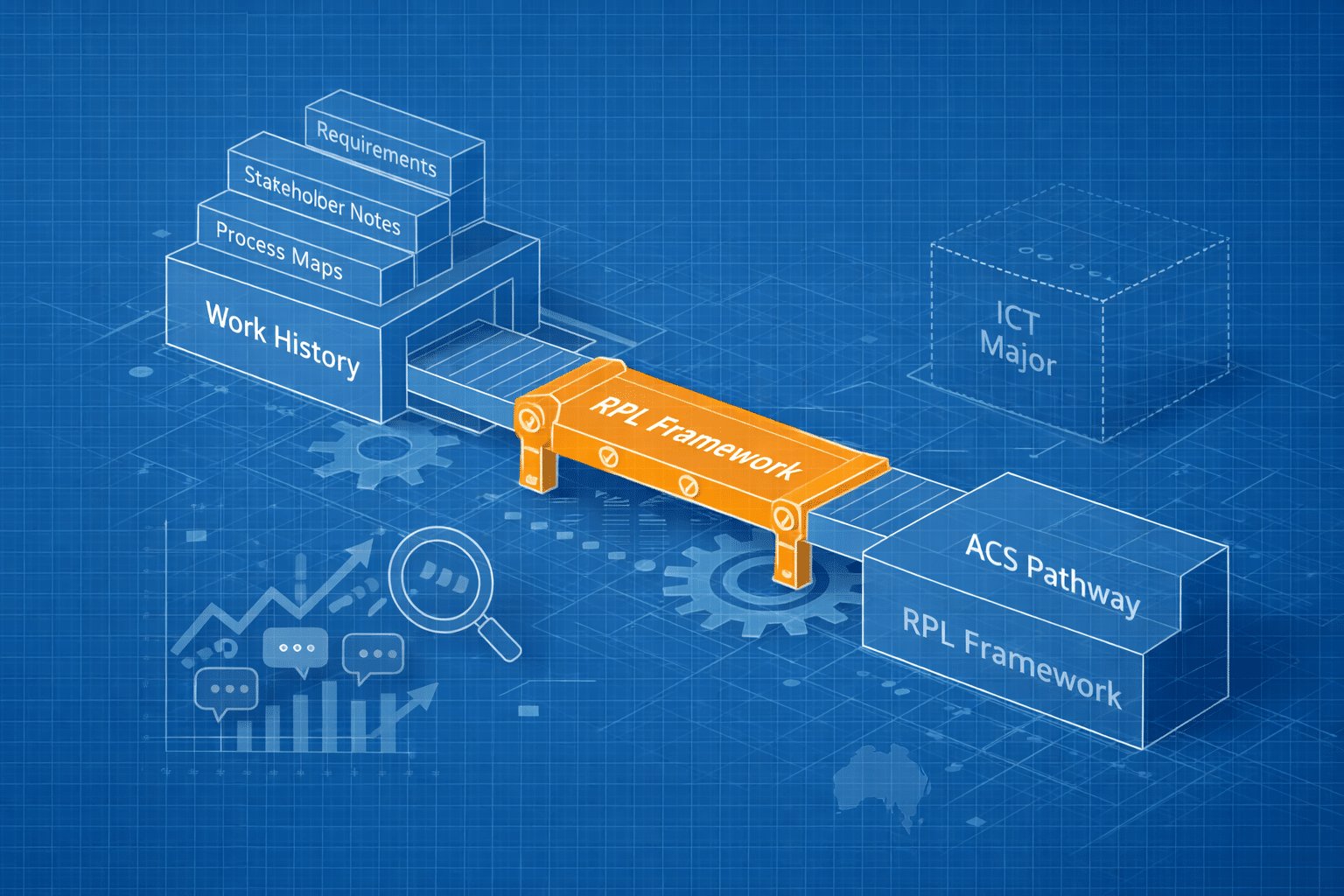
In Australia, “Recognition Of Prior Learning” (RPL) is a formal way to show you have equivalent ICT knowledge and skills gained through work experience, professional learning, and real projects, even if you do not have an ICT degree (or your degree is not closely related to ICT). For ACS, RPL is not a shortcut. It is a structured assessment pathway that asks you to demonstrate:
- What you actually did in your roles (not just your job title)
- How your work aligns with ICT professional practice
- How you developed and applied knowledge over time
- Whether your experience is relevant and recent enough
ACS is the official skills assessment authority for many ICT occupations. If you are unfamiliar with ACS, start by reading the general information on the Australian Computer Society website and then focus on the RPL pathway that matches your background.
Who Is An ICT Business Analyst (ANZSCO 261111)?
An ICT Business Analyst (ANZSCO 261111) works at the bridge between business needs and technology delivery. The ANZSCO occupation framework is published and maintained by the Australian Bureau of Statistics, which is why getting the occupation choice right matters. The role is not “only meetings” and it is not “only documentation.” It is a structured problem-solving function that translates goals into requirements and helps teams deliver solutions that make sense.
Common Responsibilities Include:
- Understanding Business Problems And Objectives
- Eliciting Requirements Through Workshops, Interviews, And Data Review
- Mapping Current-State Processes And Designing Future-State Improvements
- Writing Functional Specifications Or User Stories
- Supporting Testing By Defining Acceptance Criteria And Validating Outcomes
- Working With Stakeholders Across Product, Engineering, QA, Operations, And Leadership
In practice, many Indian professionals do “BA work” under titles like Product Analyst, Systems Analyst, Functional Consultant, Process Analyst, Implementation Analyst, or even Project Coordinator. In an ACS context, your evidence and duties matter more than the label on your business card.
RPL India to Australia ICT Business Analyst: Why This Pathway Is Common For Indian Professionals
RPL India to Australia ICT Business Analyst comes up so often because career paths in India are frequently experience-led. Many strong ICT Business Analysts started in non-ICT degrees (Commerce, Economics, MBA, Engineering in a non-ICT field) and learned systems, data, and delivery on the job.
Typical Scenarios Where RPL Makes Sense:
- You Have An MBA Or Commerce Degree And Moved Into IT Consulting Or Product Delivery
- You Have Engineering But Not In ICT And Your Work Became Mostly Digital/Systems-Focused
- You Have Strong Experience But Your Education Does Not Meet ACS ICT Qualification Rules
- You Worked In Agile Delivery And Requirements Roles Without A Formal “Computer Science” Degree
RPL is designed for exactly these real-world careers, as long as the work is substantial, relevant, and evidenced properly.
High-Level View: How ACS Skills Assessment Works For RPL Applicants
ACS skills assessment is a formal process. You submit identity documents, education details, employment evidence, and (for RPL) structured project reports plus a knowledge description. ACS then evaluates whether your skills and experience meet the requirements for the nominated occupation.
A Simple, Non-Technical Way To Think About It:
- Identity: Are you who you say you are?
- Qualification/Knowledge: Do you have enough ICT knowledge (degree or RPL evidence)?
- Employment: Do you have enough relevant ICT experience at the right level?
- Relevance: Does your experience match the nominated ANZSCO occupation?
Visa eligibility is separate from skills assessment, but the ACS outcome is often a key input into migration planning. For official visa and process information, refer to the Department of Home Affairs and confirm which visa pathway you intend to use.
What Documents Are Usually Required (High-Level)
You should always check the latest ACS requirements, but most RPL applicants prepare documents across these categories.
Identity And Personal Documents
- Passport Bio Page
- Name Change Evidence (If Applicable)
- Resume/CV (Clear, Consistent Dates)
Education (Even If Non-ICT)
- Degree Certificate
- Academic Transcript
- If You Have Short Courses Or Certifications, Keep Them Organised (But Do Not Overstate Them)
Employment Evidence
- Reference Letters On Company Letterhead (With Dates, Duties, Hours, And Contact Details)
- Pay Evidence Such As Payslips Or Tax Documents
- Employment Contracts Or Appointment Letters (If Available)
RPL-Specific Content (Conceptual Only)
- Two Project Reports That Demonstrate Substantial ICT Work
- A Description Of ICT Knowledge You Built Over Time (Often Called A Knowledge Description)
Important: RPL is not about copying a “perfect format.” It is about presenting your own work, your decisions, and your impact, backed by credible evidence.
RPL Project Reports For ICT Business Analyst: What ACS Is Looking For
Many applicants ask: “How exactly should I write my RPL project reports as an ICT Business Analyst?” The safest answer is that each case is unique, and ACS wants a clear, verifiable story that shows your professional ICT thinking, not just tasks.
At A High Level, Strong Project Reports Tend To Show:
- Project Context: What Problem Was Being Solved, For Whom, And Why
- Your Role: Your Responsibilities And Level Of Ownership
- Your Method: How You Elicited Requirements, Analysed Processes, And Validated Solutions
- Tools And Artefacts: What You Produced (Without Dumping Confidential Content)
- Outcomes: What Changed, What Improved, And How Success Was Measured
For ICT Business Analysts, ACS usually expects you to demonstrate analysis depth. That can include process mapping, stakeholder management, requirement prioritisation, change impact thinking, and alignment between business outcomes and system delivery.
Choosing The Right Projects Without Sharing Confidential Details
A common worry is confidentiality. You can usually describe projects without exposing sensitive client data, internal system names, or proprietary metrics.
Good Project Choices Often Have:
- Clear Business Objective (Cost Reduction, Compliance, Customer Experience, Automation)
- Multiple Stakeholders (So Your Analysis And Communication Skills Are Visible)
- A Defined Scope And Timeline
- Evidence That You Influenced Requirements And Delivery Decisions
Avoid projects that are too small, purely administrative, or disconnected from ICT delivery. Also avoid describing “team work” in a way that makes your personal contribution unclear.
Typical Timeframes And Planning Expectations
Timeframes vary based on your readiness and the quality of your documents. In practice, your timeline often depends on two things:
- How quickly you can gather solid employment evidence from current and past employers
- How long it takes to write and review RPL content so it is consistent and credible
A realistic planning approach is to separate your preparation into stages:
- Stage 1: Document Collection (Identity, Education, Employment)
- Stage 2: Project Selection And Evidence Mapping (Choose Projects, Confirm Dates, Align Duties)
- Stage 3: Writing And Quality Review (Clarity, Consistency, Relevance, No Contradictions)
- Stage 4: Submission And Response Handling (If Any Clarifications Are Requested)
If you also plan to study in Australia as part of a longer pathway, the government-backed Study in Australia website is a useful place to understand options and official education information.
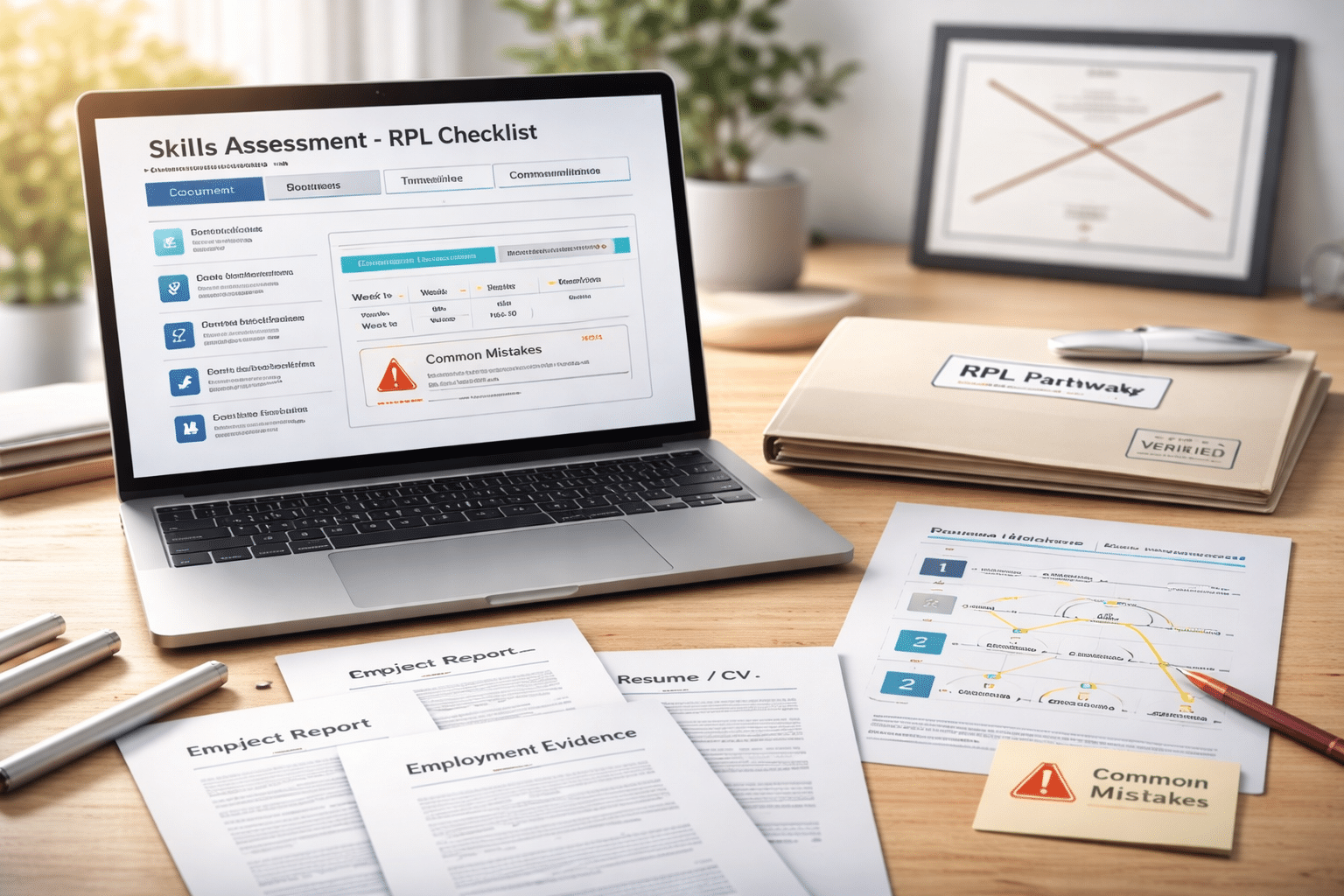
Common Mistakes That Cause Delays Or Unfavourable Outcomes
Mistakes usually happen when applicants rush, copy generic wording, or rely on titles rather than evidence. Here are frequent issues to watch for.
1) Duties That Sound Like A Job Ad
If your reference letter or project reports read like generic “BA responsibilities,” ACS may struggle to see your real, lived experience. It is better to describe what you actually did, in your own professional context, without exaggeration.
2) Date Inconsistencies Across Documents
ACS reviewers often compare your resume, reference letters, payslips, and project timelines. Even small contradictions can create doubt and lead to requests for clarification.
Checklist For Consistency:
- Employment Start/End Dates Match Everywhere
- Position Titles Are Similar (Or Explained)
- Working Hours Are Stated Clearly
- Project Dates Fit Within Employment Dates
3) Weak Evidence Of Paid Employment
RPL does not replace employment evidence. If you cannot show you were genuinely employed and paid, the assessment becomes difficult. Gather payslips, tax records, contracts, and HR letters where possible.
4) Over-Claiming Technical Work You Did Not Do
ICT Business Analysts collaborate with architects, developers, and testers, but that does not mean you should claim to have built code or designed infrastructure if you did not. Over-claiming is risky and often obvious. Focus on your actual BA strengths: analysis, requirements, validation, and delivery support.
5) Confidentiality Breaches Or Excessive Attachments
Do not include client data, personal customer information, or proprietary screenshots. Also avoid uploading large sets of irrelevant attachments. A clean, well-explained submission is usually stronger than a noisy one.
RPL India to Australia ICT Business Analyst: How To Align Your Experience Without Copy-Paste Wording
RPL India to Australia ICT Business Analyst applicants often worry about “matching ANZSCO wording.” It is normal to feel that pressure, but you should avoid copying lists of duties from public sources. Instead, aim for alignment through meaning.
A safer, more genuine approach is to:
- Map Your Work To Themes (Requirements, Process, Stakeholders, Validation, Delivery Support)
- Use Real Examples Of Decisions You Made (Prioritisation, Trade-Offs, Risk Handling)
- Describe Outcomes In Practical Terms (Time Saved, Errors Reduced, Compliance Achieved)
- Keep Language Clear And Professional, Not Inflated
If your background includes consulting, implementation, or product delivery, be explicit about whether you were doing business analysis for software, systems integration, data platforms, or operational process change. The context helps ACS understand the ICT dimension of your work.
Employment References: What “Good” Usually Looks Like
A strong reference letter is factual, specific, and verifiable. It should be written on letterhead and include a clear author (ideally a manager or HR) with contact details.
Most Credible References Include:
- Exact Employment Dates (Day/Month/Year Where Possible)
- Position Title And Whether It Was Full-Time Or Part-Time
- Main Duties (Specific To Your Role And Projects)
- Tools/Methods You Used (Agile Ceremonies, BPMN, SQL Analysis, Jira, Confluence, UAT Support, Etc.)
- Salary Or Payslip Corroboration (If Requested Or Available)
If you cannot obtain a reference letter from an older employer, you may still have options, but it becomes case-by-case and depends on what alternative evidence you can provide. Avoid inventing evidence or asking someone to sign something inaccurate.
How To Talk About Tools And Methods Without Turning It Into A Technical Manual
ACS expects ICT professionals to understand professional practices. For Business Analysts, tools and methods are often part of how you deliver outcomes.
You can reference tools at a high level, such as:
- Requirements Management Tools (Jira, Azure DevOps, Confluence)
- Process Modelling Notations (BPMN, UML Basics)
- Data Analysis (SQL For Queries, Excel, BI Dashboards)
- Testing Support (UAT Planning, Test Scenarios, Defect Triage)
- Agile Practices (Backlog Grooming, Sprint Planning, Retrospectives)
Keep it honest and aligned to your level. You do not need to present yourself as a developer to be assessed as an ICT Business Analyst.
Special Notes For Indian Applicants: Practical Paperwork Challenges
If you are applying from India, you may face some common document hurdles. Planning for them early can save time.
Common Issues:
- Older Employers No Longer Exist Or Will Not Issue Letters
- Letters Are Too Generic Or Written By Someone Who Did Not Manage You
- Payslips Are Missing For Early Roles
- Employment Was Through A Vendor/Client Model And Duties Are Split Across Entities
Helpful Steps (Still High-Level):
- Create A Timeline Of Employment And Projects First
- Identify Which Employers Can Provide Strong References
- Collect Payroll Evidence Early (Especially For Older Jobs)
- Keep Your Resume, LinkedIn, And Submitted Documents Consistent
None of these steps require “tricks.” They simply reduce confusion and make your evidence easier to validate.
RPL India to Australia ICT Business Analyst: What To Expect After Submission
Once you submit, you may receive an outcome, or you may receive a request for clarification. If a clarification request arrives, treat it seriously and respond with consistent evidence.
A professional response typically involves:
- Re-checking All Dates And Statements
- Providing Additional Employment Evidence If Requested
- Clarifying Any Ambiguous Duty Descriptions
- Avoiding Emotional Or Defensive Language
If you are in parallel planning for visas, English tests, or points strategy, keep those tracks organised separately so you do not mix up requirements.
When Professional Support Makes Sense (Without Over-Selling)
RPL can feel deceptively simple until you start writing. Many applicants benefit from support when:
- Their Work History Is Complex (Multiple Employers, Mixed Roles, Consulting)
- Their Documentation Is Incomplete Or Inconsistent
- They Struggle To Explain BA Work In A Structured, Evidence-Based Way
- They Need A Quality Review To Reduce Risk And Delays
The goal is not to “make up” anything. The goal is to present your real experience in a way that meets ACS expectations and stays consistent across all documents.
◆ The Sydney-based Australian Pathways RPL and ACS writing team can best help with tailored RPL reports and supporting documents.
FAQ: ACS RPL For ICT Business Analyst (India To Australia)
1) Is RPL Only For People Without A Degree?
No. RPL is mainly used when your qualifications are non-ICT, not closely related to ICT, or do not meet the standard ICT study requirement. Some applicants also use RPL when they have strong experience but their education does not align with ACS criteria.
2) Does An “ICT Business Analyst” Need To Prove Coding Skills?
Not necessarily. ACS expects role-relevant ICT professional practice. For ICT Business Analysts, that usually means analysis, requirements, process understanding, delivery support, and working effectively with technical teams. Claim only what you genuinely did.
3) Can I Use Projects From Different Employers In My RPL Submission?
Often yes, but your project reports must be consistent with your employment evidence. The projects should sit clearly within the timeline of paid work you can support with documents.
4) What Is The Biggest Misconception About RPL?
That it is a quick formality. RPL is a formal skills assessment pathway. Strong submissions are evidence-based, consistent, and written clearly, without generic copy-paste text.
5) If My Reference Letter Is Generic, Will ACS Refuse Me?
A generic letter increases risk because it is harder to verify your actual duties and level. It does not automatically mean refusal, but it may lead to clarification requests or a weaker outcome. Improving the specificity and supporting evidence usually helps.