
RPL experience requirements ICT Business Analyst can feel confusing at first, especially if your degree is not in ICT or your ICT study is considered “insufficient” by the Australian Computer Society. If you are aiming for an ACS skills assessment as an ICT Business Analyst (ANZSCO 261111), the key is understanding what ACS is trying to verify and how your work history can demonstrate it.
A practical starting point is to learn how RPL for ACS skills assessment works in the ACS context, and what evidence typically supports it, without falling into the trap of copying generic templates or over-claiming duties. This overview is designed to clarify the concepts and help you plan your documents with realistic expectations.
◆ The Sydney-based Australian Pathways RPL and ACS writing team can best help with tailored RPL reports and supporting documents.
What “RPL” Means in the ACS Skills Assessment Context
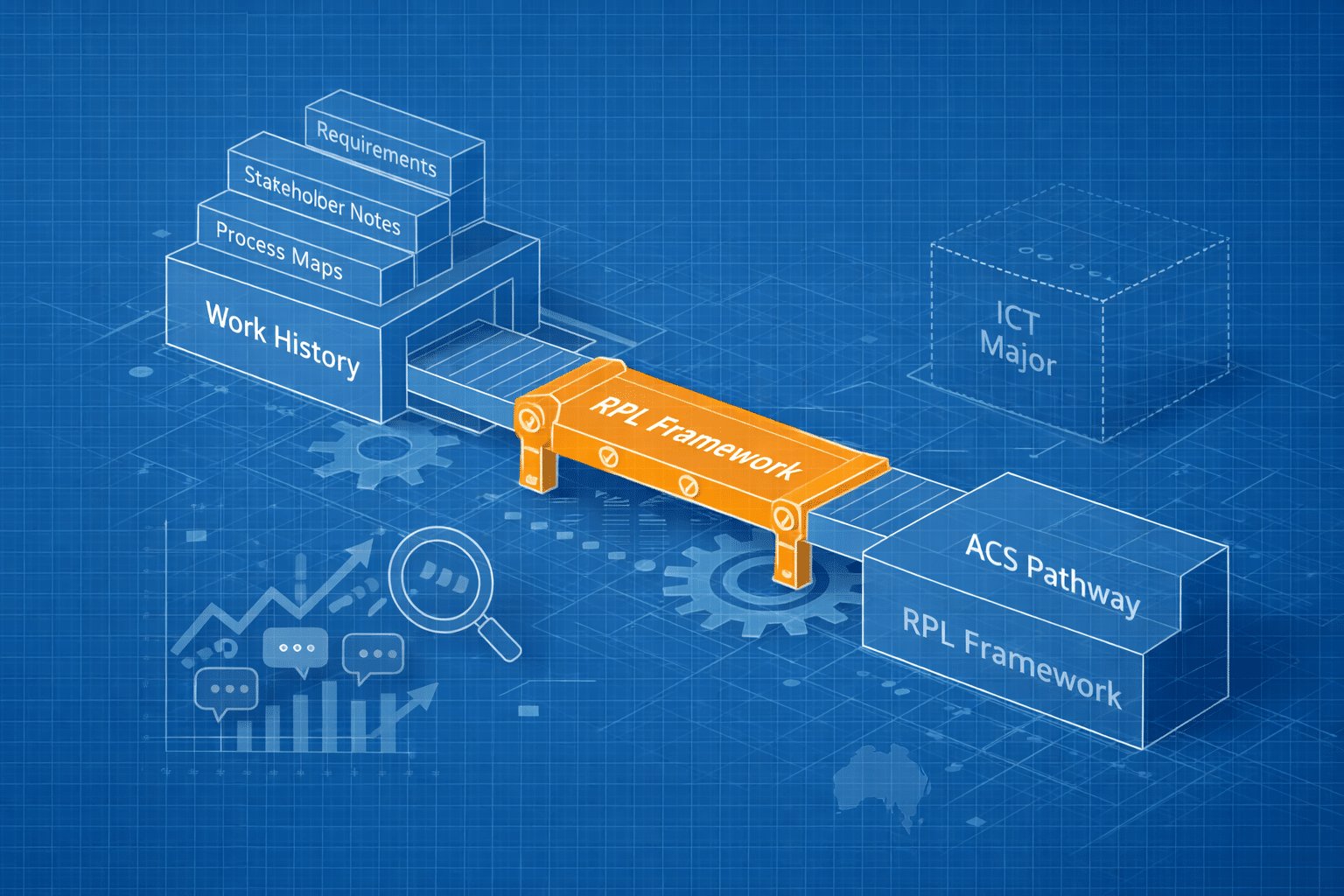
In Australia, “Recognition of Prior Learning” (RPL) for ACS is not a university credit process. It is a structured way to show that your professional ICT knowledge and ICT work experience meet the benchmark expected for an ACS skills assessment, even if your formal qualification does not closely match.
In simple terms, ACS uses RPL to answer two questions:
- Have you built the right ICT knowledge through real work and learning-by-doing?
- Have you applied that knowledge in a professional setting at an appropriate level?
To do that, ACS generally expects:
- Evidence of employment history and role scope
- Written descriptions of work that show genuine ICT problem-solving
- Proof that your experience is relevant to the nominated occupation
- Clarity, consistency, and professionalism across all documents
If you keep those goals in mind, the process becomes easier to understand.
Who Is an ICT Business Analyst (ANZSCO 261111)?
An ICT Business Analyst sits at the intersection of business needs and technology delivery. In general terms, this role focuses on analysing an organisation’s processes, systems, data, and requirements, then translating those needs into clear guidance for technical teams and stakeholders.
Typical responsibilities often include:
- Gathering and validating business and functional requirements
- Running stakeholder workshops and interviews
- Modelling business processes (current state and future state)
- Supporting solution design by clarifying what the system must do
- Working with developers, testers, and product owners during delivery
- Helping with user acceptance testing (UAT) planning and outcomes
- Documenting change impacts and supporting implementation readiness
The most important point for migration purposes is not your job title. It is whether your actual work aligns with what ACS expects for an ICT Business Analyst.
RPL Experience Requirements ICT Business Analyst: What ACS Is Really Checking
When people search RPL experience requirements ICT Business Analyst, they often expect a single universal checklist. In reality, ACS looks at the overall credibility of your claim that you have worked as an ICT Business Analyst at a professional standard.
Although each case is unique, the assessment commonly revolves around these areas:
1) Relevance of Experience to the Nominated Occupation
ACS generally wants to see that your day-to-day work is aligned with business analysis in ICT environments, not general business consulting with little technology involvement.
Strong relevance often includes work connected to:
- Software or platform implementations (ERP/CRM, web apps, mobile apps)
- Systems integration and process automation
- Data-related work tied to system requirements (not just reporting)
- Change initiatives where technology delivery is central
2) Level of Responsibility and Complexity
An ICT Business Analyst is expected to do more than write minutes or collect vague requests. ACS often looks for signs of analytical ownership, such as:
- Leading requirements elicitation and validation
- Managing competing stakeholder expectations
- Defining acceptance criteria or supporting test planning
- Translating business problems into system-focused requirements
- Handling scope, change control, and traceability in a practical way
3) Consistency Across Your Evidence
One common reason applications struggle is inconsistency. For example:
- Your CV describes advanced BA duties, but reference letters sound generic
- Dates and role names do not match across documents
- Project descriptions are too broad, or do not show personal contribution
Consistency is a major part of meeting RPL experience requirements ICT Business Analyst expectations.
4) Professional ICT Knowledge (Not Just Experience)
RPL is not only “I have worked in tech.” It is also “I understand the ICT concepts behind the work.” ACS typically expects that your work reflects knowledge in areas such as:
- Requirements types and documentation approaches
- Systems and process analysis methods
- Basics of software development life cycle (SDLC) delivery
- Stakeholder management in technology projects
- Practical understanding of testing and implementation impacts
You do not need to use fancy jargon to show this. You need clarity and accuracy.
RPL Experience Requirements ICT Business Analyst: How To Evidence Your Work Without Overdoing It
A smart approach to RPL experience requirements ICT Business Analyst is to think in “evidence layers.” You are not proving one statement. You are building a credible picture.
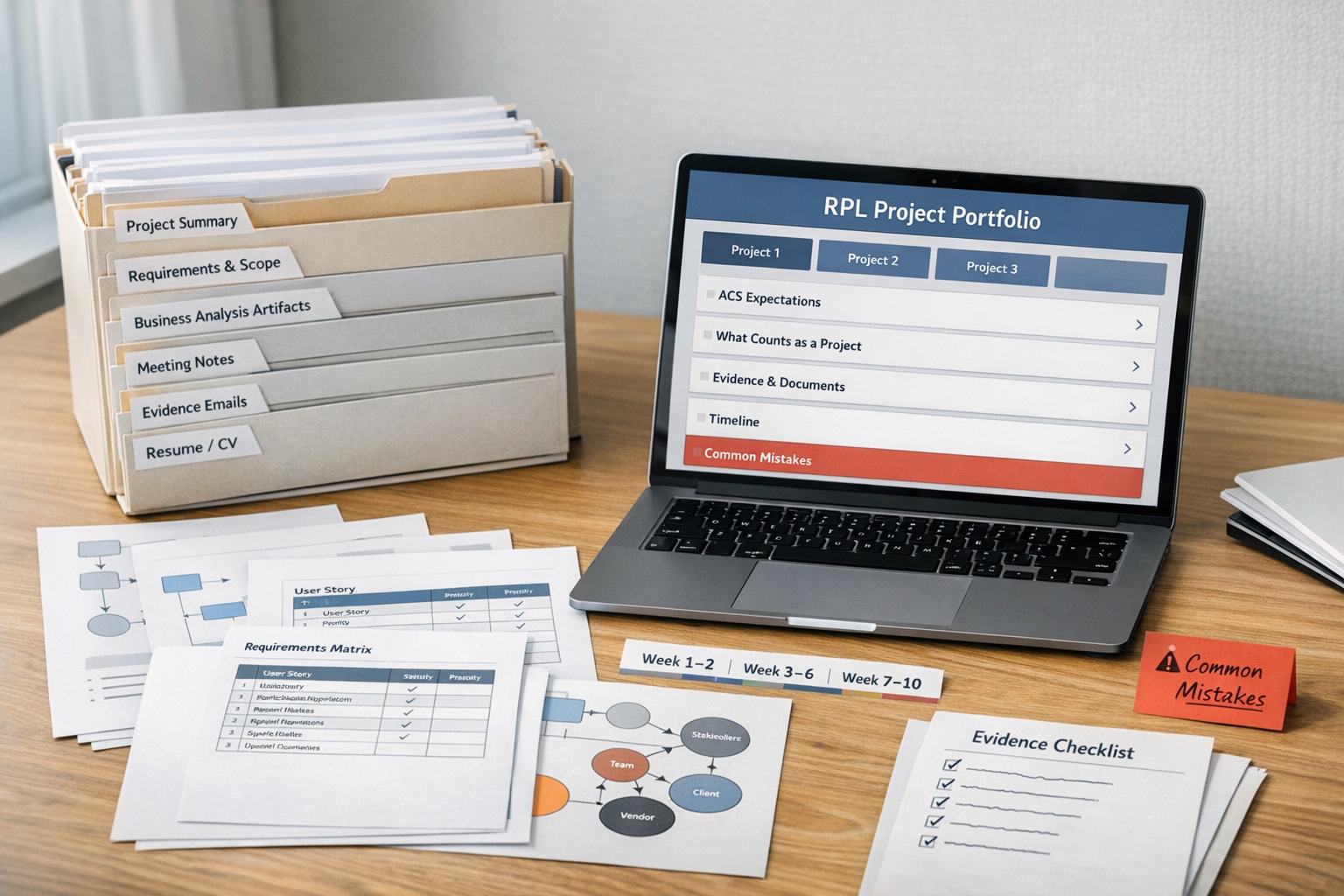
Useful evidence layers commonly include:
- Employment Evidence: Contracts, payslips, tax records, HR letters (where available)
- Role Evidence: Reference letters describing duties, seniority, and employment period
- Project Evidence: High-level project involvement proof (meeting artefacts, diagrams, requirement extracts, tickets)
- Professional Narrative: Your written explanation of what you did, why it mattered, and how you did it
A key caution: avoid flooding the application with random files. More documents do not always mean stronger evidence. Clear, relevant evidence is what matters.
Also, be careful with confidentiality. If you include project artefacts, ensure sensitive details are removed appropriately.
Where ACS Fits in the Bigger Migration Pathway
ACS is the skills assessment authority for most ICT occupations. For official context about ACS as an assessing body, you can start at the Australian Computer Society (ACS) homepage.
A skills assessment is often one of the early steps before you move into visa planning and eligibility checks. For visa pathways and official migration information, the most reliable starting point is the Department of Home Affairs website.
Many applicants also cross-check broader policy and program information via the broader Department portal at Home Affairs, especially when planning longer-term steps beyond the assessment itself.
High-Level Steps: ACS Skills Assessment for Non-ICT Degrees or Insufficient ICT Qualifications
If your qualification is not ICT-related (or is not considered sufficient), RPL may be the pathway to demonstrate your ICT knowledge and experience. While details vary, the process usually follows a sequence like this:
- Confirm The Correct Occupation
Choose ICT Business Analyst (ANZSCO 261111) only if your actual work aligns. - Build A Clean Employment Timeline
Prepare a clear timeline of roles, dates, employers, and location. - Collect Employment References
Secure references that accurately describe your duties and time in the role. - Prepare RPL Content
RPL typically involves explaining your ICT knowledge and describing projects at a professional level. This is where many applicants need careful planning, because the writing must be truthful, consistent, and specific to your experience. - Assemble Supporting Evidence
Choose evidence that supports your claims without breaching confidentiality. - Submit And Respond If Needed
After submission, you may need to clarify points if ACS requests more information.
This is intentionally high-level. The exact strategy depends on your background (industry, role maturity, country, and how your experience matches ANZSCO 261111).
Typical Document Types Applicants Prepare
While each case differs, many ICT Business Analyst applicants gather documents across these categories.
Identity And Personal Documents
- Passport and identity documents (as required)
- Name change evidence (if relevant)
Employment References
- Employer reference letters on letterhead (where possible)
- Signed statements with contact details and role description
- Supporting evidence of employment (where formal letters are difficult)
Employment Proof
- Payslips or salary records
- Tax records or social security records
- Contracts, appointment letters, or HR confirmations
- Bank statements showing salary deposits (if needed)
Project-Related Evidence (Selected And Redacted)
- Requirements artefacts (small excerpts, appropriately redacted)
- Process diagrams (with sensitive identifiers removed)
- User stories or ticketing extracts showing your role
- Meeting artefacts that show BA leadership (without confidential content)
A practical rule: every document should have a purpose. If it does not support a specific claim, it probably does not belong.
Understanding RPL Project Reports for ICT Business Analysts (Without DIY Templates)
Many applicants ask: “How exactly should I write my RPL project reports as an ICT Business Analyst?”
The most important answer is: it depends on your real projects, your responsibilities, and the evidence you can support. For that reason, it is risky to rely on ready-made samples or copy-paste wording. ACS can detect generic writing, and it can also create inconsistencies with your references and CV.
Conceptually, a strong RPL project description for an ICT Business Analyst tends to show:
- What the business problem was (in plain language)
- What systems or technology were involved
- What you personally did (not what “the team” did)
- How you gathered, analysed, and validated requirements
- How you managed stakeholders and handled change
- How your work connected to delivery outcomes (build, test, release)
You do not need to “sound impressive.” You need to sound real, structured, and consistent.
If your work involved multiple tools (Jira, Confluence, Visio, BPMN tools, SQL, API documentation, CRM/ERP platforms), mention them only if they were genuinely part of your role and you can explain your use of them naturally.
Common Mistakes That Weaken ICT Business Analyst RPL Applications
People often fail the “credibility test” not because they lack experience, but because the documents do not clearly demonstrate it. Here are frequent issues to avoid:
- Job Title Confusion: Your title says “Business Analyst,” but the described duties are purely operational or administrative.
- Generic References: Reference letters list vague statements without showing real BA scope.
- Copying ANZSCO Language: If your duties read like a pasted list, it can look unnatural and unsupported.
- Over-Claiming: Claiming architecture, coding, or senior ownership you did not actually do.
- Inconsistent Dates: Different dates across CV, references, and evidence.
- Unclear Project Role: Project descriptions that never clarify your personal contribution.
- Too Much Noise: Uploading many documents that are not directly relevant.
A useful self-check is to ask: “If a stranger reads my documents, can they clearly understand what I did, on what systems, and why it qualifies as ICT Business Analysis?”
Typical Timeframes and Planning Realistically
Timeframes vary widely depending on your situation, but many applicants underestimate the time needed to prepare a strong RPL submission.
Consider planning time for:
- Collecting references from employers (often slower than expected)
- Reconstructing project history and clarifying dates
- Redacting documents responsibly for confidentiality
- Reviewing consistency across CV, references, and RPL writing
If you are also exploring study-to-migration pathways or want official information on Australian education options, a government-backed starting point is Study in Australia.
The best results usually come from early preparation and careful document alignment, not last-minute drafting.
How To Align Your Experience With ICT Business Analyst Expectations (Without Copying Wording)
A safe and effective way to meet RPL experience requirements ICT Business Analyst is to focus on functions rather than phrases.
Ask yourself questions like:
- What problem was the business trying to solve?
- What system change or technology delivery was involved?
- How did I discover the real requirements (not just the initial request)?
- How did I handle conflicting stakeholder needs?
- What artefacts did I produce, and how were they used in delivery?
- How did I support testing, acceptance, and release readiness?
Then, ensure your documents show consistent answers.
Practical Examples of “Functions” (Not Templates)
Instead of copying formal lines, think in these categories:
- Elicitation: workshops, interviews, observation, document analysis
- Analysis: process mapping, gap analysis, impact analysis, prioritisation
- Documentation: functional requirements, user stories, acceptance criteria
- Validation: stakeholder sign-off, traceability, change control awareness
- Delivery Support: UAT coordination support, defect triage collaboration, release notes input
Each applicant will emphasise different functions depending on industry and project type.
Special Situations: Contractors, Freelancers, And Overseas Experience
Many ICT Business Analysts work in non-standard setups. That does not automatically disqualify you, but it can change how you prove your history.
If You Are A Contractor
- References may come from agencies, end-clients, or both
- You may need stronger evidence for dates, payments, and work scope
- Project evidence may be limited, so clarity in writing becomes more important
If You Are A Freelancer
- Client letters and invoices may help establish work periods
- You need to show professional-level BA scope, not informal advice
- Be careful with “multiple small projects” that do not show depth
If Your Experience Is Overseas
- Ensure translations (if required) are handled properly
- Show that your role was professional and ICT-focused
- Avoid assuming that a job title automatically matches Australian expectations
In all these situations, RPL experience requirements ICT Business Analyst still comes back to the same core idea: relevance, level, and credibility.
What To Expect From The Writing Standard
ACS-style writing is usually expected to be:
- Clear and professional
- Specific, but not confidential
- Consistent across documents
- Focused on your role and contribution
Overly dramatic claims, vague descriptions, or extremely technical dumping can all backfire. You want balanced detail that demonstrates real BA work.
When Professional Help Can Be Sensible (Without “Sales” Pressure)
RPL writing can be challenging because it is both technical and formal. The goal is not to “market yourself.” The goal is to present a truthful, well-structured record that aligns with the occupation and is consistent with your evidence.
It often helps to have an expert review for:
- Consistency checks across all documents
- Clarity and structure (especially for complex projects)
- Risk reduction (avoiding over-claiming or generic writing)
- Better alignment between references and your written narrative
◆ The Sydney-based Australian Pathways RPL and ACS writing team can best help with tailored RPL reports and supporting documents.
FAQ: ACS RPL And ICT Business Analyst (ANZSCO 261111)
1) Is RPL only for people with no degree at all?
No. RPL is commonly used when your degree is not ICT-related, or when your ICT qualification is not considered sufficient for the ACS pathway you are using. The focus is whether you can prove ICT knowledge and relevant professional experience.
2) How do I know if my work counts as ICT Business Analyst experience?
Look at what you actually did. If your work involved ICT-focused requirements, process/system analysis tied to technology delivery, stakeholder management in system projects, and support through build/test/release, it may align. If your work was mostly operational admin or general business consulting without systems involvement, it may not.
3) Do I need to match ANZSCO wording exactly in my documents?
No, and it can be risky to try. A better approach is to describe your real duties in your own accurate language, then ensure your responsibilities clearly align with BA functions in ICT environments. Each case is unique, so generic copy-paste text can create inconsistencies.
4) What are the most common RPL mistakes for ICT Business Analysts?
Common issues include generic project descriptions, inconsistent dates, vague reference letters, and overstating responsibilities. Another frequent problem is providing lots of documents that do not directly support the claims being made.
5) Can I submit RPL if I worked across multiple BA-style roles (Product, Systems, Process)?
Often yes, but you must present a clear narrative showing that your experience is still primarily aligned to the nominated occupation. Mixed roles can work if you explain your core BA contribution and support it with consistent evidence.