
Last verified by Nima Parham — 27 October 2026.
Editorial update: 26 October 2026. The Memorial is open during redevelopment, but individual gallery access may change. Use the official visit and exhibition pages for the day you intend to go.
The Australian War Memorial in Canberra is not simply a collection of uniforms, aircraft and photographs. It is a place where individual lives are brought into conversation with national history. To understand it, visitors should allow space for uncertainty and grief as well as facts. Exhibits ask what service meant to people in different wars, how families were affected and why commemoration is an active choice rather than a finished historical account.
A 2026 visit is different from one made a decade earlier. The institution is undertaking a large redevelopment while continuing to welcome visitors. The official Our Continuing Story program says work began in 2020 and is scheduled for completion in 2028. It would be inaccurate to describe the entire new building as either fully complete or unavailable. Some galleries are open; some works continue; today’s route may differ from a guide written before the new entrance opened.
What is the Memorial for?
The Memorial combines a place of remembrance, a museum and a research archive. Those three functions influence each other. Its service charter explicitly describes the combination of shrine, museum and archive and explains that development can alter access to parts of the building. The objects can be historically important without substituting for the person whose story they tell. And the names on the Roll of Honour carry meaning that a military-technology display alone cannot communicate.
It helps to plan two different kinds of time. Spend part of your visit interpreting objects in galleries, then step into the Commemorative Area and allow a quieter pace. A visitor who tries to treat each room as another attraction to “complete” may miss the moral weight of the place.
The Roll of Honour and an individual name
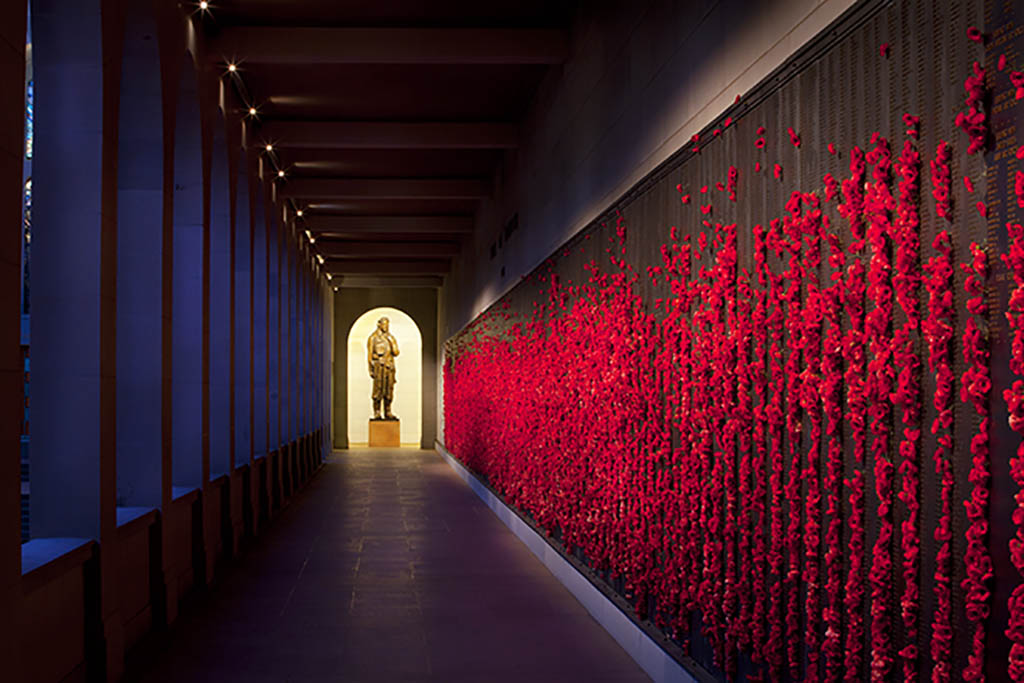
The Roll of Honour records more than 103,000 Australians who lost their lives as a result of war and certain operations. Each name identifies a person, rather than a statistic. Look closely enough to recognise that a wall of names represents interrupted families, work, studies and futures. The purpose is not to memorise every conflict. It is to understand the scale of individual loss.
The Memorial’s Last Post Ceremony tells the story of one person from the Roll each afternoon, accompanied by commemorative ritual. That one-story format is effective precisely because it refuses to reduce the individual to the war in which they served.
The 2026 galleries: what is actually open?
The redevelopment program includes modernised galleries, new circulation spaces and new approaches to peacekeeping and recent deployments. A major milestone came in 2026 when the reopened Aircraft Hall and new gallery spaces began welcoming visitors, as described in the institution’s March 2026 announcement.
The current Australian War Memorial website prominently identifies new Anzac Hall galleries and material dealing with Afghanistan, peacekeeping and the Middle East. A programme of gradual openings is different from one single reopening date. Consult the live exhibitions list shortly before arriving, particularly if you are travelling primarily to see a specific collection object or exhibition.
The new entrance is also more than an architectural novelty. The Memorial says its main entrance foyer opened in February 2025 and provides lifts, visitor services and connections to the new gallery spaces. Visitors who remember a different entrance should not rely on an old walking map. The revised approach can improve access but may also make the building initially unfamiliar.
Art that cannot be reduced to military equipment
The exhibition Treasures from the National Collection, running from August 2026 to an expected point in 2028, uses artworks to explore eyewitness experience and the longer aftermath of conflict. The inclusion of artists such as Sidney Nolan reminds visitors that memory is shaped by image, interpretation and cultural context as well as documentary records.
A painting is not the same kind of evidence as a service record. It can, however, reveal fear, exhaustion and atmosphere in ways a conventional list of dates cannot. A good visit makes room for different types of evidence rather than treating everything as a literal record of what happened.
The daily Last Post Ceremony
The daily ceremony generally begins around 4.30 pm, and the visitor information page advises that the galleries open from 10 am to 5 pm, with progressive gallery closure from 4 pm. This has a practical consequence: if you want to attend the Last Post Ceremony, visit the galleries earlier rather than planning to explore everything afterwards.
The ceremony FAQs describe its structure: anthem, lament, opportunity for wreaths, an individual story, the Ode and the sounding of the Last Post. The ceremony is sombre and may be distressing to some visitors; the Memorial itself includes a content advisory. Children may benefit from an age-appropriate conversation beforehand.
If your visit is tied to a particular family member, check the upcoming ceremony schedule and contact the team before making travel arrangements, because the scheduled names may change. The ceremony is also streamed online, making participation possible for people who cannot travel to Canberra.
Whose history is being told?
An honest visit includes perspectives that were under-represented in earlier national histories. The Memorial maintains an Indigenous service list documenting Aboriginal and Torres Strait Islander and other Indigenous people’s participation across conflicts. It acknowledges that historical records may contain outdated, distressing language and that further evidence can correct the record.
The heritage-building redevelopment plan also identifies pre-1914 galleries, including conflicts associated with colonisation and First Nations resistance, among work scheduled through 2028. The point is not that every difficult story has already been adequately told. It is that the institution’s interpretation continues to change as research, public expectations and voices change.
Visitors should consider the distinction between remembrance and endorsement. Remembering soldiers and civilians affected by war does not require accepting every decision that sent them into conflict. History becomes more useful when it allows humane commemoration and critical inquiry to coexist.
How to plan a visit without rushing
For first-time visitors, a half day is a sensible minimum if you want both galleries and the Commemorative Area. Allow extra time for guided tours and the late-afternoon ceremony. The Memorial lists daily guided tours, typically around ninety minutes, with limited spaces. Ask about a tour at the arrival desk instead of assuming you can join at any moment.
The official plan-your-visit page states that general entry is free and tickets are not required. It explains daily gallery hours, parking and arrival locations. It also warns that redevelopment may temporarily close galleries. This is the authority to check when an old travel blog claims an admission charge, a different entrance or permanent closure.
Families may choose only a small number of galleries and spend more time discussing objects. The Memorial provides school visit guidance that illustrates the need to plan group size and gallery behaviour; school groups have their own booking rules. Independent visitors should still respect the quieter atmosphere of commemorative spaces.
Three questions to carry away
Ask which individual story changed your understanding of a conflict; which object or artwork made you look more closely; and which account you would like to research further. For the last question, the Memorial’s research centre and collections guidance offer a starting point rather than relying on a caption alone.
The Australian War Memorial in Canberra is most valuable when it is approached as a living institution: open to the public in 2026, visibly changing, and responsible for stories too important to be compressed into a tourist checklist. Give those stories time. You may leave with more questions than you brought, which is often a sign of a serious historical encounter.