
Last verified by Nima Parham — 27 October 2026.
Ecological sources checked 26 October 2026. Examples are drawn primarily from Australia’s arid interior and Uluṟu-Kata Tjuṯa; they are not a claim that every “outback” region has identical plants.
The Australian Outback is often described in travel writing as empty, red and almost treeless. That shorthand hides a highly specialised plant world. Flora in the Outback may grow slowly, protect its leaves, store resources underground, wait for intermittent rain or recover after carefully managed fire. A patch of stony scrub, a sand dune, a dry creek and a salt-flat edge can contain very different communities within a short distance.
The essential lesson is that arid does not mean biologically simple. Australia’s national botanic and park authorities describe acacia woodlands, spinifex grasslands, saltbush shrublands and seasonal vegetation as distinctive habitats. The Australian Museum’s arid-habitat introduction explains that plants are present across sandy, rocky, shrub and grassland settings despite low and irregular water availability.
Six habitats, not one desert
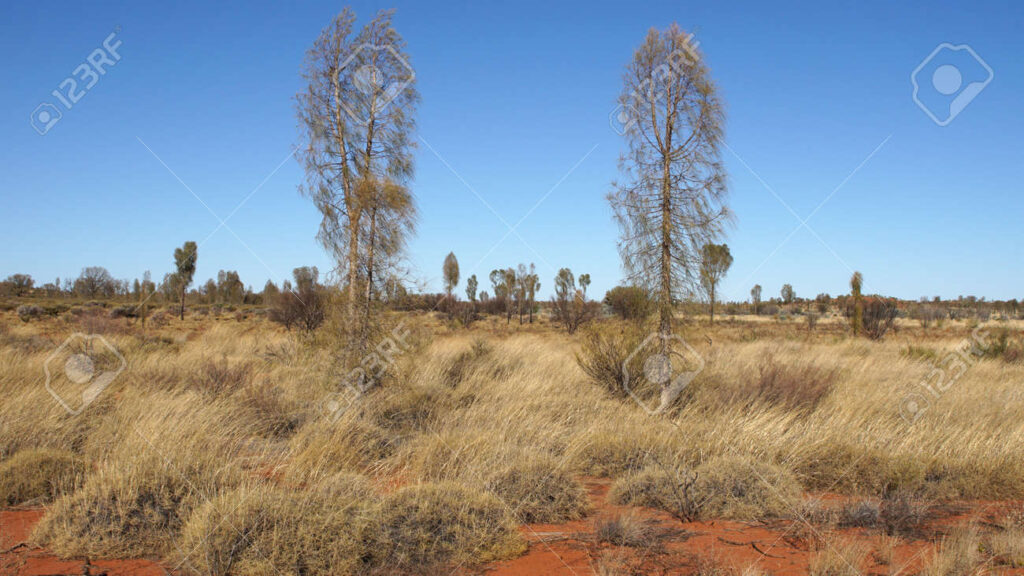
A useful case study is Uluṟu-Kata Tjuṯa National Park. Parks Australia describes the landscape through six habitat types recognised in the Aṉangu ecological framework: puḻi rocky areas, karu creek-lines, puṯi acacia scrubland, pila spinifex plains, tali sand dunes and nyaru areas regenerating after fire. The distinctions are explained by the park’s official landscapes guide.
A dry creek can support trees that are absent from a neighbouring dune because water collects differently beneath the surface. A rock crevice may shelter plants that would struggle in exposed sand. Where soils become saline, tolerant low shrubs have an advantage. Across broad plains, the dominant plants can change following an exceptional rain season or a burn.
That mosaic is why a long list of “the ten plants of the Outback” is less useful than explaining where each plant lives and what problem it has solved.
Spinifex: not an ornamental grass
From a distance, spinifex looks like a collection of prickly tussocks. On the ground, it creates microhabitats. Reptiles, small mammals and invertebrates can shelter around the mounds, while plant litter and soil characteristics create places that differ from open sand. Parks Australia identifies several Triodia species in Uluṟu-Kata Tjuṯa, including soft spinifex (Triodia pungens) and hard spinifex (Triodia basedowei). Its spinifex field guide describes the tussocks’ size and ecological role.
The leaves are narrow and tough, limiting exposure and water loss. The plant can survive dry periods that would overwhelm many garden grasses. Yet not all spinifex communities respond to fire in the same way: plant age, rainfall, burn size and the presence of other species change the outcome.
There is also a cultural dimension. Parks Australia explains that Aṉangu process resin from spinifex into kiti, a traditional adhesive used in tools. Traditional ecological knowledge includes the selective use of fire in old spinifex areas to open the landscape and encourage new growth. It is misleading to reduce these practices to uncontrolled “bush burning”: they are part of place-specific knowledge and management responsibilities.
Mulga: conserving water by changing the shape of light
Mulga is commonly associated with the arid and semi-arid interior. Rather than having broad leaves like a temperate shade tree, many mulga plants use phyllodes—modified structures that perform the function of leaves. Parks Australia explains that mulga phyllodes can stand relatively upright, intercepting morning and evening light while reducing exposure to harsh midday sun. Under dry conditions, dropped plant material can contribute to surface mulch. See the park’s mulga profile.
The species often described as common mulga is Acacia aneura, although actual mulga communities include multiple related taxa. The Australian National Botanic Gardens’ Acacia aneura record identifies its arid distribution across several Australian states and territories.
Mulga also shows why an ecological field guide should avoid turning every plant into a mere survival trick. It creates habitat, supplies material and food resources, and has long-standing cultural meaning. Parks Australia’s description notes the use of seeds and timber in Aṉangu life. Any article presenting such knowledge should name its community sources rather than treating all Indigenous Australian knowledge as interchangeable.
Desert oak: the slow clock of the dune
A young desert oak can be surprisingly narrow, almost like a tall dark-green column. A mature tree may spread into a broad canopy with deeply furrowed bark. Parks Australia identifies the species as Allocasuarina decaisneana and notes that mature specimens in its central Australian park can be extremely old. Its official desert-oak profile explains the different life stages and fire-protective bark.
A visitor who sees an isolated oak on a sandy plain might assume the landscape has few biological connections. In reality, shade, fallen material and the tree’s relationship with soil and other organisms can influence nearby habitat. Long-lived trees are also a reminder that damage from careless vehicle use or branch removal may be impossible to undo quickly.
Saltbush, bluebush and the chemistry of dry soils
Water scarcity is only one challenge. Some inland soils contain enough salt to limit the plants that can survive there. Saltbush and related shrubs are adapted to conditions where many crops and ornamental species struggle. The Australian Museum’s habitat guide identifies saltbush and bluebush communities within Australia’s arid heath environments.
The words “saltbush” and “bluebush” describe groups rather than a single plant species across every region. Identifying an individual bush from colour alone is unreliable. For a precise field identification, use regional flora guides, leaf form, flowering structures, geography and expert botanical references.
Salt-tolerant vegetation is also important to land management. Disturbing soil surfaces, overgrazing or allowing invasive species to spread can change the balance between perennial vegetation and erosion-prone bare ground. A credible ecology article does not claim that every area is degrading; it asks what measurements and local records support a particular assessment.
Rainfall does not simply “turn the desert green”
Rain can trigger a striking flush of grasses and annual wildflowers. The timing and mix depend on soil, temperature, seed banks and how rainfall is spread across days or weeks. Some plants flower after particular rain patterns; others may survive in a dormant or low-growth state until conditions improve. A single wet season can change the visual impression of the Outback without changing its long-term arid character.
The official Uluṟu-Kata Tjuṯa plants overview reports more than 400 plant species in that national park alone. It describes vegetation spanning eucalypt woodlands and spinifex grasslands, illustrating that relatively small protected landscapes can contain far more diversity than popular stereotypes suggest.
Dry creeks are particularly interesting after rain. Parks Australia’s habitat descriptions show how water availability along karu creek-lines supports plants such as river red gums and bloodwoods that do not dominate the driest nearby ground. The lesson is geographical: the same regional rainfall can become very different ecological water supplies depending on landform.
Fire: destruction and renewal, but never a one-line story
Fire can remove vegetation and threaten wildlife, but fire regimes—how often, when, how intensely and across how large an area fires occur—also shape many Australian plant communities. In parts of the central desert, Traditional Owners use carefully informed fire practices to support habitat diversity and protect significant places. Parks Australia’s habitat classification includes nyaru, burnt and regenerating country, as a recognisable ecological state.
Calling every fire beneficial is as inaccurate as describing every burn as ecological catastrophe. Species differ in their ability to resprout, regenerate from seed or survive extreme heat. Climate conditions, introduced grasses and fire size can alter outcomes. A field observer should record fire age, patchiness, vegetation type and evidence of regeneration before drawing conclusions.
Traditional knowledge belongs to particular peoples and places
The word “bush food” can make Indigenous knowledge sound like a universal menu. It is not. Distinct peoples have their own languages, laws, land relationships and protocols around harvesting, sharing and teaching. Parks Australia describes how Aṉangu identify habitats and use plants at Uluṟu-Kata Tjuṯa, but that does not authorise an outsider to collect any native species elsewhere or assume every plant is safe to eat.
The park’s landscape and living-culture explanations show why ecological information is tied to Tjukurpa and responsibilities to care for Country. In public-facing writing, name the knowledge holder where appropriate and avoid extracting precise cultural practices into commercial “tips” without authority.
How to observe Outback flora responsibly
A respectful field visit requires more than carrying a camera. Stay on designated tracks where requested. Do not pick flowers, collect seeds, remove branches or disturb biological soil surfaces. Learn to recognise evidence of drought stress without assuming a plant is dead. Compare the same habitat at different times of day and, if practical, different seasons.
The national park’s visitor guidance asks people not to walk through or damage fragile vegetation. That matters because a deep tyre track, a compacted dune or a broken slow-growing shrub can persist long after the visitor has left. Photograph and record the location rather than taking a specimen unless collection is specifically authorised for scientific work.
A five-question field notebook
- What is the landform? Dune, rocky rise, dry creek, claypan or stony plain?
- Where would water accumulate? Look for run-off channels, shade, soil changes and ephemeral pools.
- What dominates the plant structure? Tree woodland, shrubs, grass hummocks, annual herbs or an open mosaic?
- Is there evidence of fire or rain-driven regeneration? Record what you can observe, not what you assume happened.
- Who manages and knows this Country? Begin with Traditional Owner and park sources when learning the place’s meaning and management history.
An Outback that is neither empty nor identical
Flora in the Australian Outback is a record of water, soil, time and stewardship. Spinifex creates refuge and responds to fire; mulga manages intense sunlight and resource scarcity; desert oak embodies long, slow growth; and saltbush thrives in soils where others cannot. The exact mix is a feature of place, not a universal desert recipe.
For authoritative starting points, use Parks Australia’s plants guide, its six-habitat framework, the Australian Museum’s habitat overview and the Australian National Botanic Gardens. They provide a far more meaningful picture than the image of a lifeless red plain.