
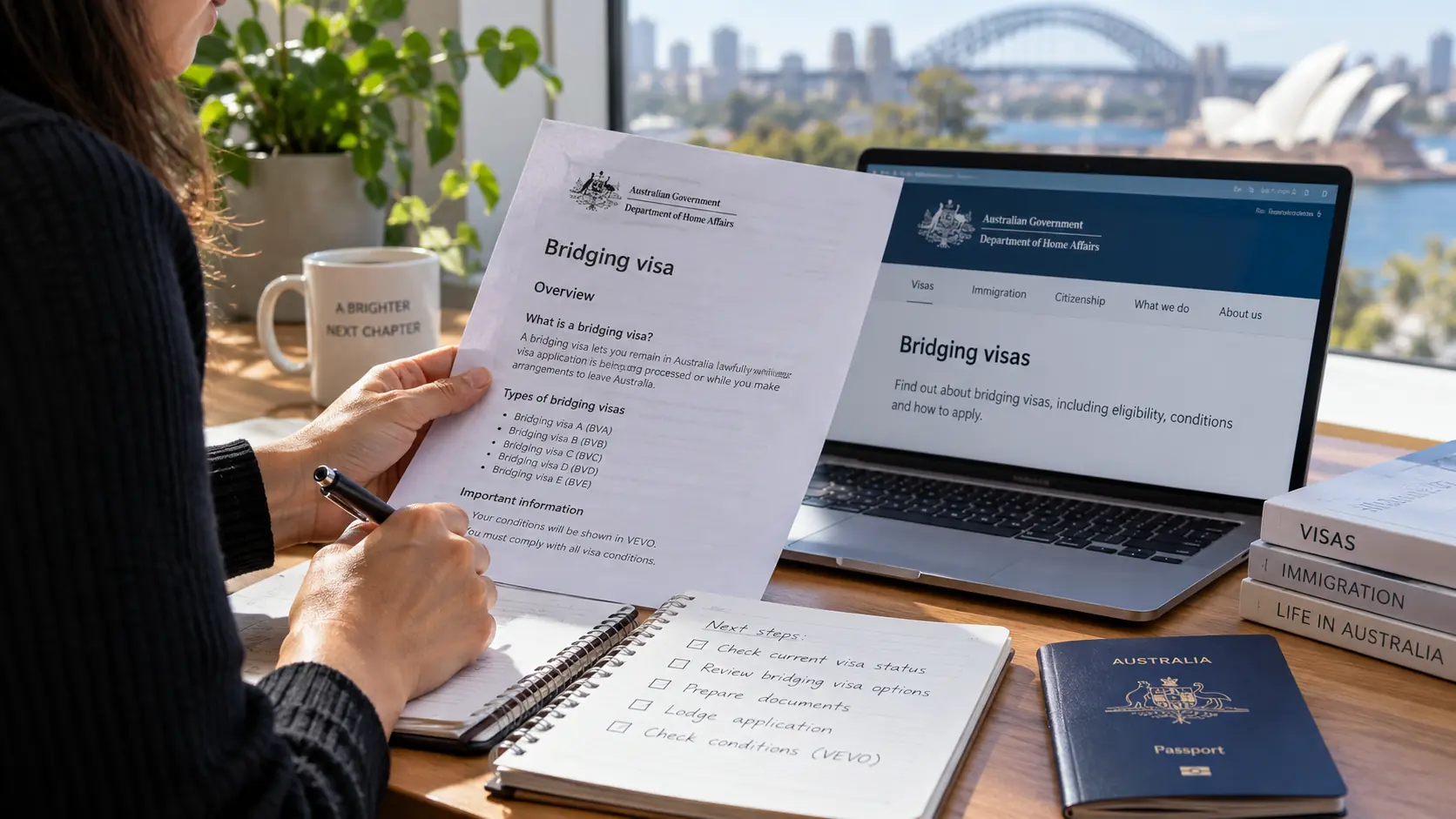

190 visa bridging visa options depend on what immigration status you hold when you lodge the actual subclass 190 application—not when you submit an Expression of Interest (EOI). An EOI or even an invitation does not create a bridging visa. If you make a valid subclass 190 application in Australia while holding a substantive visa, Bridging Visa A (BVA) is the usual bridge once that substantive visa ends. Bridging Visa B (BVB) is the travel option for eligible BVA/BVB holders, while Bridging Visa C (BVC) can become relevant in some non-substantive-visa situations.
Do not plan your lawful stay around the EOI. Home Affairs says an EOI is not a visa application and does not make you eligible for a bridging visa. The bridging stage starts only after a valid onshore visa application has been lodged. For subclass 190, Home Affairs currently says an onshore applicant must hold a substantive visa, BVA, BVB or BVC at lodgement.
EOI
No bridging visa. Keep another lawful status or leave before your current visa expires.
Invitation
You have a limited invitation period to lodge, but the invitation itself still does not create a bridge.
Valid Onshore 190 Application
Your status at lodgement determines whether the application is valid and which bridging framework may apply.
Bridging Status
If a bridging visa has been granted, check when it starts, its conditions and your travel position.
General information only. Bridging-visa outcomes are fact-sensitive, particularly after refusals, cancellations, visa-condition breaches or periods without a substantive visa.
The Rule That Decides Whether a Bridging Visa Exists
Subclass 190 is the Skilled Nominated permanent visa. The process commonly begins with state or territory nomination activity and an EOI in SkillSelect, followed by an invitation to apply. However, those pre-application steps are legally different from lodging the visa itself. The Home Affairs EOI guidance confirms that invited applicants have 60 days to submit the visa application. Its current subclass 190 page also makes the bridging point explicit: if your visa is expiring while you wait for an invitation, you need another visa or must leave Australia; the EOI does not entitle you to a bridging visa.
This distinction is the most important part of 190 visa bridging visa options. A person may have a strong points score, a state nomination strategy and a live EOI but still become unlawful if their current visa expires and they have no other lawful basis to remain. An invitation also does not retrospectively fix that problem. If you are approaching expiry, the lawful-status plan has to be solved independently of the EOI timeline.
Once invited, the onshore validity rule becomes crucial. Home Affairs currently states that a person applying for subclass 190 in Australia must hold a substantive visa, BVA subclass 010, BVB subclass 020 or BVC subclass 030. The page does not list Bridging Visa E. Being physically in Australia is therefore not enough; the visa you hold at the moment of application matters. Applicants should also treat nomination, points and evidence as separate validity and merits risks. Australia Pathways’ guide to subclass 190 common mistakes covers those pre-lodgement issues in more detail.
BVA, BVB and BVC: What Each Option Actually Does
Bridging Visa A
- Typical role
- Maintains lawful status after a substantive visa ends while a valid onshore application remains undecided.
- Travel
- No return travel facility once BVA is the visa in effect.
- 190-linked conditions
- Current Schedule 2 provisions prescribe nil conditions where the BVA is granted on the basis of a Class SN application.
Bridging Visa B
- Typical role
- Allows an eligible BVA/BVB holder to leave and return during a specified travel period while the substantive application is pending.
- Travel
- This is the bridging visa designed for departure and re-entry.
- 190-linked conditions
- Current Schedule 2 also prescribes nil conditions for a BVB based on a Class SN application.
Bridging Visa C
- Typical role
- Can be relevant where a person without a substantive visa has made a valid onshore substantive-visa application.
- Travel
- No return travel facility; do not assume a BVC can simply be converted to a BVB for a trip.
- 190-linked conditions
- Current Schedule 2 prescribes nil conditions for a BVC based on a Class SN application.
The legal basis for these distinctions sits in the current Migration Regulations 1994 compilation. For a standard BVA route, the regulations include the situation where the applicant held a substantive visa when the relevant substantive application was made. For BVB, the ordinary pending-application criterion requires the person to hold a BVA or BVB and to have substantial reasons for wanting to leave and re-enter Australia. BVC criteria cover certain applicants who do not hold a substantive visa and have a valid onshore substantive application awaiting final determination.
Work Rights: Separate Your Current Visa from Your Future Bridge
Applicants often ask whether lodging subclass 190 gives immediate unrestricted work rights. Usually, that is the wrong way to frame the question. If your substantive visa remains in effect after you lodge the 190 application, you continue to be governed by that substantive visa and its conditions until it ceases. A BVA granted in connection with the 190 application may exist in the background but not yet be the visa controlling your stay.
Your substantive visa is still in effect
Its work restrictions, expiry date and other conditions continue to matter. Lodging subclass 190 does not switch them off.
Your 190-linked bridging visa comes into effect
Check the bridging grant notice and the visa actually in effect. Current Schedule 2 provisions specify nil conditions for BVA, BVB and BVC when granted on the basis of Class SN.
This is one area where the current legislation is especially useful. In the bridging-visa provisions of Schedule 2, the Skilled—Nominated (Permanent) class, Class SN, appears in the categories for which the relevant BVA, BVB and BVC condition clauses prescribe “nil” conditions. That is materially different from assuming every bridging visa in every migration context has unrestricted work. The conclusion is tied to the basis on which the bridging visa was granted.
For operational checking, use the grant notice and VEVO. Home Affairs notes that VEVO shows the visa currently in effect and does not display a bridging visa that has been granted but has not yet come into effect. So if your substantive visa is still active, it can be normal for VEVO to show that visa rather than the future bridge.
Travel Is the Highest-Risk Bridging-Visa Decision
The practical rule is simple: do not leave Australia on an in-effect BVA or BVC assuming you can return on it. Home Affairs’ travel-while-processing guidance says only a BVB allows a bridging-visa holder to leave and re-enter Australia while waiting for a substantive visa decision. It also warns that leaving Australia while another bridging visa is in effect can cause that bridging visa to cease.
A BVB is not an unlimited travel document. Under the current regulations, the ordinary BVB pathway for a pending substantive application requires the applicant to hold a BVA or BVB, and decision-makers must be satisfied there are substantial reasons for leaving and re-entering. A BVB is granted with a defined travel period. If you need to travel, apply early enough to obtain the correct status before departure and read the grant notice carefully.
If you are still on a substantive visa with a valid travel facility, the analysis may be different because that substantive visa—not the bridging visa—may still govern your departure and return. The critical dates are the substantive visa expiry, the intended return date and when any bridging visa will come into effect.
Can You Lodge the 190 Onshore from Your Current Status?
The following is a simplified decision guide, not an official eligibility determination. It reflects the status categories listed on Home Affairs’ current subclass 190 page and then explains the likely bridging issue that follows.
| Status at 190 lodgement | Onshore 190 application | Practical bridging consequence |
|---|---|---|
| Substantive visa | Listed by Home Affairs as an accepted onshore status. | If the application is valid, a BVA is the usual bridge for the period after the substantive visa ceases while the 190 remains pending. |
| BVA or BVB | Both are listed as accepted onshore statuses. | Do not assume a fresh BVA with identical timing or conditions. The existing bridge may be tied to another application; check what happens if that earlier matter ends. |
| BVC | Listed as an accepted onshore status. | Travel needs special caution. The ordinary BVB criterion requires a BVA or BVB holder, so a BVC holder should not assume a direct BVB travel solution. |
| BVE or unlawful | Not among the statuses Home Affairs lists for a valid ordinary onshore 190 application. | An invitation does not repair the status problem. Get case-specific advice before attempting lodgement or travel. |
Two Application Bars That Need Separate Checking
No Further Stay Conditions
Holding one of the listed visa types is necessary, but it is not always sufficient. A No Further Stay condition can prevent a person from applying for many temporary and permanent visas while in Australia. Home Affairs identifies conditions including 8503, 8534, 8535 and 8540 in its No Further Stay waiver information. Waiver grounds are limited and a waiver request is not a substitute for maintaining lawful status. Check your visa grant letter and VEVO rather than assuming your visa category tells the whole story.
Section 48 After a Refusal or Cancellation
Section 48 of the Migration Act 1958 restricts certain further onshore applications by people who do not hold a substantive visa after specified refusals or cancellations. However, it is inaccurate to say that section 48 automatically blocks subclass 190. Current regulation 2.12 of the Migration Regulations lists Skilled—Nominated (Permanent), Class SN, among the prescribed visa classes that may be applied for despite the section 48 restriction.
That exception does not cure every other problem. A person still needs a valid invitation, nomination and application, must satisfy the separate subclass 190 onshore-status rule, and must deal with any other applicable bar or condition. For example, being on a BVE remains important because Home Affairs does not list BVE among the statuses from which the ordinary onshore subclass 190 application can be made. This is exactly the kind of situation where a single label—“section 48 affected”—is not enough to determine the result.
Four Fixed Scenarios: Which One Resembles Your Position?
An invited applicant lodges a valid 190 application while the Student visa is still in effect. The Student visa conditions continue until it ceases. A 190-linked BVA may then become the operative visa if the 190 is still undecided.
The applicant lodges the valid 190 before the 485 expires. The 485 remains the controlling visa until expiry; the bridging grant and commencement dates should be checked rather than assuming lodgement itself changes work or travel rights.
Home Affairs permits onshore 190 lodgement from a BVA, but the existing BVA may be linked to an earlier substantive application. The applicant must understand what happens to that bridge when the earlier application or review process ends.
A BVC is an accepted status for onshore 190 lodgement, but it has no return travel facility. Because the ordinary BVB criterion requires a BVA or BVB holder, travel should not be booked on the assumption that a BVB will automatically be available.
These scenarios show why 190 visa bridging visa options are better understood as a sequence of legal statuses than as a menu of three visas. The safe question is not “Which bridge do I want?” but “What visa do I hold at lodgement, what application is my bridge linked to, when does it come into effect, and do I need to leave Australia before the 190 is decided?”
What to Check Before You Lodge or Travel
- Confirm the visa currently in effect. Check VEVO and the grant notice, including conditions and expiry.
- Separate EOI, invitation and visa application dates. Only the valid visa application can trigger the bridging framework.
- Confirm onshore validity at the moment of 190 lodgement. Home Affairs currently lists substantive visa, BVA, BVB and BVC.
- Check what your bridging visa is linked to. This matters especially if you are already on a bridge because of another visa application, review or court process.
- Read the commencement clause in the grant notice. A granted BVA may not yet be the visa in effect while your substantive visa continues.
- Do not infer travel rights from a pending 190. If a bridging visa is in effect and you need to leave and return, verify BVB eligibility before departure.
- Screen for No Further Stay and other application bars. A permitted visa status does not override a separate legal restriction.
- Preserve every grant and lodgement record. VEVO may not show a bridging visa that has been granted but is not yet in effect.
Home Affairs provides a dedicated BVA, BVB and BVC application pathway for eligible applicants, including ImmiAccount routes where the substantive application was lodged there. That page is the better operational reference than relying on old forum instructions or screenshots.
Related Australia Pathways Guides
Sources and Verification
- Department of Home Affairs — Skilled Nominated visa (subclass 190): current onshore application status, EOI/bridging warning and decision-location guidance.
- Department of Home Affairs — SkillSelect Expression of Interest: EOI process and 60-day invitation period.
- Federal Register of Legislation — Migration Regulations 1994, current 1 July 2026 compilation: BVA, BVB, BVC criteria, Class SN bridging conditions and regulation 2.12 framework.
- Federal Register of Legislation — Migration Act 1958: section 48 application restriction framework.
- Department of Home Affairs — Travel while a visa is being processed: BVB travel function and departure risk for other bridging visas.
- Department of Home Affairs — VEVO: checking the current in-effect visa and conditions.
- Department of Home Affairs — Bridging A, B and C application guidance: current online application routes.
- Department of Home Affairs — No Further Stay waiver: relevant visa conditions and waiver process.
Verified 9 September 2026 against current Home Affairs guidance and the Federal Register of Legislation. Immigration law and administrative settings can change, and individual histories can alter bridging outcomes. This article is general information, not personalized migration legal advice.
Your Practical Next Step
Build a one-page status timeline before making any move: current visa and expiry date, EOI date, nomination and invitation dates, intended 190 lodgement date, bridging grant and commencement dates, and any planned overseas travel. Then match each date to the visa actually in effect. This exposes the gaps that are easy to miss when attention is focused only on the permanent visa.
The most defensible way to use 190 visa bridging visa options is therefore sequentially. Protect lawful status while waiting for invitation; lodge subclass 190 only when the onshore application is valid; keep the conditions of your current substantive visa in mind until it ends; confirm the exact bridge and commencement date from the grant notice; and obtain the correct travel authority before leaving Australia. If your history includes a BVC, BVE, refusal, cancellation, No Further Stay condition or another pending application, treat the case as one requiring individual verification rather than applying the standard BVA narrative.