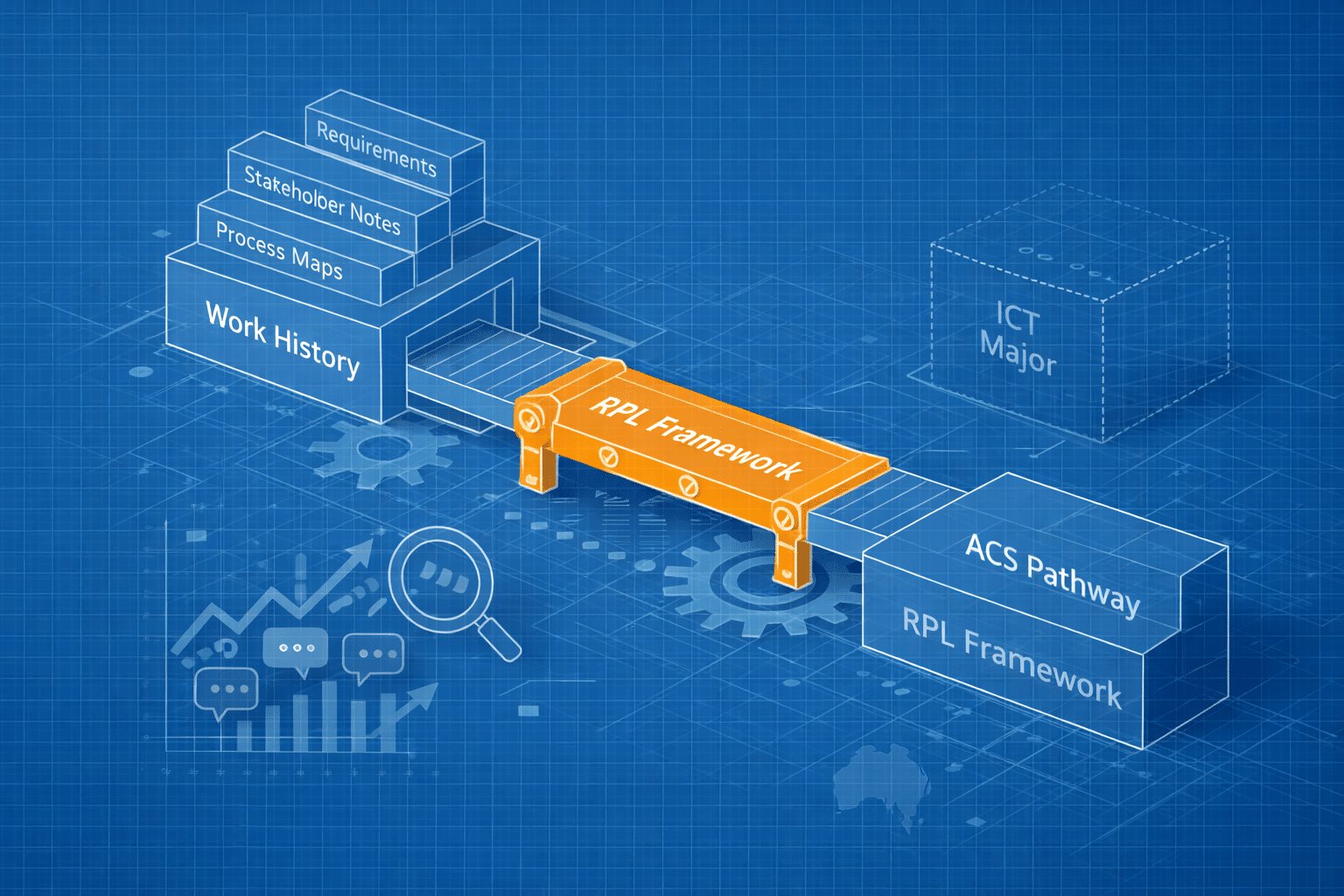


The phrase RPL sample report ICT Business Analyst is one of the most common searches made by ICT professionals who want to migrate to Australia but do not have a formal ICT degree.
Many candidates feel lost between official ACS requirements, ANZSCO descriptions, and all the “sample reports” they see online. This article will not give you a ready-made template to copy, but it will help you understand what these samples mean, what ACS is really looking for, and how to think about your own experience in a structured and compliant way.
1. What Is RPL In The ACS Context?
In the Australian migration system, the Australian Computer Society (ACS) is the assessing authority for most ICT occupations. When your qualification is not ICT-related or contains insufficient ICT content, you may need to apply through the Recognition of Prior Learning (RPL) Assessment Pathway.
On the official ACS website, the RPL pathway is described as a route for applicants with “ample IT, Data Science or Cyber Security experience” who lack the right tertiary ICT qualification.
In simple terms:
The RPL pathway lets you prove your ICT knowledge through your work, not only through university degrees.
You must submit two detailed project reports and a Key Areas of Knowledge section to show that your experience is equivalent to formal ICT study.
ACS then decides whether your skills align with Australian ICT standards for skilled migration.
Because of this, many people search for RPL sample report ICT Business Analyst to understand the expected structure, tone, and level of detail.
2. Who Is An ICT Business Analyst (ANZSCO 261111)?
Before you think about RPL, you must understand the occupation you are applying under.
According to ACS occupation information, an ICT Business Analyst (ANZSCO 261111) “identifies and communicates with users to formulate and produce requirements specifications to create system and software solutions.”
Other typical tasks include:
Working with stakeholders to understand business problems.
Reviewing and evaluating existing systems and processes.
Documenting system requirements and functional specifications.
Coordinating with development and testing teams.
Recommending improvements to increase efficiency and productivity.
It is also important to note that non-ICT business roles, such as general management consultants, are not included in this ANZSCO unit group.
When ACS looks at your RPL, they want to see evidence that your real work experience matches this ICT-focused description, rather than a purely business, financial, or management profile. This is why people look for an RPL sample report ICT Business Analyst: to see what kind of responsibilities and outcomes are aligned with ANZSCO 261111.
3. ACS Skills Assessment Pathways And When RPL Is Needed
The ACS Migration Skills Assessment is designed to check whether your qualifications and experience meet Australian ICT standards for skilled migration visas such as subclass 189 and 190.
Applicants With Recognised ICT Qualifications
Degrees in ICT with enough core ICT content may be assessed under the standard qualification pathways.
ACS focuses on whether your qualification level and employment duration meet the criteria. acs.org.au
Applicants Without Adequate ICT Qualifications
Non-ICT degrees, or degrees with insufficient ICT content, often require the RPL pathway.
You must show a longer period of relevant work experience plus the RPL report.
The Department of Home Affairs then uses your positive ACS assessment as part of the points-tested visa process, which includes age, English, work experience, and other factors.
For ICT professionals who developed their skills on the job, the RPL pathway is often the only route to prove that their experience is equivalent to formal ICT study.
4. What An RPL Sample Report ICT Business Analyst Actually Shows
When you search online for RPL sample report ICT Business Analyst, you will see many websites offering:
“ACS-approved” samples,
Key Areas of Knowledge examples, and
Project report outlines.
Most of these sample RPL reports share a similar structure, because ACS has a standard project report form:
Project title and time frame.
Your role and responsibilities.
Business problem or context.
Solution design and implementation.
Tools, methods, and technologies.
Outcomes, impact, and your personal contribution.
The main purpose of an RPL sample report ICT Business Analyst is to help you:
Understand how detailed your descriptions should be.
See how other applicants connect their tasks to ICT knowledge areas.
Get a high-level feel for the language and structure, without copying.
However, ACS is very strict about plagiarism. Reports that reuse wording from existing samples can be rejected or lead to negative outcomes.
So, treat every RPL sample report ICT Business Analyst as a reference only, not a template.
5. Key Elements Of A Strong ICT Business Analyst RPL Report
Instead of copy-pasting, you should think about the core qualities ACS expects to see in your project reports.
5.1 Alignment With ANZSCO 261111
Your projects should clearly demonstrate tasks and responsibilities consistent with ICT Business Analyst roles, such as:
Gathering and documenting user requirements.
Analysing existing business processes.
Producing functional and non-functional specifications.
Coordinating with technical teams to design or modify systems.
Validating solutions against business needs.
You do not need to copy ANZSCO phrases word-for-word. Instead, use your own experience and vocabulary, but make sure the overall picture matches the role.
5.2 Clear Evidence Of ICT Knowledge
The Key Areas of Knowledge section and the project reports together should show that you possess ICT knowledge equivalent to a formal qualification.
This usually involves:
Understanding system development methodologies.
Working with databases, data structures, or integration tools.
Using analysis techniques such as process modelling or use cases.
Engaging with software lifecycle stages: analysis, design, testing, implementation.
Rather than writing in generic terms, your projects should reflect real tools, environments, and decisions, without transforming the report into a technical manual.
5.3 Emphasis On Personal Contribution
ACS is interested in what you did, not just what the team did.
When you read an RPL sample report ICT Business Analyst, you often see a clear separation between:
The project context (company, system, timeline), and
The applicant’s personal tasks and decisions.
You should avoid vague statements such as “we analysed the system” or “we created the solution” without explaining your role.
6. Typical Structure Of A Conceptual ICT Business Analyst RPL Project
Without giving you a copy-paste template, we can still describe a conceptual structure that many genuine RPL reports follow:
Project Overview
Time period, organisation, and your job title.
High-level description of the system or process involved.
Business Problem Or Opportunity
What was wrong with the existing system?
What business goals or performance issues triggered the project?
Role And Responsibilities
Main duties as an ICT Business Analyst.
Stakeholders you worked with (users, management, developers, testers).
Analysis And Requirements Gathering
How you collected requirements (interviews, workshops, documentation).
How you documented and validated those requirements.
Solution Design And Collaboration
How you translated business requirements into system specifications.
Collaboration with technical teams to design or refine the solution.
Implementation, Testing, And Handover
Involvement in user acceptance testing or system testing.
Training, documentation, and support activities.
Outcomes And Impact
Efficiency or quality improvements.
Business benefits achieved (for example, reduced processing time).
If you compare this conceptual framework with any RPL sample report ICT Business Analyst you find online, you will recognise the same logical flow, even though the wording and details differ.
7. Timeframes, Experience, And Documentation (High-Level Overview)
7.1 Work Experience Requirements
For applicants using the RPL pathway, ACS generally requires more years of relevant work experience than for those with recognised ICT degrees. ACS guidelines explain that applicants with non-ICT qualifications need both a certain number of relevant years and an RPL application.
While the exact calculations can depend on your specific combination of work and study, the principle is:
The less formal ICT content you have,
The more relevant experience you need to demonstrate.
7.2 Supporting Documents
Although requirements can change, a typical ACS RPL application includes:
Identity documents and passport.
Qualification certificates and transcripts (even if non-ICT).
Detailed employment references covering duties, dates, and hours worked.
The RPL application form with Key Areas of Knowledge and two project reports.
7.3 Typical Timeframes
Processing times for ACS skills assessments can vary depending on application volumes and whether ACS requests further information.
For up-to-date indications, it is best to check the ACS site periodically, as timeframes are not fixed in law and may change. acs.org.au
8. Common Mistakes When Using An RPL Sample Report ICT Business Analyst
Many ICT professionals search for RPL sample report ICT Business Analyst hoping that one “perfect” sample will solve everything.
In reality, over-reliance on samples often leads to problems, including:
8.1 Copying Or Over-Adapting Existing Reports
ACS uses tools and processes to detect plagiarism and repeated wording.
Common risky behaviours include:
Copying entire paragraphs from a public sample.
Replacing only company names or project titles while keeping the same structure.
Using identical sentences across multiple applicants.
Even if the content is technically correct, ACS may treat it as plagiarism or misrepresentation.
8.2 Mis-Matching Duties To ANZSCO 261111
Some applicants try to “force” their experience into the ICT Business Analyst occupation when their real role was more like:
General business consultant,
Sales or account manager, or
Purely administrative coordinator.
If your tasks do not genuinely involve system analysis, requirements, and ICT solutions, ACS may not consider you suitable for ANZSCO 261111, regardless of how strong your RPL sample report ICT Business Analyst appears
8.3 Being Too Generic Or Too Technical
Another frequent mistake is going to extremes:
Some reports are so generic that they could describe any office job.
Others are so deeply technical that ACS cannot see the business analysis and stakeholder communication aspects.
A balanced ICT Business Analyst RPL report usually:
Connects business language and technical language.
Shows how you translate business needs into system requirements and solutions.
9. How To Think About Your Own Projects (Without Templates)
Instead of asking “Where can I download a complete RPL sample report ICT Business Analyst?”, it can be more productive to ask:
“Which two projects best demonstrate my ICT Business Analyst skills?”
“In which projects did I have a clear, central role in analysis and system change?”
9.1 Choosing The Right Projects
Useful criteria for project selection include:
Your role involved collecting and documenting requirements.
You were responsible for communicating with both business and technical stakeholders.
The project resulted in a system or process improvement, not just routine maintenance.
You can clearly explain your personal contribution in each stage.
9.2 Mapping Your Experience To ACS Expectations
You can think of ACS expectations as three overlapping circles:
Business Understanding – knowledge of processes, stakeholders, and organisational goals.
Technical Insight – understanding of system architecture, data, and tools.
Analytical Practice – the way you translate business needs into structured specifications.
Your RPL project reports should show where your real-world tasks sit in the intersection of these three areas, rather than only listing tools or job titles.
9.3 Respecting Official Guidance
For authoritative information about ICT occupations and ICT study pathways, you can consult:
The ACS Migration Skills Assessment pages on acs.org.au for assessment rules and forms.
The Department of Home Affairs website (immi.homeaffairs.gov.au) for visa categories and points tests.
The Study Australia website for an overview of Information Technology and computing study options that can complement your skills.
These official resources give the framework within which every RPL sample report ICT Business Analyst must operate, regardless of who writes it.
10. RPL sample report ICT Business Analyst: Conceptual “Sample” Vs Copy-Paste Content
The term RPL sample report ICT Business Analyst can be misleading.
There are two very different ideas hidden inside this phrase:
Conceptual Sample
Explains structure, headings, and types of content.
Shows how to link duties to ICT knowledge areas.
Helps you understand ACS expectations in a general way.
Copy-Paste Sample
Offers full sentences or paragraphs ready to reuse.
Encourages applicants to change only a few details.
Puts you at risk of plagiarism and rejection.
Image alt text: “RPL sample report ICT Business Analyst conceptual structure overview”
By thinking conceptually, you can adapt to future changes in ACS forms or policy updates, rather than depending on a fixed template that may quickly become outdated.
11. Skills, Study, And Long-Term Planning
Finally, it is useful to remember that an ACS RPL assessment is only one step in your migration journey, even if it feels central today.
If your RPL is successful and you obtain a positive ICT Business Analyst assessment, you still need to meet visa criteria such as points, English, health, and character.
Over the long term, combining your work experience with additional study in Information Technology or related fields in Australia can strengthen your career.
The Study Australia site gives an overview of IT courses, specialisations, and future roles, including analysis, data, and software.
From a career perspective, the process of preparing a thoughtful RPL report can also help you:
Clarify your professional profile as an ICT Business Analyst.
Recognise gaps in your skills or knowledge.
Plan future certifications, training, or university courses that align with Australian industry expectations.
FAQ: ACS RPL For ICT Business Analyst
Q1. What is ACS RPL for ICT Business Analyst?
ACS RPL for ICT Business Analyst is a migration skills assessment pathway where experienced professionals without adequate ICT qualifications demonstrate their ICT knowledge through work-based evidence and project reports, rather than through a formal ICT degree.
Q2. Do I always need RPL if I am an ICT Business Analyst?
No. If you have a recognised ICT qualification with sufficient core ICT content, you may be assessed through a standard qualification pathway. You usually only need RPL if your qualifications are non-ICT or have insufficient ICT content, even if your job title is ICT Business Analyst.
Q3. Can I just copy an RPL sample report ICT Business Analyst from the internet?
Copying or heavily reusing wording from any public RPL sample report ICT Business Analyst is risky. ACS may treat this as plagiarism or misrepresentation, and this can negatively affect your assessment. Samples should be used only as high-level references for structure and style, not as templates to duplicate.
Q4. How detailed should my project reports be?
Your project reports should give a clear and specific picture of your role in requirements analysis, system design, and implementation. They should not be generic job descriptions, but they also do not need to be extremely technical. Focus on what you did, how you did it, and what impact your work had, always in the context of ICT Business Analyst responsibilities.
Q5. Where can I find official information about ACS and skilled migration?
For assessment rules and forms, you should refer to the ACS Migration Skills Assessment pages on acs.org.au.
For visa options, points tests, and skilled occupation lists, check the Department of Home Affairs website at immi.homeaffairs.gov.au.
For study pathways and ICT courses in Australia, you can review the Information Technology and Computing section of Study Australia.