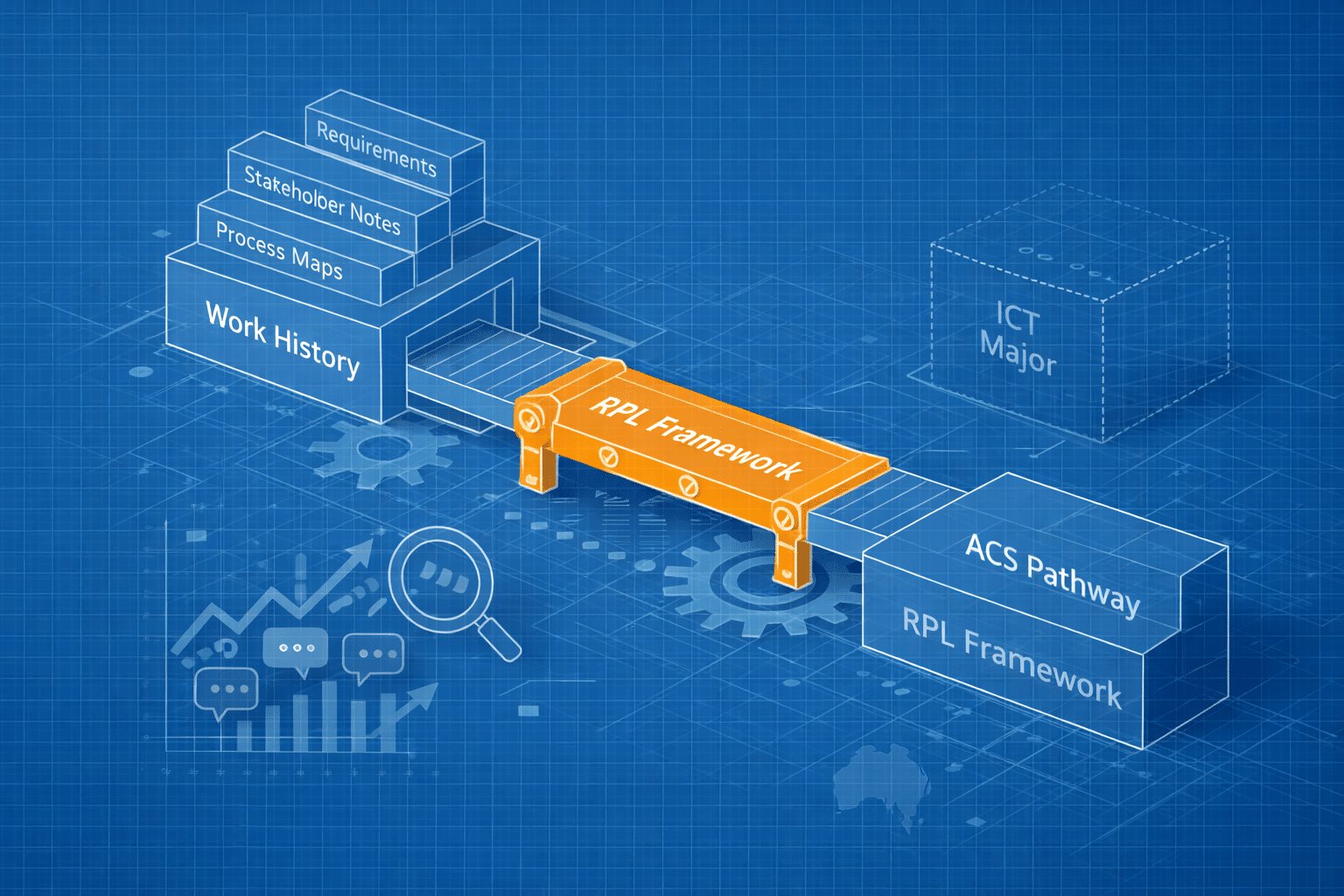


RPL ICT Business Analyst is one of the most popular pathways for experienced IT professionals who want to migrate to Australia but do not have a formal ICT degree.
If you have years of hands-on experience working as a Business Analyst in IT projects, but your qualification is not closely related to ICT, the RPL ICT Business Analyst pathway allows you to prove your skills and knowledge through your work history instead of your academic background.
In this guide, you will learn what the RPL ICT Business Analyst pathway is, who it is for, how the ACS assessment works, and how to prepare a strong RPL report that showcases your professional value in clear, simple English.
What Does An ICT Business Analyst Do In Australia?
Before diving into the RPL ICT Business Analyst process, it helps to understand what this role means in the Australian context.
An ICT Business Analyst (ANZSCO 261111) acts as the bridge between business stakeholders and technical teams. They focus on understanding business needs, analysing processes, and translating them into clear functional and non-functional requirements for developers, testers, and other ICT specialists.
Typical responsibilities include:
Gathering and documenting business requirements from stakeholders
Mapping current and future processes (As-Is and To-Be)
Preparing functional specifications and user stories
Coordinating with developers, QA, and project managers
Supporting UAT (User Acceptance Testing) and change management
Analysing data and producing reports to support decision-making
If this looks like your day-to-day job, but your degree is non-ICT (for example, Business, Commerce, Economics, Arts, or unrelated Engineering), then the RPL ICT Business Analyst option is designed exactly for you.
What Is The RPL ICT Business Analyst Pathway?
The ACS (Australian Computer Society) is the designated authority for assessing ICT occupations for Australian skilled migration. When your qualifications are not considered “ICT-major” or you do not have any formal ICT qualification, ACS may still recognise your skills through an RPL (Recognition of Prior Learning) assessment.
The RPL ICT Business Analyst pathway allows you to:
Demonstrate that your knowledge is equivalent to a formal ICT qualification.
Show that you have performed ICT Business Analyst tasks at the required skill level.
Use your real projects and professional experience as evidence.
Instead of relying on a degree, ACS evaluates your RPL report, your detailed employment history, and your responsibilities to decide whether you meet the requirements for the ICT Business Analyst occupation.
Who Should Apply For The RPL ICT Business Analyst Assessment?
You should consider the RPL ICT Business Analyst pathway if:
You have no formal ICT qualification, but at least 6–8 years of relevant ICT experience, including strong Business Analyst duties.
Your qualification is only partially related to ICT, and ACS requires additional evidence of ICT knowledge.
Your role title may be different (for example, Product Owner, Functional Consultant, Implementation Specialist), but your core tasks match the ICT Business Analyst description.
You are planning to apply for a skilled visa that requires a positive ACS skills assessment, such as Skilled Independent (Subclass 189), Skilled Nominated (190), or Skilled Work Regional (491).
The key is not your job title, but whether your duties align with the ANZSCO description for ICT Business Analyst and whether you can prove this over enough years of employment.
ACS Requirements For RPL ICT Business Analyst
Although specific details can change over time, the general expectations for RPL ICT Business Analyst applicants include:
Relevant Work Experience: A minimum number of years working in ICT roles, with a significant portion spent performing ICT Business Analyst tasks.
Consistent Employment Evidence: Reference letters, contracts, payslips, or other supporting documents that match your claimed positions and durations.
RPL Report: Two detailed project reports that demonstrate your ICT knowledge areas and professional competencies.
English-Language Documentation: All documents must be in English or translated by an accredited translator.
When ACS reviews an RPL ICT Business Analyst application, they look for:
Depth of involvement in the full software or systems lifecycle
Evidence of analytical thinking, problem-solving, and stakeholder management
Use of recognised techniques (for example, requirement elicitation, modelling, process mapping, UML, user stories, data analysis)
Use of ICT tools and platforms in your work
Step-By-Step RPL ICT Business Analyst Application Process
1. Confirm Your ANZSCO Code
First, check that ICT Business Analyst (ANZSCO 261111) is the correct occupation for you. Read the official ANZSCO description and compare it with your role. If most of the tasks match your day-to-day responsibilities, then the RPL ICT Business Analyst route is a good fit.
2. Gather Your Employment Evidence
Collect documents for each relevant position, such as:
Employment reference letters on company letterhead
Position descriptions or contracts
Payslips or tax documents
LinkedIn profile screenshots (as supporting evidence only)
Make sure your reference letters:
Include exact job titles and dates (day/month/year)
Detail your responsibilities in clear, simple English
Highlight ICT Business Analyst tasks (requirements gathering, process analysis, documentation, testing support, communication with stakeholders)
3. Map Your Experience To ICT Knowledge Areas
The ACS RPL form requires you to link your experience to key ICT knowledge areas. For the RPL ICT Business Analyst pathway, relevant areas often include:
Business information systems
Systems analysis and design
Project management and methodologies
Database concepts and data modelling
Software development lifecycle (SDLC)
Quality and testing principles
Before you start writing, make a list of where in your career you applied each of these knowledge areas.
4. Select Two Strong Projects For Your RPL Report
You must submit two project reports. For RPL ICT Business Analyst applicants, choose projects where you played a central analytical role. Good options include:
Implementing a new ERP, CRM, or core banking system
Designing and rolling out a new reporting or BI solution
Overhauling a key business process through digital transformation
Leading requirement analysis for a new web or mobile application
Each project should show:
Clear business context and objectives
Your specific responsibilities
The techniques and tools you used
The outcomes and value delivered
5. Write Your RPL ICT Business Analyst Project Reports
Your project reports are the heart of your application. They need to be detailed but easy to understand. For each project, cover:
Project Overview – Organisation, business area, project goals, timelines.
Your Role – Your position title, reporting lines, team structure.
Problems And Objectives – What business problems were you trying to solve?
Approach And Methodology – How you gathered requirements, analysed processes, defined scope, and handled changes.
Tools And Techniques – Diagrams, workflows, user stories, data analysis, modelling tools, or frameworks you used.
Outcomes – Benefits for the organisation, improvements in efficiency, cost saving, or risk reduction.
Personal Contribution – Make it clear what you did personally, not only what the team achieved.
Using the key phrase naturally is fine, for example:
“In this project, I acted as the lead analyst, which aligns closely with the ICT Business Analyst role required for my RPL ICT Business Analyst assessment.”
How To Make Your RPL ICT Business Analyst Report Stand Out
Use Clear, Simple English
ACS assessors review applications from candidates worldwide. They are not looking for complex academic language. For a strong RPL ICT Business Analyst report:
Use short sentences and simple vocabulary.
Avoid heavy jargon and unexplained acronyms.
Explain business context clearly before going into technical details.
Focus On Analytical Work, Not Just Operations
Many candidates describe their operational tasks (like handling tickets or routine support) but forget to highlight analysis and planning. Make sure your reports emphasise:
Requirement workshops with stakeholders
Root cause analysis and problem-solving
Process redesign and optimisation
Impact assessment and risk analysis
Show The Full Lifecycle
ACS wants to see that you understand the full ICT solution lifecycle. In your RPL ICT Business Analyst projects, highlight how you:
Participated in scoping and feasibility
Developed or refined requirements and specifications
Supported design, development, and testing
Assisted with deployment and training
Measured post-implementation results
Demonstrate Use Of Tools And Techniques
Mention specific tools and techniques you used, such as:
BPMN diagrams, flowcharts, or swimlane diagrams
UML use case diagrams or sequence diagrams
User stories and acceptance criteria in tools like Jira or Azure DevOps
SQL queries and data analysis in Excel, Power BI, or similar tools
This shows your practical ability, not only high-level theory.
Employment References For RPL ICT Business Analyst
Strong employment references are essential. For each position, ask your employer or manager to:
Confirm your job title and exact dates
Describe your main duties as an ICT Business Analyst or similar role
Mention major projects and your contribution
Include contact information for verification
If your official title was something different, like “Business Systems Consultant” or “Product Owner”, you can still use the RPL ICT Business Analyst pathway. Just ensure the reference letter explains your actual tasks clearly and shows strong alignment with the ICT Business Analyst occupation.
Life In Australia As An ICT Business Analyst
Many candidates choosing the RPL ICT Business Analyst route are thinking not just about a skills assessment, but about building a new life in Australia. After a successful ACS assessment and visa, you will need to settle in a new city, find housing, and adapt to a different lifestyle.
If you prefer shared accommodation when you first arrive, Flatmates is a very popular option for finding rooms in shared houses or apartments. It is widely used by international students, young professionals, and skilled migrants.
To understand tenant rights and rental rules, each state has an official tenancy authority. For example, in New South Wales you can check the government’s information through their Fair Trading site at a .gov.au tenancy page. These resources explain bonds, inspections, rent increases, and your responsibilities as a tenant.
Even though these topics are not directly part of the RPL ICT Business Analyst assessment, they are an important part of planning your move and feeling confident about everyday life in Australia.
Image Alt Text Example
When you add an image to your blog or website, use an alt tag that includes the keyphrase in a natural way. For example:
Image alt text: “RPL ICT Business Analyst career pathway from overseas experience to Australian PR”
This supports both accessibility and SEO.
Common Mistakes In RPL ICT Business Analyst Applications
Many applications fail or result in an unfavourable outcome for avoidable reasons. Here are some common mistakes:
Copy-Paste Content: Using templates from other candidates or sample reports found online. ACS can easily detect duplicate content and may refuse your application.
Too Little Detail: Providing only high-level descriptions like “I collected requirements” without explaining how, with whom, and what tools you used.
Inconsistent Dates: Employment dates in your RPL form, reference letters, and CV do not match. This creates doubts about your claims.
Over-Technical Or Over-Generic: Either writing only about tools (databases, servers, programming languages) or only about business tasks, without showing your role as an ICT Business Analyst.
Ignoring ACS Guidelines: Not following the structure or mandatory sections in the ACS RPL form.
By avoiding these mistakes and carefully planning your RPL ICT Business Analyst submission, you greatly improve your chances of success.
Practical Tips To Prepare For Your RPL ICT Business Analyst Submission
Start Early: Collecting reference letters and documents can take weeks. Do not leave it to the last minute.
Create A Career Timeline: Write down all your roles, companies, start and end dates, key projects, and technologies. This helps you see gaps or overlaps.
Match Duties To ANZSCO: For each role, highlight duties that align directly with ICT Business Analyst tasks.
Review Your English: Check for grammar, spelling, and clarity. A clean, well-written RPL ICT Business Analyst report looks more professional.
Keep Copies Of Everything: Save digital copies of all documents and reports you submit. You may need them later for visa or state nomination applications.
FAQ – RPL ICT Business Analyst
1. What Is The RPL ICT Business Analyst Pathway?
The RPL ICT Business Analyst pathway is an assessment process used by the Australian Computer Society (ACS) for candidates who do not have a formal ICT degree but have strong practical experience in ICT Business Analyst roles. It allows you to prove your skills and knowledge through detailed project reports and employment evidence.
2. Do I Need A Degree For RPL ICT Business Analyst?
No, you do not need an ICT degree for the RPL ICT Business Analyst pathway. However, you must have enough relevant work experience to compensate for the lack of formal study. ACS will evaluate how many years of experience are needed based on your background.
3. How Many Years Of Experience Do I Need?
The required number of years can vary depending on whether you have any partially-related qualification. Generally, you need several years of full-time, post-qualification (or overall) ICT experience, including time specifically in ICT Business Analyst tasks. The more solid and continuous your experience, the stronger your RPL ICT Business Analyst application will be.
4. Can My Job Title Be Different From “ICT Business Analyst”?
Yes. Your official job title can be something like Business Systems Consultant, Functional Analyst, Product Owner, or Implementation Specialist. What matters is that your actual duties match the ANZSCO description of ICT Business Analyst and that your reference letters explain this clearly.
5. What Happens If My RPL ICT Business Analyst Application Is Not Successful?
If your application is not successful, ACS will explain the main reasons in their outcome letter. You may be able to submit a review or a new application in the future, once you have corrected the issues or gained more experience. Carefully reading the feedback and improving your documentation is essential before you try again.