

RPL case study ICT Business Analyst stories are often the most helpful way to understand how Recognition of Prior Learning actually works in real life.
In this guide, we follow a realistic scenario of an experienced business analyst who does not have a formal ICT degree, yet still achieves a positive skills assessment through the ACS RPL pathway. Along the way, we will unpack what RPL is, who an ICT Business Analyst (ANZSCO 261111) is, what documents are usually involved, and which common mistakes to avoid.
The aim is to make the process clearer and less intimidating for international professionals thinking about migration to Australia as ICT Business Analysts, without giving copy-paste templates or “perfect” report wording. Every application is unique, and this RPL case study ICT Business Analyst example is only a conceptual roadmap, not a ready-made formula.
1. Quick Reminder: What Is ACS RPL In The Migration Context?
The Australian Computer Society (ACS) is the assessing authority for many ICT occupations, including ICT Business Analyst (ANZSCO 261111). For applicants whose degree is non-ICT, or whose ICT content is not sufficient, ACS offers the Recognition of Prior Learning (RPL) Assessment Pathway. acs.org.au
In simple terms:
RPL allows you to prove your ICT knowledge through work experience instead of a formal ICT degree.
You must submit two detailed RPL project reports plus a structured knowledge section that maps your skills to ACS ICT knowledge areas.
The ACS Migration Skills Assessment itself is a formal process to validate your qualifications and experience for skilled migration purposes.
The official process, eligibility rules, and latest forms are always outlined on the ACS Migration Skills Assessment pages on the Australian Computer Society site, which should be your first reference point for technical requirements.
2. Who Is An ICT Business Analyst (ANZSCO 261111)?
ICT Business Analysts sit between business and technology. According to the ANZSCO classification and ACS occupation descriptions, an ICT Business Analyst typically:
Works with business users to identify and document system requirements.
Develops system plans and documentation.
Reviews and evaluates existing systems and suggests enhancements.
Designs and modifies ICT solutions to meet business needs.
The occupation ICT Business Analyst (ANZSCO 261111) appears on various Australian skilled occupation lists, which means it can be relevant for several skilled visa subclasses, depending on current policy.
To see how this fits into the broader skilled migration framework, applicants usually refer to official information from the Department of Home Affairs, for example on the immi.homeaffairs.gov.au website, where you can explore skilled visas, occupation lists and points test rules.
3. When Do ICT Business Analysts Need The RPL Pathway?
Not every ICT Business Analyst uses RPL. Many applicants have degrees that ACS accepts as equivalent ICT qualifications.
You are more likely to need RPL if:
Your bachelor’s degree is not ICT-related (for example, Business, Economics, Commerce, or Engineering with very few computing units).
Your degree is ICT but from a non-accredited institution, or the ICT content is below ACS minimum thresholds.
You do not hold any tertiary degree, but have many years of hands-on ICT experience.
Recent guides suggest that applicants without formal ICT qualifications may need around 6–8 years of relevant professional experience, plus two strong RPL project reports, to meet ACS expectations.
4. RPL case study ICT Business Analyst: Applicant Background
In this RPL case study ICT Business Analyst scenario, imagine an applicant called Arjun:
Age: 35
Nationality: Indian
Education: Bachelor’s in Business Administration (no major ICT components).
Experience: 9 years working as a Business Analyst in banking and payments software projects.
Goal: Obtain a positive ACS skills assessment as ICT Business Analyst (ANZSCO 261111) to be able to lodge an Expression of Interest for a skilled visa in Australia.
Arjun clearly fits the RPL profile. He has:
Strong business analysis experience.
Responsibility for requirements, process modelling, and system changes.
Limited formal ICT study.
His challenge is to translate real-world BA work into ACS language that demonstrates solid ICT knowledge and hands-on technical involvement, without exaggerating or copying any ready-made RPL templates.
5. Mapping Arjun’s Duties To The ANZSCO Description
Before touching the RPL form, Arjun studies the ANZSCO and ACS descriptions for ICT Business Analyst. These are publicly available on official resources such as:
The ACS occupation and ANZSCO code pages, which describe ICT Business Analyst tasks.
The ABS and other ANZSCO references that detail unit group 2611 ICT Business and Systems Analysts.
From these descriptions, he learns that assessors expect to see evidence of activities like:
Engaging with users to gather and clarify requirements.
Documenting functional and non-functional specifications.
Reviewing current systems and recommending ICT-based improvements.
Working closely with developers, testers, architects, and project managers.
In this RPL case study ICT Business Analyst example, Arjun lists his key responsibilities from different roles and checks how they align conceptually with these core tasks. He does not copy the wording. Instead, he focuses on authentic duties that naturally match the occupation.
6. Choosing Projects For The ACS RPL Reports
ACS requires two RPL project reports, usually:
One project from the last 3 years.
One project within the last 5 years (but not the same as the first).
For our RPL case study ICT Business Analyst scenario, Arjun chooses:
Project 1 (Recent): Implementation of a digital payments platform for a regional bank, where he led requirements workshops, wrote user stories, coordinated with developers, and supported UAT.
Project 2 (Earlier): Replacement of a legacy loan origination system, including business process re-design and high-level solution design with the technical team.
He selects these projects not because they are “perfect”, but because:
They show progression in responsibility.
They involve clear ICT systems, not just pure process consulting.
He can explain his individual contribution in detail.
7. Structuring The RPL Narrative (Conceptually, Not As A Template)
In the ACS RPL report, the focus is always on what you personally did, not on generic company descriptions.
In this RPL case study ICT Business Analyst example, Arjun approaches his project descriptions by:
Writing in first person (“I analysed…”, “I designed…”) to highlight personal responsibility.
Demonstrating end-to-end involvement, from initial requirements to solution implementation and post-go-live optimisation.
Emphasising the use of ICT tools, systems, and methods (e.g., SQL queries, data mapping, APIs understanding, system configuration) rather than just meeting facilitation.
Linking activities back to the ACS knowledge areas in a natural, narrative way rather than as a bullet list of buzzwords.
Notice what he does not do:
He does not copy any phrases from online RPL samples.
He does not present his projects as purely managerial.
He does not exaggerate technical expertise he never had.
The goal is to make the RPL case study ICT Business Analyst narrative credible, consistent, and technically grounded while still honest and personal.
8. Typical Documents For An ICT Business Analyst RPL File
Although the exact document checklist can change, a realistic RPL file for an ICT Business Analyst might include:
Identity documents
Passport bio page.
Name change documents, if any.
Educational documents
Degree certificate (even if non-ICT).
Academic transcript with subjects and grades.
Employment evidence
Reference letters on official letterhead, with dates, duties, hours, and contact details.
Employment contracts, payslips, tax records, or social security records when available.
ACS forms and RPL documents
Completed ACS online application.
RPL Knowledge Area section.
Two RPL project reports.
Supporting career evidence (optional but helpful)
Professional certifications.
Internal training certificates.
System access screenshots or high-level architecture diagrams (without breaching confidentiality).
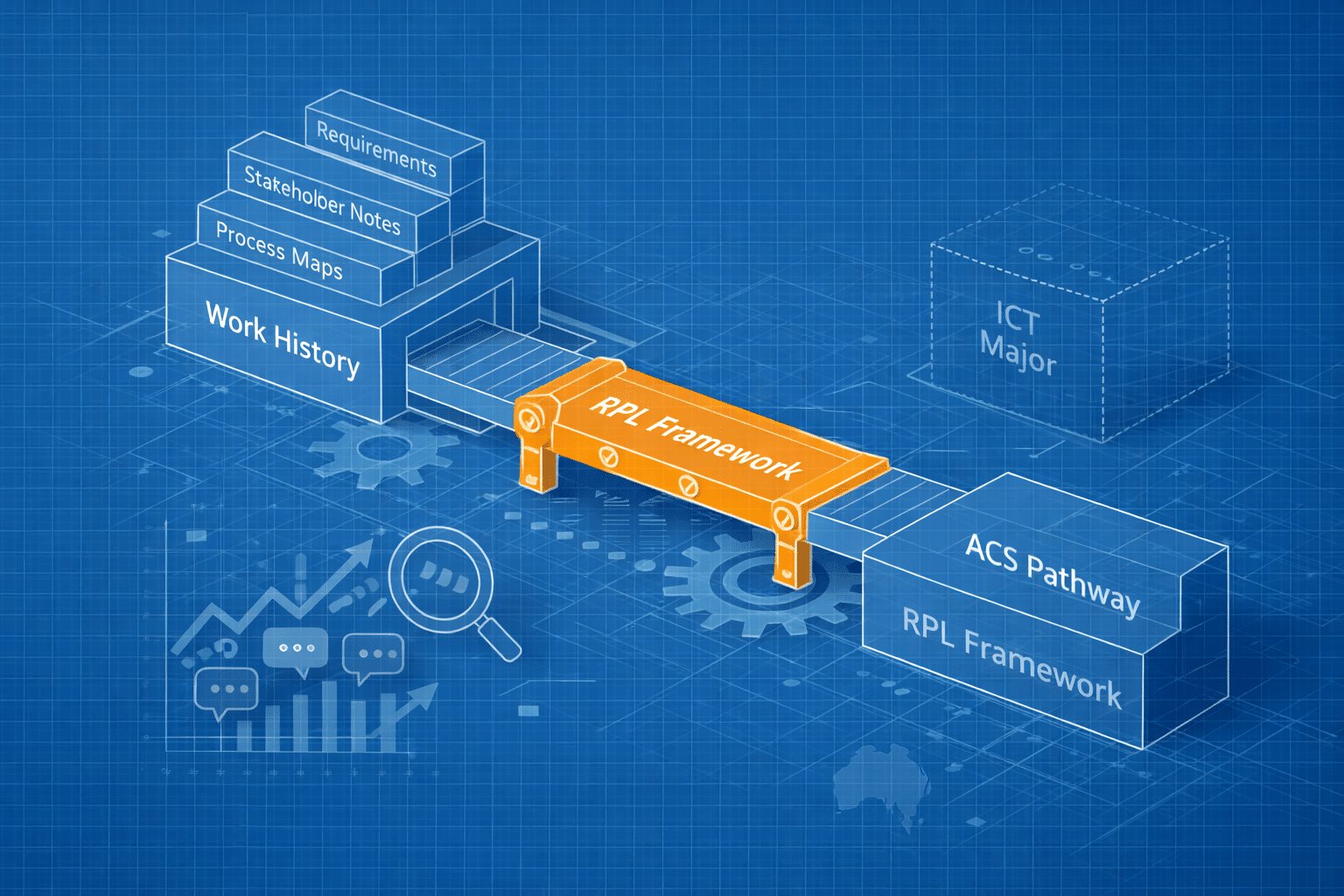
Alt text for a possible explanatory diagram: “RPL case study ICT Business Analyst process overview from experience to ACS decision”.
Always confirm the latest checklist on the ACS site itself, as requirements may change over time.
9. High-Level Timeline: From Preparation To ACS Outcome
Every case is different, but a typical path for an ICT Business Analyst using RPL may look like this:
Research & Planning (2–4 weeks)
Read ACS guidelines carefully.
Confirm ANZSCO 261111 is the correct occupation.
Check visa options and occupation lists on homeaffairs.gov.au
Document Collection (3–6 weeks)
Request employment references.
Gather payslips, contracts, tax records.
Collect degree and transcript copies.
RPL Drafting (4–8 weeks)
Map experience to ACS knowledge areas.
Draft and refine two project reports.
Check alignment with ICT Business Analyst duties.
Submission & ACS Processing (typically several weeks to a few months)
Submit online application and pay ACS fee.
Respond to any ACS requests for more evidence.
Outcome & Next Steps
If assessment is positive, move on to visa steps using the Department of Home Affairs guidance on skilled visas.
This RPL case study ICT Business Analyst timeline is approximate. Actual durations can be shorter or longer depending on document availability and ACS processing times.
10. Common Mistakes Highlighted By The Case Study
From Arjun’s experience, several pitfalls became clear. Avoiding them can significantly reduce the risk of a negative assessment.
10.1 Over-Focusing On Business, Under-Showing ICT
Many business analysts spend most of their time in workshops and stakeholder meetings. In an RPL context, however, ACS wants to see concrete ICT work.
In this RPL case study ICT Business Analyst example:
Arjun realised his first draft sounded like a pure management consultant.
He revised it to show his interaction with systems, databases, and technical teams.
He made sure to highlight where he interpreted data models, supported integration testing, or configured systems.
10.2 Copying Or Over-Relying On Online Samples
ACS strongly values authenticity. While RPL samples found on third-party websites can be educational, copying phrases or structure can be risky and may lead to questions about originality.
Arjun used samples only to understand format and level of detail, but he:
Wrote his own narrative in his own voice.
Changed the order in which he presented information.
Focused on real projects, not generic or hypothetical ones.
10.3 Weak Employment References
Employment references are a common weak point. If they only say “worked as Business Analyst”, the ACS assessor may not see enough ICT evidence.
In this RPL case study ICT Business Analyst journey, Arjun asked his managers to:
Confirm his job title, full-time status, and dates.
Briefly include major ICT duties aligned with his RPL narrative (in their own words).
Provide official company contact details and sign on letterhead.
Again, no one copied ANZSCO text; they just gave accurate descriptions of his actual responsibility.
11. High-Level Advice On Writing RPL Project Reports
“How exactly should I write my RPL project reports?” is one of the most frequent questions. In line with the limits of this article, we will keep the advice conceptual, not give ready-to-copy wording.
Consider the following principles:
Tell a clear story
Start from the business problem.
Explain your analysis approach, system understanding, and solution.
Show how the project ended and what was improved.
Emphasise your personal role
Use “I”, not “we”, when describing actions you personally performed.
Show ownership of key tasks: requirements, solution validation, testing support.
Demonstrate ICT depth
When relevant, mention tools, technologies, and methods you actually used.
Keep the language accessible, but do not hide the technical aspects.
Stay consistent
Ensure job titles, dates, and responsibilities match your references and CV.
Avoid sudden changes in tone or wording that may look copied.
The RPL case study ICT Business Analyst project reports essentially act as evidence-rich stories of your ICT career, not as creative writing exercises or marketing documents.
12. How This Case Study Ends
After several weeks of preparation, careful alignment with ACS requirements, and refinement of his RPL content, Arjun submits his application.
Some key elements that worked in his favour:
His experience clearly matched ICT Business Analyst (ANZSCO 261111) tasks.
His projects showed progression in complexity and responsibility.
The RPL project reports gave assessors a coherent view of his ICT skills, not just business process knowledge.
His supporting documents backed up claims made in the RPL.
In our RPL case study ICT Business Analyst scenario, the ACS eventually issues a positive skills assessment. That result enables Arjun to move on to the visa stage, where he explores skilled migration options via resources such as the Department of Home Affairs skilled visa pages.
13. Where This Case Study Helps — And Where It Does Not
The RPL case study ICT Business Analyst example here is intentionally high-level. It shows:
Why someone with a non-ICT degree might choose the RPL pathway.
What type of experience is typically relevant.
How projects might be chosen and framed conceptually.
Which mistakes are common and how they can be reduced.
However, it does not replace:
Your own analysis of ACS guidelines and updates.
Professional judgment about which ANZSCO code truly fits your profile.
Tailored advice on structuring your particular RPL reports, which depends heavily on your exact employment history, technologies, and responsibilities.
Every ICT Business Analyst has a different combination of business domain, tools, team structure, and role depth. That is why any RPL case study ICT Business Analyst article should be taken as guidance, not a blueprint.
14. FAQ: ACS RPL For ICT Business Analyst
1. What is ACS RPL for ICT Business Analyst?
ACS RPL for ICT Business Analyst is the Recognition of Prior Learning pathway used when your degree is non-ICT or your ICT qualification is not sufficient for standard assessment. It allows you to prove ICT knowledge and experience through two detailed project reports and a structured knowledge section, assessed by the Australian Computer Society for migration purposes.
2. Do I need an ICT degree to apply as ICT Business Analyst (ANZSCO 261111)?
No. If you have a relevant ICT degree, you may follow the standard ACS skills assessment route. If your degree is non-ICT or not closely aligned, you can still be assessed under ANZSCO 261111 by using the RPL pathway, provided you have substantial, relevant ICT work experience in business analysis roles.
3. How many years of experience are usually needed for ACS RPL?
There is no single fixed number for every case, but recent guideline summaries and practitioner experience suggest that applicants without formal ICT qualifications often need around 6–8 years of solid, relevant ICT work experience plus two strong RPL project reports to meet ACS suitability criteria. Always check the latest ACS documentation for current rules.
4. Can I copy an online RPL sample for my ICT Business Analyst report?
Copying online RPL samples is strongly discouraged. Samples from third-party websites are for reference only, and assessors expect original, honest descriptions of your own work. Copying or closely imitating public samples can raise serious concerns about authenticity and may damage your application.
5. Does a positive ACS assessment guarantee my Australian visa?
No. A positive ACS skills assessment is only one requirement within the broader visa process. The Department of Home Affairs decides visa outcomes based on many factors such as points score, age, English level, health and character checks, and state/territory nomination policies.