
RPL assessment for ICT Business Analyst is a key pathway for experienced professionals who want an Australian skills assessment even if their degree is not in ICT. If you have strong business analysis experience but a non-ICT or unrelated qualification, the ACS RPL route, alongside general guidance such as RPL for ACS skills assessment, may be exactly what you need.
Many ICT Business Analysts around the world work in complex digital environments but do not hold a formal computer science degree. This article explains how the ACS views Recognition of Prior Learning, what the ICT Business Analyst ANZSCO 261111 role generally involves, and how the overall RPL process works at a high level.
◆ Our Sydney-based Australian Pathways RPL and ACS writing team can assist with tailored RPL reports and documentation where needed, always in a neutral and case-by-case manner.
What Is RPL in the ACS Context?
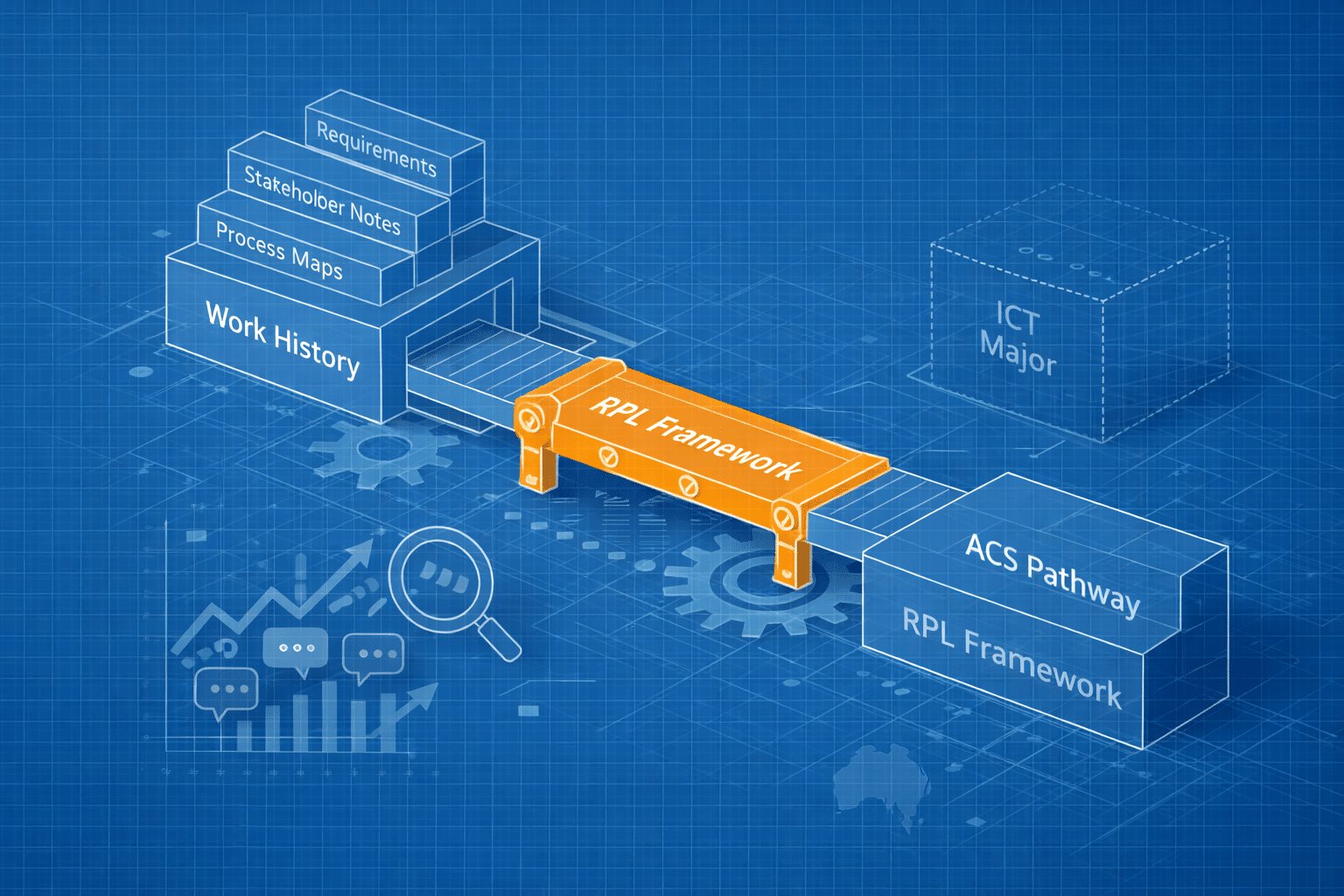
In the Australian Computer Society (ACS) framework, Recognition of Prior Learning (RPL) is a formal way to convert your work experience and self-learning into ICT “equivalence” when your academic qualifications are not strongly ICT-focused.
Instead of rejecting applicants who have grown into ICT Business Analyst roles from other backgrounds, the ACS allows you to:
- Explain your ICT knowledge through structured project reports.
- Demonstrate how your duties align with accepted ICT concepts.
- Show progression and depth in your ICT responsibilities over time.
The ACS, as the official assessing authority for many ICT occupations, uses RPL to check whether your experience reasonably matches Australian outcomes for degree-level ICT learning. You can read more about their general role and criteria on the Australian Computer Society (ACS) website.
Who Is an ICT Business Analyst (ANZSCO 261111)?
An ICT Business Analyst (ANZSCO 261111) acts as the bridge between business stakeholders and technical teams. They focus on understanding business needs and translating them into ICT requirements that developers, architects, and testers can implement.
Typical activities for an ICT Business Analyst include:
- Gathering and documenting business and system requirements.
- Mapping business processes and identifying gaps or inefficiencies.
- Working with stakeholders to define priorities and solution options.
- Preparing functional specifications, user stories, or use cases.
- Supporting testing, change management, and implementation.
An ICT Business Analyst does not always write code, but must understand systems, data flows, and solution architecture at a practical level. For ACS purposes, your RPL material needs to show that your work experience genuinely sits within this ICT-heavy context, not in purely administrative or non-technical business roles.
When Do You Need an RPL assessment for ICT Business Analyst?
You usually consider an RPL assessment for ICT Business Analyst when your formal education does not clearly meet ACS requirements for ICT content. Common scenarios include:
- Non-ICT Degree
You hold a degree in business, management, finance, or another field with minimal ICT subjects, yet you have spent many years working as an ICT Business Analyst. - Partially Related Degree
Your qualification includes some ICT units, but not enough for ACS to treat it as a major or minor in computing. RPL can help you “top up” your profile with evidence from your experience. - No Tertiary Degree
You have built your career through certifications, vendor courses, and on-the-job learning instead of a traditional university path. - Older Qualifications or Mixed Career Path
Your degree may be quite old, or your career may have started in a non-ICT area before shifting into ICT business analysis.
In all these situations, the ACS assesses whether your experience, supported by your RPL project reports, can substitute for formal ICT study. A positive ACS outcome is often required later by the Department of Home Affairs when you lodge a skilled migration visa application.
Overview of ACS Skills Assessment for ICT Business Analysts
Even when you apply via RPL, the overall ACS skills assessment follows a structured flow. While each case is individual, a high-level view looks like this:
- Check Your ANZSCO Match
You verify that ICT Business Analyst (ANZSCO 261111) is the best occupation for your background. This involves comparing your real duties with the general ANZSCO description and ensuring that ICT-related tasks dominate your role. - Gather Employment Evidence
You compile reference letters, contracts, and other proof of employment that show your job title, dates, hours, and key responsibilities. The ACS wants to confirm that your ICT work is both genuine and at the appropriate skill level. - Confirm Your Qualifications
You list your degrees, diplomas, and certificates. For RPL, the focus is on how much ICT content they include and how your learning has continued through experience. - Prepare the RPL Forms and Project Reports
You complete the ACS RPL form, which includes two substantial project reports. These project reports are the heart of an RPL assessment for ICT Business Analyst because they illustrate your ICT knowledge in action. - Submit Application and Monitor Progress
After submission and payment, your application moves through ACS processing queues. Timeframes vary, but many applicants receive outcomes in a few weeks to a few months, depending on volume and any requests for further information. - Use the Outcome for Migration Purposes
If the result is positive, you can then use your ACS letter as evidence of skilled employment and qualifications when following official Home Affairs skilled migration guidance.
Throughout this process, accuracy and consistency matter. Job titles, dates, and duties in your RPL, references, and CV should tell a coherent story.
How to Prepare Your RPL assessment for ICT Business Analyst
Preparing your RPL assessment for ICT Business Analyst should be systematic rather than rushed. Since the ACS is evaluating whether your experience can be treated as the equivalent of an ICT degree, your documentation must show depth, structure, and logical progression.
At a conceptual level, the two RPL project reports should:
- Focus on substantial projects where you had clear ICT Business Analyst responsibilities.
- Demonstrate how you worked with both business and technical stakeholders.
- Reflect your understanding of systems analysis, data, and solution design.
Selecting Suitable Projects
Choosing the right projects is one of the most important decisions. In general terms, strong projects tend to:
- Last long enough to show meaningful involvement (e.g., several months or more).
- Involve systems, applications, or platforms with clear ICT components.
- Show your role in requirements, design input, and implementation support.
Avoid very small, routine tasks or purely administrative assignments. Your projects should clearly highlight your analytical role, your understanding of ICT systems, and your contribution to delivering or improving solutions.
Describing Your Duties at the Right Level
When you describe your duties in the RPL reports, try to balance technical and business language. Conceptually, your descriptions should:
- Explain the business problem or opportunity.
- Show how you elicited and analysed requirements.
- Indicate how you worked with developers, architects, or vendors.
- Mention your involvement in testing, training, or post-implementation review.
However, it is important not to treat these descriptions as templates that anyone can copy. The ACS expects your wording to reflect your actual role, organisation, and context. Exact phrasing and task lists that look generic or copied from online samples may weaken the credibility of your application.
Evidence and Supporting Documentation
Alongside the RPL form, you will usually provide supporting material such as:
- Employment reference letters on company letterhead.
- Contracts, payslips, or tax documents as proof of employment.
- Qualification certificates and transcripts.
- Professional certifications or vendor training documents.
The ACS uses this material to cross-check the information in your RPL project reports, so consistency is essential. Dates, job titles, and organisations should match across all documents.
Documents, Timeframes, and Practical Expectations
While ACS policies may change over time, ICT Business Analysts using the RPL pathway can generally expect to prepare:
- An RPL application form with personal details and qualification history.
- Two detailed ICT-focused project reports.
- Employment references for each relevant role.
- Proof of identity and name changes if applicable.
Timeframes vary, but many applicants spend weeks preparing documentation before submission. Once lodged, assessment can take several weeks or more, especially if ACS requests additional information or clarification.
Planning ahead is important. Since ACS is part of a larger migration process, you need to align your RPL assessment for ICT Business Analyst with other steps, such as English testing, expression of interest, and visa deadlines described on the official Study in Australia website.
From a practical standpoint, you should also:
- Allow time to obtain detailed references from past employers.
- Check that contact details for referees are current.
- Keep scanned copies of all documents in good quality and readable format.
Common Mistakes in RPL assessment for ICT Business Analyst Applications
Many applicants underestimate the complexity of the RPL pathway. While it is designed to recognize experience, it is still a rigorous assessment. Typical pitfalls include:
- Overly Generic Duties
Writing very vague responsibilities such as “analyzed business needs” without explaining the ICT context, systems, or methods makes it difficult for the assessor to see the real scope of your role. - Copying ANZSCO Descriptions Word-for-Word
The ANZSCO description for ICT Business Analyst is a useful reference, but your RPL should not simply repeat it. The ACS expects concrete examples from your own projects, not generic text. - Insufficient ICT Detail
Some applicants emphasize business processes but omit the technical side. For an RPL assessment for ICT Business Analyst, you still need to show understanding of data, integration points, system behaviour, and solution design. - Inconsistent Information Across Documents
Differences in dates, job titles, or responsibilities between your RPL, CV, and references can raise questions. Even small mismatches may lead to requests for clarification or a negative outcome. - Underestimating the Time Required
Preparing strong project reports, collecting references, and aligning everything is time-consuming. Rushing near a visa deadline can increase stress and errors. - Not Explaining Career Progression
If you moved from junior to senior roles, or from non-ICT work into ICT Business Analyst positions, your documentation should show how your responsibilities evolved and your ICT knowledge deepened over time.
Addressing these points conceptually in your RPL material can make your application more coherent, without turning it into a rigid template.
How ACS Views Non-ICT Degrees and Mixed Backgrounds
Many ICT Business Analysts start with degrees in business, economics, or even arts. The ACS does not automatically reject such applicants. Instead, it looks at:
- The proportion of ICT content in your formal studies.
- The length and depth of your ICT work experience.
- The relevance of your project reports to ICT Business Analyst duties.
If your degree is not ICT-heavy, the RPL pathway helps you show that your practical learning has reached a level comparable to a formal ICT qualification. This is why your RPL assessment for ICT Business Analyst should emphasize real projects, real responsibilities, and real outcomes, rather than theoretical descriptions.
Relationship Between ACS Assessment and Skilled Migration
A positive ACS outcome does not guarantee a visa, but it is a core requirement for many skilled migration pathways. The ACS assessment letter acts as evidence that your skills match ICT Business Analyst (ANZSCO 261111) at the required level.
Later, the Australian government will assess your visa application, considering factors such as:
- Age, English language proficiency, and work experience points.
- Whether your occupation appears on the relevant skilled occupation list.
- Health, character, and other general requirements.
The ACS outcome supports your claims about skills and employment, while the Department of Home Affairs and related pages such as the main Home Affairs migration portal provide guidance on how the overall skilled migration program works.
Understanding this relationship helps you plan your timeline. If you know that you will later submit an expression of interest or state nomination application, it is wise to complete your RPL assessment early and keep all documents organized for reuse.
Is RPL Right for Every ICT Business Analyst?
Not every ICT Business Analyst needs the RPL option. If you already hold an ICT-major degree that clearly meets ACS criteria, the standard assessment might be more straightforward.
RPL is particularly useful when:
- Your formal study is unrelated or only loosely connected to ICT.
- You have many years of hands-on ICT Business Analyst experience.
- You can document substantial projects in enough detail.
For some applicants, a combination of partial ICT study and RPL-based recognition provides the best overall picture of their skills. Because every career path is different, the decision to use RPL should be based on your full profile rather than a single factor such as degree title.
◆ Our Sydney-based Australian Pathways RPL and ACS writing team is often approached by ICT professionals who want neutral, case-specific guidance on how to frame their ACS documentation and RPL project reports.
FAQ: ACS RPL and ICT Business Analyst
Q1. What is the ACS RPL pathway for an ICT Business Analyst?
The ACS RPL pathway allows experienced professionals to demonstrate ICT knowledge through project reports when their degree is not strongly ICT-focused or when they lack a formal tertiary qualification. For an ICT Business Analyst, it means showing, in structured form, how your work covers analysis, requirements, and system-related responsibilities that align with ANZSCO 261111.
Q2. Do I always need RPL assessment for ICT Business Analyst if I work in this role?
No. If you already hold an ICT-major degree that clearly meets ACS requirements, you may be assessed through the standard route without RPL. RPL assessment for ICT Business Analyst is mainly for applicants with non-ICT or partially related qualifications, or for those whose ICT learning is largely based on experience rather than formal study.
Q3. How many years of experience do I need for the ACS RPL route?
The ACS publishes guidelines on minimum years of relevant experience for RPL applicants. While the exact requirement can change, you should expect to demonstrate several years of ICT-relevant work at the skill level of an ICT Business Analyst, supported by detailed references and project reports. The focus is on genuine, verifiable experience rather than just job titles.
Q4. What are ACS project reports, and how detailed should they be?
For RPL, you must submit two project reports describing substantial ICT-related work you have done. They should explain, at a conceptual level, the problem, your role, the ICT environment, and the outcomes. The ACS does not expect literary narratives, but clear, structured explanations that demonstrate your ICT understanding. Reports should be detailed enough to show real responsibility but not copied from any online sample or template.
Q5. Can I reuse someone else’s wording or online RPL samples?
No. Reusing wording from online samples or other people’s reports can be risky and may lead to concerns about authenticity. The ACS expects your RPL assessment for ICT Business Analyst to reflect your unique experience, in your own words. You can certainly be inspired by general guidance, but the content must describe your actual projects, context, and responsibilities.