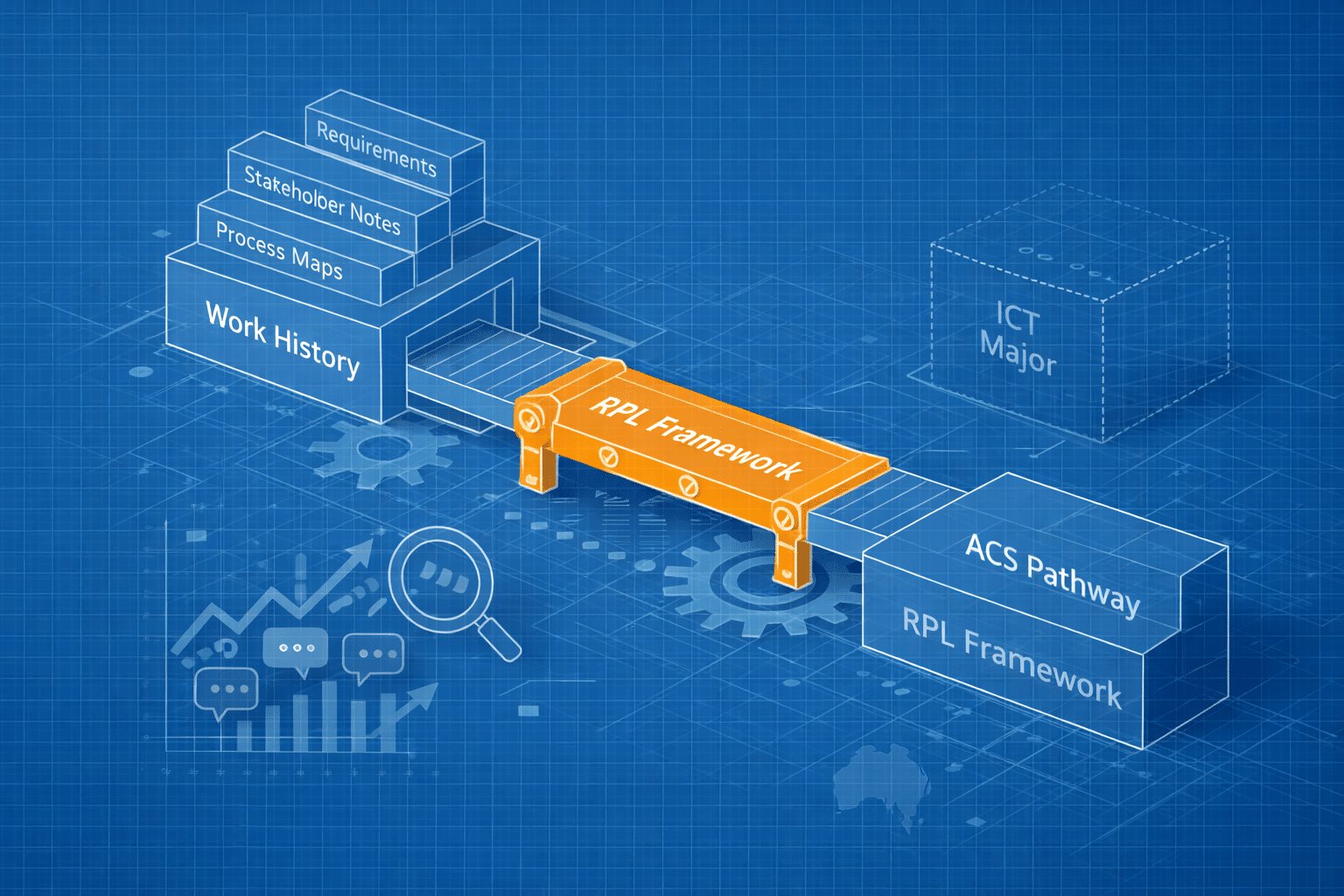

If You Are Exploring PR visa via RPL ICT Business Analyst, You Are Probably Trying To Connect Three Big Topics: The ACS Skills Assessment, The RPL Pathway, And Your Long-Term Skilled Migration Strategy. This Guide Breaks It Down In Plain English, Starting With The Most Confusing Part: What “RPL” Means In The ACS Context. For A Helpful Overview Of The Process, See This Page On RPL for ACS skills assessment.
Many Applicants Feel Stuck Because Their Degree Is Not ICT, Their Major Is Only Partly ICT, Or Their Work History Is Strong But Hard To “Prove” On Paper. That’s Normal. The Goal Is Not To Turn You Into A Lawyer Or A Case Officer. The Goal Is To Understand The Moving Parts So You Can Prepare Realistic Evidence And Avoid The Most Common Missteps That Cause Delays Or Refusals.
◆ The Sydney-based Australian Pathways RPL and ACS writing team can best help with tailored RPL reports and ACS documentation, depending on your background and evidence.
PR Visa Via RPL ICT Business Analyst: How ACS RPL Works In Simple Terms
RPL Stands For Recognition Of Prior Learning, But In The ACS World It Has A Very Specific Meaning. It Is A Pathway For People Who Do Not Have A Suitable ICT Qualification (Or Do Not Have Enough ICT Content In Their Studies) Yet Have Built Strong ICT Knowledge Through Professional Experience.
Think Of ACS RPL Like This:
- The ACS Needs To Assess Your ICT Knowledge Level
- If Your Degree Does Not Clearly Show That Level, Your Work Experience Can Demonstrate It
- But It Must Be Demonstrated In The Way ACS Expects, With Verifiable Evidence
The Skills Assessing Authority Commonly Referenced For ICT Occupations Like ICT Business Analyst Is The Australian Computer Society (ACS). The ACS Focuses On Whether Your Claimed Skills And Work History Match The Occupation You Are Nominating, And Whether Your Background Meets Their Assessment Rules.
What RPL Is Not (Important Misconceptions)
A Lot Of Confusion Comes From What People Assume RPL Can Do. RPL:
- Does Not “Convert” Any Job Title Into An ICT Occupation
- Does Not Replace The Need For Evidence
- Does Not Mean “Any Tech-Adjacent Role Qualifies”
- Does Not Guarantee Any Visa Outcome
RPL Is A Skills Assessment Pathway. It Helps You Reach The Starting Line For A Migration Plan, Not The Finish Line.
Why ACS Cares About Project-Based Evidence
For Roles Like ICT Business Analyst, The ACS Often Expects You To Demonstrate Real ICT-Related Work Outputs, Not Just General Office Duties. That Does Not Mean You Must Share Confidential Client Data Or Copy Internal Company Documents.
It Means You Need To Show, At A High Level, That You Worked On Systems, Processes, Requirements, Stakeholders, And Outcomes That Fit The Nature Of The Occupation.
Who Is An ICT Business Analyst (ANZSCO 261111)?
An ICT Business Analyst (ANZSCO 261111) Is Generally A Professional Who Helps Organisations Improve Or Build Technology-Enabled Solutions By Understanding Business Needs And Translating Them Into Clear Requirements For Technical Teams.
In Plain Terms, An ICT Business Analyst Sits Between “What The Business Needs” And “What The System Must Do.”
Typical Environments Include:
- Banking And Financial Services
- Government Digital Transformation
- Health, Insurance, And Logistics Platforms
- Retail, eCommerce, And Supply Chain Systems
- Enterprise Software Implementations (ERP, CRM, Data Platforms)
Common Responsibilities (General, Non-Copyable)
Because Every Employer Uses Different Titles And Tools, It Helps To Think In Categories Instead Of Fixed Phrases:
- Discovery And Problem Definition: Clarifying The Actual Problem Behind A Request
- Stakeholder Management: Coordinating With Users, Managers, Vendors, And Developers
- Requirements Work: Turning Needs Into Functional Requirements And Acceptance Criteria
- Process And Data Understanding: Mapping Processes, Inputs, Outputs, And Rules
- Solution Support: Helping Teams Validate That A Build Matches The Requirements
- Change And Rollout Support: Supporting Testing, Training, Or Transition Planning
You Do Not Need To Match A Perfect Checklist. The Core Idea Is That Your Work Is About ICT-Focused Analysis, Not Only General Business Administration.
Where People Get Tripped Up
Many Applicants Confuse An ICT Business Analyst With:
- A General Business Analyst (Non-ICT)
- A Project Coordinator
- A Product Sales Specialist
- A Data Entry Or Reporting Role
Some Of These Roles Can Include ICT Elements, But The Evidence Must Show That The ICT Element Is Substantial And Central.
PR Visa Via RPL ICT Business Analyst: Where The Skills Assessment Fits In A PR Pathway
A Skills Assessment Is Often A Key Gate Before You Can Move Forward In Many Skilled Migration Pathways. Visa Eligibility, Points, And Occupation Requirements Are Managed Through Official Government Channels Like The Department of Home Affairs, So It’s Important To Treat The Skills Assessment As One Part Of A Larger Plan.
At A High Level, Skilled Migration Planning Often Involves:
- Choosing The Correct Occupation (Example: ANZSCO 261111)
- Getting A Positive Skills Assessment In That Occupation
- Reviewing Visa Options And Their Requirements
- Checking Points, English, Health, Character, And Other Criteria
- Preparing Supporting Documents Across The Whole Application
Rules Change Over Time, So It’s Wise To Use Official Sources For The Current Settings And Checklists, Including Home Affairs For Broader Skilled Migration Information And Updates.
High-Level ACS Skills Assessment Steps For Non-ICT Degrees Or Insufficient ICT Qualifications
This Section Stays Conceptual On Purpose. The Right Approach Depends On Your Exact Education, Employment Type, Industry, And Evidence Quality.
Still, Most Applicants Go Through A Similar Decision Flow.
Step 1: Confirm Your Occupation Choice Matches Your Real Work
Before You Do Anything Else, Ask:
- Does My Day-To-Day Work Actually Look Like ICT Business Analysis?
- Do I Have Projects Or Systems Work I Can Explain And Evidence?
- Can My Employer Verify My Role And Dates Clearly?
If Your Core Work Is Not Really ICT Business Analysis, It’s Better To Reassess Early Than Force A Mismatch.
Step 2: Map Your Education Against ICT Relevance
Even If Your Degree Is Not “Computer Science,” It Might Still Contain ICT Content. Common Examples:
- Engineering Degrees With Systems Units
- Business Degrees With Information Systems Components
- Science Degrees With Data, Programming, Or Technical Subjects
The Key Is Whether It Is Considered “Suitable” And “Sufficient” Under The ACS Approach. If Not, RPL May Be The More Appropriate Pathway.
Step 3: Prepare Employment Evidence That Can Be Verified
Most Applicants Need A Bundle That Supports:
- Who You Worked For
- When You Worked
- What You Did
- How It Relates To The Nominated Occupation
Evidence Often Works Better When It Is Consistent Across Multiple Sources, Not When It Relies On A Single Letter.
Step 4: Prepare Project-Based Descriptions Carefully (No Copy-Paste Formulas)
This Is Where People Most Want A “Perfect Template.” But Templates Can Create Risk Because:
- Every Workplace Uses Different Systems And Terminology
- Over-Generic Text Can Sound Untrue Or Inflated
- Copyable Wording Can Cause Similarity Problems Across Applicants
Conceptually, The Stronger Approach Is:
- Choose Real Projects You Personally Worked On
- Describe The Problem, Your Role, The Stakeholders, And The Outcome
- Explain Your ICT Analysis Contribution Without Revealing Confidential Data
- Keep Everything Consistent With Your Employment Timeline
Step 5: Submit, Then Respond If More Information Is Requested
Sometimes Applicants Receive Requests For Clarification. The Best Preparation Is:
- Keeping Your Claims Honest And Evidence-Based
- Ensuring Dates, Titles, And Duties Match Across Documents
- Being Ready To Explain Any Employment Gaps Or Role Changes
Typical Document Types Applicants Prepare (General Guidance)
While Requirements Vary By Person, Many Applicants Commonly Prepare The Following Categories.
Identity And Personal Documents
- Passport Bio Page
- Name Change Evidence (If Relevant)
- Updated CV / Resume With Clear Dates
Employment Evidence
- Employer Reference Letters (On Letterhead Where Possible)
- Payslips Or Payroll Summaries
- Tax Documents Or Social Security Evidence (If Applicable In Your Country)
- Employment Contracts Or Appointment Letters
- Organisational Charts Or Position Descriptions (If Available And Safe To Share)
Work Output And Context Evidence (High-Level)
Not Everyone Has The Same Access, But Helpful Examples Can Include:
- Non-Confidential Requirement Summaries Or Process Diagrams You Produced
- Project Timelines Or Delivery Notes Showing Your Participation
- Meeting Minutes With Your Name (If Not Sensitive)
- Testing Or UAT Evidence Showing Your BA Role (If Appropriate)
The Point Is Not To “Flood” The Application. The Point Is To Support Credibility With Evidence That Aligns With Your Claims.
Timeframes: What To Expect And How To Plan Without Stress
Timeframes Can Change Based On Application Volume, Document Quality, And Whether Clarifications Are Needed.
A Practical Planning Approach Is:
- Plan Your Evidence Collection First (Often The Slowest Step)
- Avoid Booking Life-Changing Deadlines Based On Best-Case Scenarios
- Keep A Buffer For Rewrites, Employer Delays, And Document Corrections
If You Are Under Pressure (For Example, Work Contract Deadlines Or Age/Points Considerations), The Most Useful Thing Is Not Speed. It Is Reducing Mistakes That Cause Rework.
Common Mistakes That Weaken An RPL-Based ICT Business Analyst Case
Most Problems Come From Inconsistency, Not From Lack Of Talent.
Here Are Common Issues To Watch For:
- Mismatch Between Title And Duties: A Title Like “Analyst” But Evidence Shows Mostly Admin Work
- Over-Claiming Technical Work: Claiming Developer-Level Tasks Without Proof
- Generic Project Descriptions: Text That Could Apply To Any Industry Or Any Role
- Unclear Timelines: Conflicting Dates Across CV, Letters, And Payslips
- Weak Employer Letters: No Duties, No Hours, No Clear Verification Details
- Confidentiality Panic: Either Sharing Too Much Sensitive Detail Or Sharing Nothing Useful
- Copy-Paste Language: Repeated Phrases That Look Artificial Or Non-Personal
A Strong File Usually Reads Like One True Story Told Consistently From Multiple Angles.
How To Describe ICT Business Analyst Work Without Turning It Into A DIY Template
This Is The Most Important “Conceptual” Section.
If You Ask, “How Exactly Should I Write It?” The Honest Answer Is: It Depends On Your Systems, Industry, Role Scope, And Evidence.
But You Can Use These Safe Principles:
- Be Specific About Context: What System Or Process Was Involved? What Was The Objective?
- Be Clear About Your Role: What You Owned Versus What Others Did
- Show BA Thinking: Requirements, Stakeholders, Process Logic, Acceptance Criteria
- Show Outcomes: What Changed, Improved, Or Was Delivered
- Stay Truthful: Do Not Add Tasks You Did Not Perform
If Your Work Includes Both Business And Tech Elements, Focus On The Bridge You Built Between Them. That Bridge Is Often The Heart Of ICT Business Analysis.
What If You Studied Outside ICT But Worked In Tech For Years?
This Is A Very Common Situation. Many Professionals Move Into ICT Through:
- On-The-Job Learning
- Vendor Certifications
- Internal Promotions Into Digital Teams
- Industry Tools (Jira, Confluence, BPMN Tools, BI Platforms)
- Implementation Projects Across Different Departments
RPL Exists Because The Market Reality Is Real: Skilled ICT Professionals Do Not Always Come Through Traditional Degrees.
Still, RPL Requires Structure. Strong Experience Can Be Undervalued If It Is Not Documented In A Way That Can Be Verified.
When Studying In Australia Might Be Part Of The Long-Term Plan
Some Applicants Consider Australian Study To Strengthen Their Profile Or Transition Into A Clearer ICT Qualification Path. If That’s You, Use A Government-Backed Source Like Study in Australia To Understand Study Options, Visa Settings, And Official Guidance.
Study Is Not A Shortcut. It Is A Strategic Choice That Must Fit Your Budget, Timeline, And Goals.
PR Strategy Considerations For ICT Business Analysts (High-Level Only)
This Is Not Legal Advice, And It Is Not A Substitute For A Personal Eligibility Review. But These General Ideas Help People Think Clearly.
When People Pursue A PR Outcome, They Usually Balance:
- Occupation Demand
- Points Competitiveness
- State Or Regional Pathways
- English Levels
- Partner Skills (If Relevant)
- Timing And Document Readiness
If Your Main Goal Is PR visa via RPL ICT Business Analyst, Treat The Skills Assessment As A Foundation Document. Everything Else Builds On It, Including How You Present Your Work History Across Different Stages.
Keeping Your Case “Audit-Ready” Without Being Overly Complex
One Smart Mindset Is To Prepare As If Someone Will Ask:
- “Can You Prove This Claim?”
- “Do These Dates Match?”
- “Is This Work Truly ICT Business Analysis?”
You Do Not Need To Be Perfect. You Need To Be Consistent And Verifiable.
A Simple Way To Self-Check Is:
- Put All Dates Into One Timeline Document
- Compare CV Versus Employer Letters Versus Payslips
- Ensure Your Project Descriptions Match The Period You Worked There
- Remove Any Statement You Cannot Support If Asked
Why Professional Support Often Helps (Without Turning This Into A Sales Pitch)
RPL And Skills Assessment Work Is Often Hard Not Because It Is Impossible, But Because It Sits At The Intersection Of:
- Evidence Collection
- Technical Role Clarity
- Writing Discipline
- Consistency Across Documents
Applicants Often Know Their Work Very Well, Yet Struggle To Explain It In A Structured Way That Matches An Assessment Framework. This Is Especially True When English Is Not Their First Language Or When Their Employment Evidence Is Fragmented Across Countries.
◆ The Sydney-based Australian Pathways RPL and ACS writing team can best help with tailored RPL reports and ACS documentation, based on your specific background and evidence.
FAQ: ACS RPL And ICT Business Analyst Skills Assessment
1) Can I Use ACS RPL If My Degree Is Not In ICT?
Yes, Many People Explore RPL When Their Degree Is Not Considered A Suitable ICT Qualification. The Key Is Whether Your Work Experience Can credibly Demonstrate ICT Knowledge And ICT-Relevant Duties In The Nominated Occupation.
2) What Does The ACS Look For In An ICT Business Analyst Profile?
In General Terms, ACS Will Expect Evidence That Your Work Focuses On ICT-Oriented Analysis, Requirements, Stakeholder Alignment, And Supporting Technology-Enabled Solutions. The Strongest Applications Usually Show Clear Projects, Clear Roles, And Verifiable Employment Evidence.
3) Does A Positive Skills Assessment Guarantee PR?
No. A Positive Skills Assessment Is Often A Prerequisite Step, But PR Outcomes Depend On Many Factors Like Visa Eligibility, Points, Occupation Settings, And Government Requirements That Can Change Over Time.
4) What Are The Biggest Reasons RPL-Based Applications Get Delayed?
Delays Often Come From Inconsistent Dates, Weak Employer Letters, Overly Generic Project Descriptions, Or Missing Evidence That Confirms The Claimed Work. Good Preparation Usually Reduces Back-And-Forth.
5) Is It Safe To Share Work Documents For Evidence?
You Should Avoid Sharing Confidential Or Proprietary Information. In Many Cases, Applicants Use High-Level Descriptions And Non-Sensitive Supporting Evidence. If You Are Unsure, Get Guidance On How To Present Your Work Without Breaching Workplace Confidentiality.