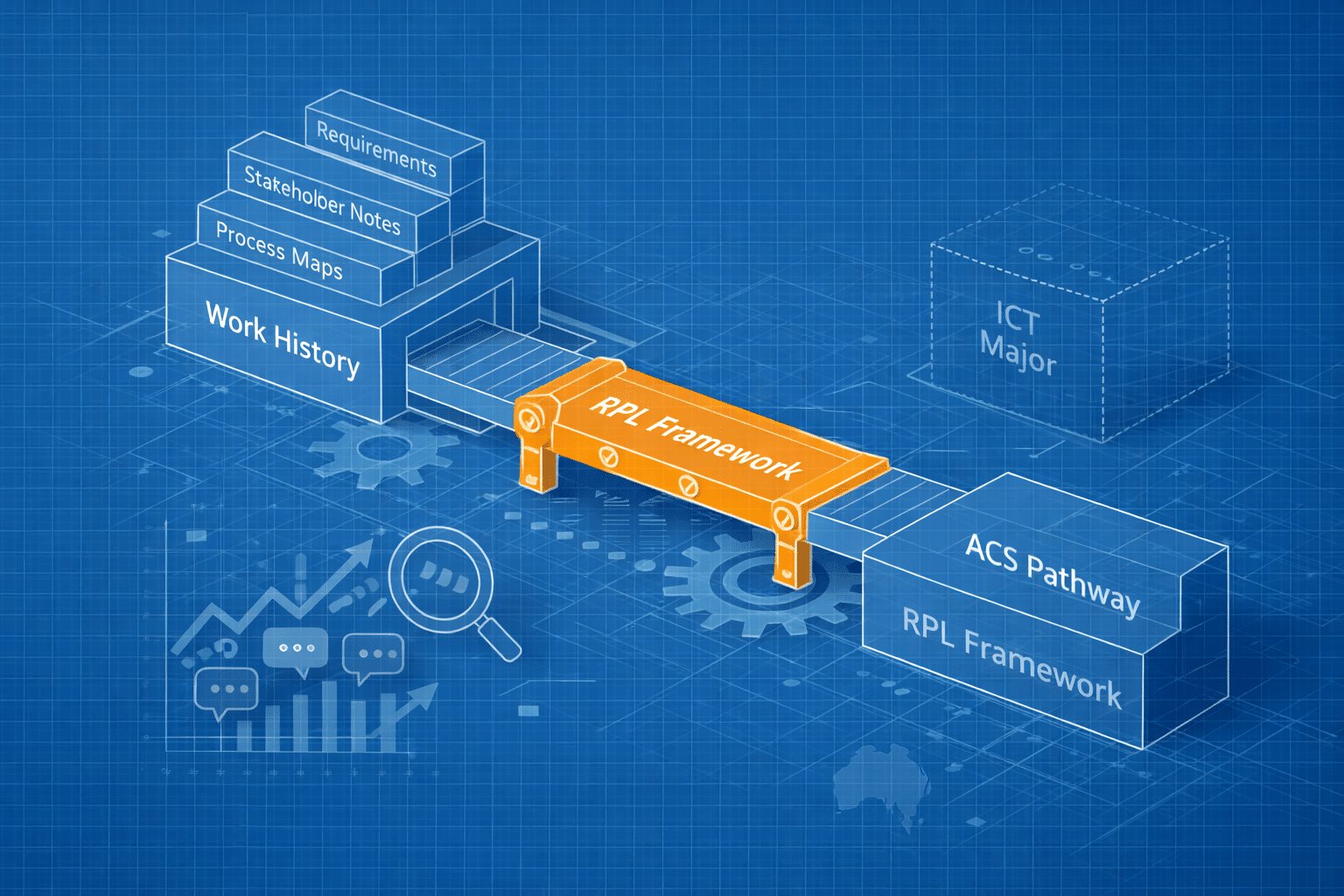


Migration pathway RPL ICT Business Analyst is one of the most searched phrases by skilled professionals who have strong ICT experience but lack a matching ICT qualification. If you are trying to align work history with Australia’s skilled migration system, understanding how ACS RPL works is often the first big step, especially for roles like ICT Business Analyst (ANZSCO 261111). For a deeper overview of the assessment route, see our guide on RPL for ACS skills assessment in context.
Many applicants feel confident about their job history, then get stuck when they realise the skills assessment is not simply a CV check. The Australian Computer Society (ACS) is looking for structured evidence that your knowledge is at the required professional level, and that your experience is relevant to the nominated occupation.
◆ The Sydney-based Australian Pathways RPL and ACS writing team can best help with tailored RPL reports and ACS documentation, depending on your individual background.
Why This Pathway Matters For Skilled Migration Planning
When people talk about “migration pathways,” they often jump straight to visa subclasses. In reality, for many ICT applicants, the skills assessment is the gate that must open first.
A positive ACS outcome can support different visa strategies, including points-tested skilled options, state nomination options, or employer-led pathways. The right approach depends on your profile, location flexibility, and timeline.
For official visa eligibility and requirements, the most reliable place to confirm current rules is the Department of Home Affairs.
Migration pathway RPL ICT Business Analyst And What RPL Means In The ACS Context
In ACS language, Recognition of Prior Learning (RPL) is a pathway for applicants who do not hold an eligible ICT qualification (or who have insufficient ICT content in their studies), but who have gained comparable knowledge through professional work.
It is not a shortcut. It is a structured way to demonstrate that your learning happened through real projects, responsibilities, and problem-solving over time.
In practical terms, ACS RPL typically asks you to show:
- That you have developed ICT knowledge equivalent to formal training
- That your experience is relevant to the occupation you nominate
- That your evidence is consistent, credible, and professionally presented
RPL is most commonly used when you have:
- A Non-ICT Degree (Or An Unrelated Major)
- An Incomplete Qualification History
- A Qualification That Does Not Meet ACS Requirements
- Strong Work Experience That Clearly Sits In ICT Roles
The key idea is “evidence of skills,” not just “years in a job title.”
Who Is An ICT Business Analyst (ANZSCO 261111) In Plain Terms?
An ICT Business Analyst generally works at the intersection of business needs and technology solutions.
They help organisations define problems, document requirements, and improve systems or processes. The role can exist in banks, health, retail, government, logistics, startups, and almost any industry that runs on systems.
Typical ICT Business Analyst work can include:
- Gathering Stakeholder Requirements
- Mapping Current And Future Processes
- Translating Business Needs Into Functional Specifications
- Supporting System Implementation And Testing
- Coordinating Between Technical Teams And Business Teams
- Analysing Data, Workflows, And System Impacts
The official occupation framework sits under ANZSCO, which is maintained by the Australian Bureau of Statistics ecosystem. If you want an authoritative reference point for Australia’s occupation classification context, start at the Australian Bureau of Statistics.
Important note: A “Business Analyst” job title alone is not enough. ACS will focus on what you actually did, what systems you worked with, and whether your tasks align with ICT-oriented analysis rather than general business consulting.
Where Applicants Get Confused About “Business Analyst” Roles
Many people have done analysis work, but not all analysis work is ICT-focused.
For example, these can be borderline if not clearly tied to ICT systems:
- Pure Financial Analysis Without System Responsibilities
- Pure Operations Analysis With No ICT Deliverables
- Strategy Consulting With Minimal System Interaction
- HR Or People Analytics Without Technology Project Evidence
On the other hand, these are often closer to ICT Business Analyst work:
- ERP / CRM Implementation Projects
- System Upgrade And Migration Projects
- API Integration Requirement Mapping
- User Stories, Backlog Grooming, And Acceptance Criteria
- UAT Planning And Defect Triage Linked To System Behaviour
The difference is whether the work clearly connects to ICT systems and solution design, not just reports and meetings.
High-Level Steps Of ACS Skills Assessment For Non-ICT Backgrounds
ACS requirements can vary depending on your exact education and employment profile, so treat this as a general overview, not a universal checklist.
A typical high-level flow looks like this:
- Choose A Suitable Occupation Code
You need to nominate an occupation that matches your real work history, not your preferred title. - Confirm Which Assessment Pathway Fits You
Some applicants use standard qualification-based assessment, while others use RPL due to limited ICT education. - Prepare Core Identity And Background Documents
This supports who you are, your education history, and continuity of your information. - Prepare Employment Evidence
ACS generally expects employer references and supporting proof that your roles and dates are accurate. - Prepare RPL Documentation (If Applicable)
RPL focuses on demonstrating knowledge gained through experience, supported by project-based evidence. - Submit And Wait For Outcome
Processing times can vary based on volumes and completeness of documents.
Throughout the process, keep your documents consistent. One mismatch in dates, titles, or claimed duties can raise questions.
For the official skills assessment authority and process overview, reference the front page of the Australian Computer Society.
Typical Document Types You May Need (General Overview)
Document requirements can differ case by case, but applicants commonly prepare items like:
Identity And Background
- Passport Bio Page
- Name Change Evidence (If Relevant)
- Updated CV/Resume
Education
- Degree Certificates
- Academic Transcripts
- Syllabi Or Subject Details (Sometimes Helpful Where ICT Content Is Unclear)
Employment Evidence
- Employer Reference Letters On Letterhead
- Payslips Or Tax Evidence (Where Relevant)
- Contracts, Promotion Letters, Or Role Change Letters (Where Relevant)
- Evidence Of Projects And Deliverables (In A Professional, Non-Confidential Way)
RPL-Specific Evidence (Conceptual)
- Structured Explanation Of Knowledge Development
- Two Project Summaries Showing Applied ICT Knowledge
- Clear Link Between Your Work And The Nominated Occupation
A common misconception is that “more documents” always means “stronger.” In reality, relevance and clarity are often more important than volume.
Migration pathway RPL ICT Business Analyst: What The Assessors Are Really Looking For
Migration pathway RPL ICT Business Analyst applicants often succeed when their submission tells a coherent, believable story.
Assessors generally want to see:
- Professional-Level ICT Reasoning, Not Just Task Lists
- Evidence That You Understand Systems And Requirements Lifecycle
- Consistency Between Your CV, References, And Project Descriptions
- Work That Aligns To ICT Business Analyst Outcomes
It also helps when your submission makes the reader’s job easier:
- Clear Structure
- Consistent Terminology
- No Contradictory Dates
- No Overclaiming Or “Keyword Stuffing”
The Right Level Of Detail For RPL Project Evidence
This is where many applicants want a “perfect template.” But RPL is not one-size-fits-all, and copying formulas can backfire if it does not match your actual background.
A safe, professional approach is to keep project descriptions:
- Truthful And Specific To Your Role
- Focused On What You Owned Or Produced
- Clear About Context (System, Stakeholders, Objectives)
- Careful About Confidential Information
Instead of trying to “sound like ANZSCO,” aim to sound like a competent professional describing real work.
General Timeframes And Planning Considerations
Timeframes can vary and change. Still, planning helps reduce stress.
Most applicants should factor time for:
- Collecting Employment References (Often The Slowest Step)
- Validating Dates, Titles, And Payroll Evidence
- Drafting And Reviewing RPL Documents
- Buffer Time For Corrections If Something Is Missing
A realistic way to think about it is:
- Document Collection: Often Weeks (Sometimes Longer)
- Writing And Review: Often Weeks
- Assessment Processing: Varies By Case And Volume
If your visa strategy has deadlines (state nomination windows, age points thresholds, or employer timelines), build a timeline early.
Common Mistakes That Lead To Delays Or Negative Outcomes
These issues show up repeatedly across RPL submissions:
1) Mismatch Between CV And Reference Letters
If your CV says one thing and your employer letter says another, the assessor may question reliability.
Common mismatches include:
- Different Titles For The Same Period
- Different Employment Dates
- Responsibilities That Do Not Match The Nominated Occupation
2) Overly Generic RPL Content
If your RPL reads like a textbook or a copied structure, it may fail to demonstrate your unique learning and applied knowledge.
3) Unclear ICT Focus
Applicants sometimes describe “analysis” work without showing the ICT system element.
A quick self-check:
- Did you work with systems, requirements, integration, testing, or functional specs?
- Or were you mostly doing business strategy and reporting?
4) Missing Evidence For Claimed Employment
Relying only on a single letter without any supporting evidence can be risky, especially when the role history is complex.
5) Poor Document Quality Or Presentation
Small issues can create friction:
- Unreadable Scans
- Missing Pages
- Unclear Letterhead Or Signatures
- Inconsistent Formatting
Good presentation does not replace substance, but poor presentation can undermine strong substance.
How To Keep Your RPL Approach Professional Without “Overdoing It”
Many applicants worry they must “prove everything” in extreme detail. Others assume “my experience speaks for itself.”
A balanced approach is best:
- Be Specific, But Not Excessive
- Be Clear About Your Personal Contribution
- Use Simple, Accurate Language
- Avoid Inflating Titles Or Responsibilities
If your role included a mix of duties, you may need to clarify which parts were central and which were minor. That is often more credible than claiming you did everything.
How This Skills Assessment Fits Into Visa Pathways
Once you have a positive skills assessment, you can explore visa options based on:
- Points Score (Age, English, Experience, Education)
- State Or Territory Demand
- Location Flexibility
- Employer Sponsorship Potential
Rules can change, so always validate your pathway through official sources. If you are considering study as part of a longer plan (for example, gaining an Australian qualification to strengthen your profile), government-backed information can be found at Study in Australia.
Practical Tips For Coordinating Employers And Referees
Employer references often become the bottleneck.
To reduce delays:
- Request Letters Early, Not At The End
- Explain The Purpose Clearly (Skills Assessment Evidence)
- Provide A Clean Summary Of Dates And Role Titles For Accuracy
- Ask For A Signatory With Authority (Manager, HR, Director)
- Keep Communication Professional And Simple
If you have multiple employers, ensure the role story remains consistent across time.
A Reality Check On “Exact Matching” To ANZSCO Duties
People often ask: “How exactly should I phrase my duties to match ANZSCO?”
The best answer is: avoid trying to force perfect wording.
Each case is unique, and assessors are looking for genuine alignment, not copied phrases. If you distort your actual role to “match,” inconsistencies may show up across documents.
A safer approach is:
- Describe What You Actually Did
- Explain How Your Work Supported ICT Solutions
- Show Evidence Of Analytical And Systems Thinking
- Keep Terminology Natural To Your Workplace Context
This is also why professional review can be useful: not to invent content, but to ensure clarity, structure, and alignment without overclaiming.
When RPL Might Not Be The Best Option
RPL can be appropriate, but it is not always the best fit.
You may need to reassess if:
- Your Work Is Not Clearly ICT-Oriented
- Your Evidence Is Weak Or Unverifiable
- Your Role Is Better Matched To Another ICT Occupation
- Your Longer-Term Plan Could Be Stronger With Additional Study
This is not a “yes/no” judgment. It is about choosing the pathway that best matches your real profile.
Migration pathway RPL ICT Business Analyst planning works best when you look at the full picture: occupation fit, document strength, timeline, and visa strategy.
◆ The Sydney-based Australian Pathways RPL and ACS writing team can best help with tailored RPL reports and ACS documentation, depending on your individual background.
FAQ: ACS RPL For ICT Business Analyst Applicants
Q1) Is ACS RPL only for people with no degree at all?
No. ACS RPL is commonly used when your degree is non-ICT, your ICT content is insufficient, or your qualification does not meet ACS criteria. The focus is proving equivalent ICT knowledge gained through professional experience.
Q2) What does ACS focus on for an ICT Business Analyst (ANZSCO 261111)?
ACS typically looks for evidence that your work involved ICT systems and solution analysis, such as requirements, functional specifications, system change support, testing involvement, and stakeholder translation for technology outcomes.
Q3) How long does it take to prepare an RPL submission?
It depends on how quickly you can collect employer references and how complex your work history is. Many applicants spend weeks gathering documents and refining RPL content before submission.
Q4) Do I need to match ANZSCO wording exactly to pass?
No. Copying wording is not the goal and can create inconsistency. A stronger approach is to describe your real duties clearly and show how they relate to ICT system outcomes, while keeping your documents consistent.
Q5) What is the most common misconception about ACS RPL?
That it is a simple substitute for a degree. In reality, RPL is an evidence-based pathway that still needs structured documentation, credible employment proof, and project-based demonstration of ICT knowledge.
WordPress Tags
Migration pathway RPL ICT Business Analyst, ACS RPL, ACS skills assessment, ICT Business Analyst ANZSCO 261111, RPL for non ICT degree, ICT skills assessment Australia, RPL migration Australia, ACS assessment documents, Skilled migration ICT Australia