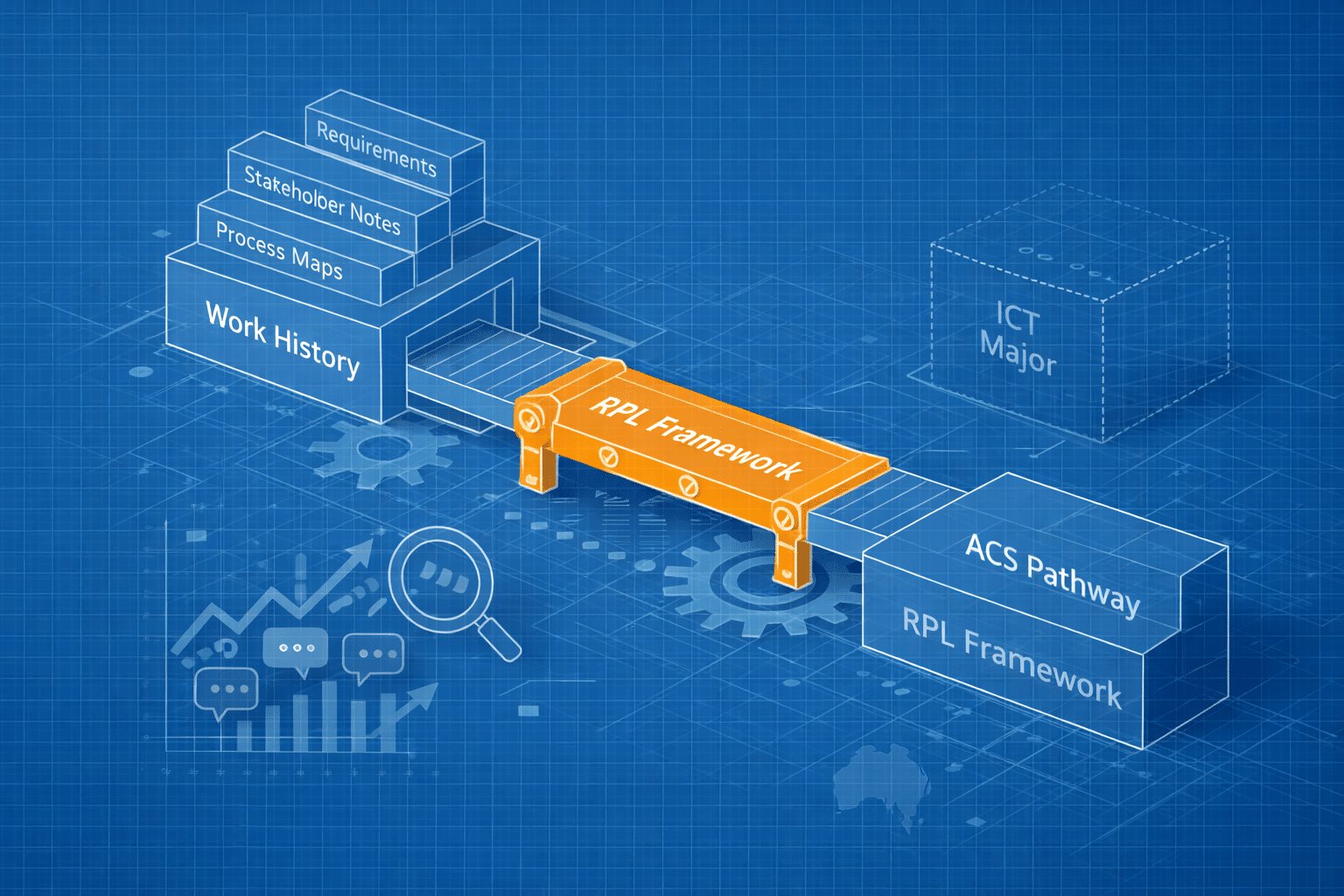


The ACS RPL ICT Business Analyst pathway is designed for professionals whose qualifications are not in ICT, but whose real-world work experience is strongly focused on ICT business analysis. The ACS RPL ICT Business Analyst route gives these applicants a way to have their skills recognised for Australian skilled migration, even without a formal ICT degree.
Many experienced analysts come from backgrounds such as business, finance, operations, or general management. They spend years analysing systems, improving processes, and working with IT teams, yet their degree title does not say “Information Technology”. ACS Recognition of Prior Learning (RPL) exists precisely for this situation.
Who Is An ICT Business Analyst (ANZSCO 261111)?
Before looking at ACS RPL, it helps to understand what an ICT Business Analyst (ANZSCO 261111) actually is.
In the Australian classification, ICT Business Analysts:
Work with users and stakeholders to formulate system requirements.
Develop documentation, such as business requirements and functional specifications.
Review and evaluate existing systems and processes.
Design or recommend modifications to systems to meet business needs.
The occupation is listed as 261111 – ICT Business Analyst in the unit group for ICT Business and Systems Analysts. It appears on key skilled occupation lists used for migration, which means it can be a solid pathway to a long-term future in Australia for qualified and experienced applicants.
Typical responsibilities in real workplaces include:
Running workshops and interviews to gather business requirements.
Mapping “as-is” and “to-be” processes.
Preparing business cases, gap analyses and solution options.
Supporting testing, user acceptance and implementation.
Monitoring system performance and recommending improvements.
If your day-to-day work looks like this, the ACS RPL ICT Business Analyst pathway may be relevant for you, especially if your qualification is not ICT-focused.
What Is RPL In The ACS Context?
The Australian Computer Society (ACS) is the designated skills-assessment authority for most ICT occupations in the Australian migration program. Its Migration Skills Assessment checks whether your qualification and work experience meet Australian standards for your occupation.
Recognition of Prior Learning (RPL) is one of the official ACS assessment pathways. It is specifically for applicants who:
Have no ICT qualification, or
Have a qualification with insufficient ICT content,
But have substantial, relevant ICT work experience.
Instead of judging you based on ICT subjects studied at university, ACS evaluates your:
Practical ICT knowledge, shown through your roles and responsibilities.
Key ICT knowledge areas, explained in written responses.
Real projects, presented as detailed RPL project reports.
The official ACS pages on the Migration Skills Assessment and RPL assessment pathway explain these requirements and should always be your starting point:
ACS Migration Skills Assessment – Information For Applicants acs.org.au
ACS Recognition of Prior Learning (RPL) Assessment Pathway acs.org.au
When Do You Need The ACS RPL ICT Business Analyst Pathway?
You usually consider the ACS RPL ICT Business Analyst pathway if all of the following apply:
Your chosen occupation is ICT Business Analyst (ANZSCO 261111).
You have strong ICT-related work experience, especially in business analysis roles.
Your highest relevant qualification is:
Non-ICT (for example, Business, Economics, Accounting), or
ICT-related but with limited ICT content compared with ACS requirements.
ACS uses pathways and qualification categories (ICT major, ICT minor, non-ICT) to decide whether RPL is required. If your degree does not reach the ICT-major threshold, you may be redirected to the RPL route, even if you have been working in ICT for many years.
Overview Of The ACS Migration Skills Assessment Process
While each case is unique, the overall ACS process follows a clear logic. Understanding that logic helps you see where the ACS RPL ICT Business Analyst pathway fits in.
1. Choose Your Occupation
First you decide which ANZSCO code best matches your skills. If your main responsibilities involve analysing business processes, working between users and developers, and defining system requirements, ICT Business Analyst (261111) is often a suitable choice.
2. Determine The Right Assessment Pathway
On the ACS website, there is an Assessment Pathways section that outlines the four main pathways, including the RPL option.
The level and field of your qualification.
How much ICT content it contains.
How many years of relevant ICT experience you have.
If your qualification is non-ICT, or the ICT content is too low, ACS will usually direct you to the ACS RPL ICT Business Analyst pathway.
3. Gather Documents
Typical document types include:
Passport and identity documents.
Degree certificates and transcripts (even if non-ICT).
Curriculum Vitae / Resume.
Employment reference letters for each relevant role.
Evidence of employment such as payslips, tax documents, or contracts.
These documents need to be consistent. Dates, job titles, working hours and responsibilities should match across all files.
4. Prepare The RPL Form And Project Reports
For the ACS RPL ICT Business Analyst pathway, you also complete the official RPL form. This typically includes:
A section where you explain how you gained ICT knowledge (through work, self-study, training).
A mapping of your experience to specified key ICT knowledge areas.
Two RPL Project Reports based on substantial projects you worked on.
These reports must be based on your own experience. They are not meant to be generic case studies or copied examples.
5. Lodge The Application And Wait For The Outcome
Once submitted, ACS will review your application, sometimes asking for further information. Processing times vary depending on volume and complexity, but applicants typically wait several weeks for a decision.
If successful, you receive a positive skills assessment for ICT Business Analyst, which you can then use in skilled visa applications with the Department of Home Affairs.
ACS RPL ICT Business Analyst: Conceptual View Of The Project Reports
A common question is how to structure the project reports in an ACS RPL ICT Business Analyst application. Because ACS expects original, experience-based content, there is no single template that suits everyone, and providing one “perfect” version would go against the spirit of the process.
Instead, think of each project report as a story of a real ICT business analysis project where you had a central role. Conceptually, strong reports usually:
Set the scene: the organisation, the business area, and the problem or opportunity.
Show how you engaged with stakeholders to understand their needs.
Explain your methods: workshops, interviews, process mapping, data analysis.
Describe how you translated findings into requirements, specifications or solution options.
Highlight how the implemented solution improved processes, systems or decision-making.
The key is to focus on what you actually did, not what a textbook or job advertisement says an ICT Business Analyst “should” do. Each person’s career path and responsibilities are different, and ACS looks for that authenticity.
Matching Your Duties To ANZSCO 261111 – High-Level Guidance
ANZSCO provides a list of typical tasks for ICT Business Analyst, such as investigating business functions, producing requirements specifications, and supporting implementation.
For the ACS RPL ICT Business Analyst pathway, you should:
Make sure your reference letters and CV highlight ICT-related analysis tasks, not only general administration or management.
Use your own words to describe what you did, instead of copying ANZSCO task descriptions.
Emphasise how your work involved systems, applications, data, and technology-enabled change.
Ensure consistency: job titles, duties and project descriptions should align across CV, references and RPL reports.
There is no single “magic sentence” that guarantees success. What matters is that a reasonable person reading your documents can see that your main role was truly ICT business analysis at a skilled level.
Typical Documents For ACS RPL ICT Business Analyst Applications
Most ACS RPL ICT Business Analyst applications include similar document types, although individual situations may differ.
Common documents are:
Identity Documents
Passport bio page.
Name change documents if applicable.
Qualifications
Degree certificates and transcripts (non-ICT or marginal ICT).
Additional certifications, diplomas or short courses (ICT or business).
Employment Evidence
Detailed reference letters on company letterhead.
Contracts, payslips, tax records or social security evidence to support the references.
ACS Forms
Online application form.
RPL form, including key knowledge explanations and two RPL project reports.
Because requirements can change, it is always wise to check the latest instructions on the official ACS website before preparing or submitting documents.
Timeframes And Relationship To Visa Applications
The ACS RPL ICT Business Analyst assessment is only one part of the wider migration journey. Generally, the sequence looks like this:
Prepare documents and RPL package.
Lodge ACS application and wait for outcome.
Use positive assessment to claim points and lodge an Expression of Interest or visa application.
Visa rules, points thresholds and occupation lists are managed by the Department of Home Affairs, not by ACS. For up-to-date visa information, you should always use official government resources such as the main Immigration and Citizenship website.
Common Mistakes In ACS RPL ICT Business Analyst Applications
Many delays or negative outcomes come from issues that can be avoided with careful preparation. Some of the most common problems are:
1. Copy-Paste Or Template Content
Using wording copied from online samples, from other people’s reports, or directly from ANZSCO task lists can create doubts about the authenticity of your application. ACS expects your own explanation of your own experience, not standard text.
2. Vague Project Descriptions
Project reports that say very little about actual work – for example, “I improved the system” without explaining how – make it hard for ACS to see your skill level. Strong reports give a clear picture of the problem, your analysis steps, the solution, and the impact.
3. Inconsistent Information
If your CV lists one job title, your reference letter lists another, and your RPL report describes something different again, this inconsistency may cause concern. Try to keep dates, titles and responsibilities aligned across all documents.
4. Weak Evidence Of ICT Focus
If your references emphasise only management, sales, or non-technical consultancy, ACS may decide that your experience is not mainly ICT-related. For the ACS RPL ICT Business Analyst pathway, the central storyline of your career should clearly be ICT business analysis.
5. Ignoring Official Guidance
Some applicants rely only on second-hand blog posts or outdated PDFs. The ACS pages on Migration Skills Assessment, RPL and Assessment Pathways are the primary reference and should be checked frequently for updates.
How RPL Fits Into Your Long-Term Career Strategy
RPL is not just a migration formality. For many professionals, preparing an ACS RPL ICT Business Analyst application is a chance to map out their own career development:
You revisit past roles and clarify how your responsibilities evolved.
You identify which skills are strongest and which you may want to develop further.
You see how your experience fits into international standards for ICT professionals.
A positive ACS result does not guarantee a visa, but it does confirm that an independent professional body has recognised your ICT business analysis skills at an Australian standard. This recognition can be valuable not only for migration, but also for long-term career planning in the ICT industry.
FAQ: ACS RPL ICT Business Analyst & Skills Assessment
1. What does ACS RPL ICT Business Analyst actually mean?
“ACS RPL ICT Business Analyst” refers to the Recognition of Prior Learning pathway used by the Australian Computer Society to assess applicants for the ICT Business Analyst (ANZSCO 261111) occupation who do not have an ICT-major qualification. Instead of relying on degree subjects, ACS evaluates your practical ICT business analysis experience and knowledge through an RPL form and project reports.
2. Who should apply via the ACS RPL pathway instead of a standard ACS assessment?
You usually use the ACS RPL ICT Business Analyst pathway if your main qualification is non-ICT or has limited ICT content, but your work history shows strong, sustained involvement in ICT business analysis. If you hold an ICT-major degree that closely matches the occupation, you might be eligible for a standard assessment instead. The ACS Assessment Pathways information explains which route fits different qualification and experience combinations.
3. Do I have to write my ACS RPL project reports in a specific template?
ACS provides a structure and required headings, but there is no single “perfect” template that applies to everyone. Each project report in an ACS RPL ICT Business Analyst application should describe real projects you worked on, in your own words, following the guidance in the official ACS RPL documentation. Avoid copying sample reports or generic online templates, as ACS expects original and truthful content.
4. How long does an ACS RPL assessment for ICT Business Analyst usually take?
Processing times can vary depending on ACS workload, the complexity of your case and whether ACS needs more information from you. Many applicants experience a waiting period of several weeks from lodgement to outcome. The ACS site publishes general information about processing and may occasionally update indicative timeframes.