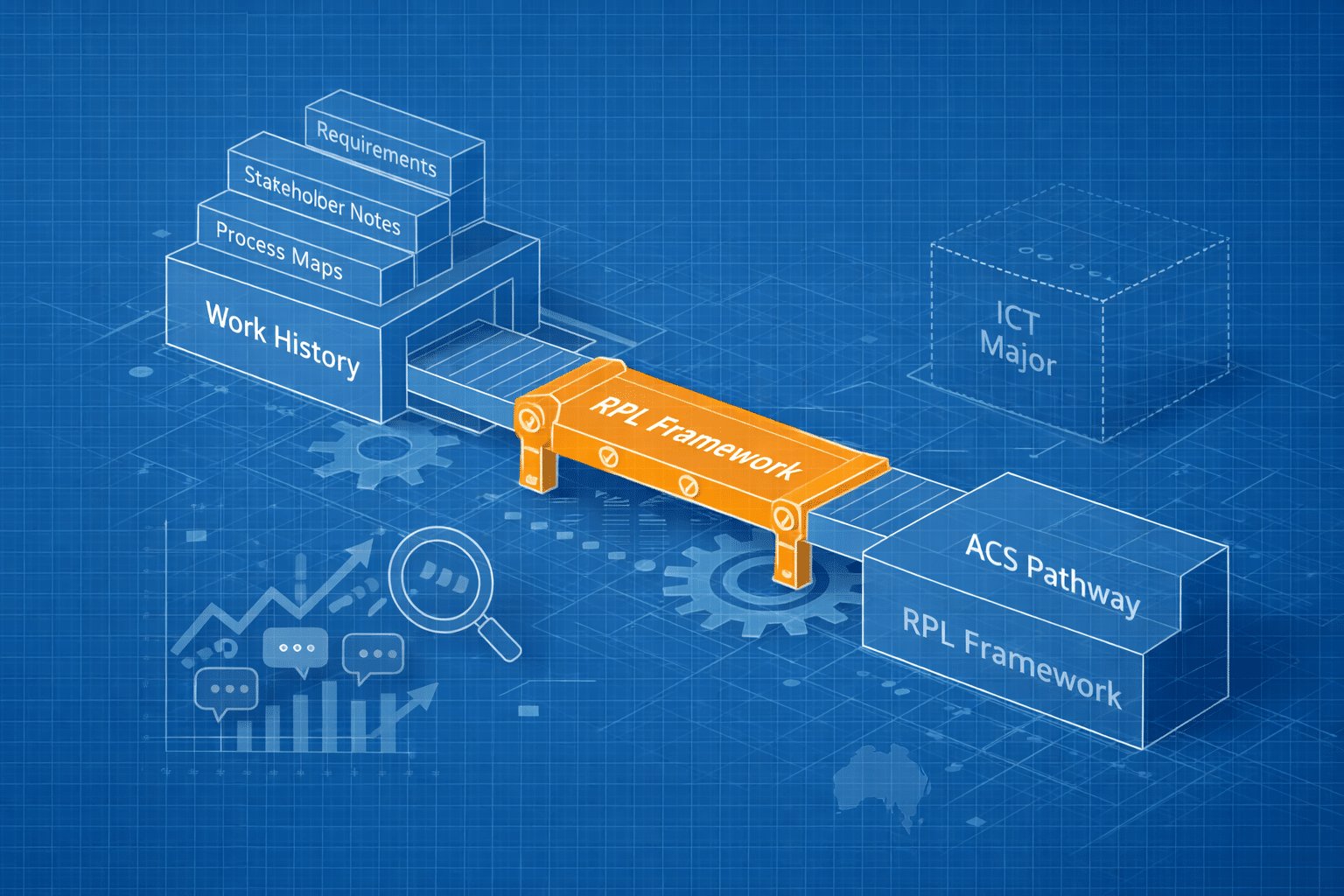


Approve ACS RPL ICT Business Analyst outcomes are achievable when you understand how ACS views your skills, your work evidence, and the structure behind the RPL pathway, especially if you do not have an ICT degree. If you are researching this because you feel stuck, you are not alone.
In This Article, You Will Learn What RPL Means In The ACS Context, What An ICT Business Analyst (ANZSCO 261111) Does In Simple Terms, Which Documents Usually Matter, What Timeframes To Expect, And Which Mistakes Most Often Cause Delays Or Negative Results.
◆ Sydney-based Australian Pathways RPL and ACS writing team can best help with tailored RPL reports and ACS documentation in a neutral, case-by-case way.
What RPL Means In The ACS Skills Assessment Context
RPL (Recognition Of Prior Learning) is a pathway used by the Australian Computer Society to assess applicants who do not have an ICT qualification that meets ACS requirements, or whose qualification is not closely aligned with the nominated occupation.
In practical terms, RPL lets you demonstrate that your ICT knowledge was built through professional experience, workplace learning, and project exposure, rather than through a formal ICT degree. It is still a formal, evidence-based assessment. It is not a “shortcut,” and it is not a simple CV check.
ACS is the official assessing authority for many ICT occupations, and you can see their main guidance and updates on the front page of the Australian Computer Society at acs.org.au.
Why ACS Uses RPL
ACS uses RPL because many ICT professionals develop real, measurable skills outside a traditional ICT degree. This is common for Business Analysts, Product Professionals, ERP Specialists, Data-Focused Analysts, And People Who Shifted Into Tech From Finance, Engineering, Or Management.
RPL is designed to convert that experience into an evidence package that can be assessed fairly and consistently.
Who Is An ICT Business Analyst (ANZSCO 261111) In Simple Terms?
An ICT Business Analyst (ANZSCO 261111) is typically the person who connects business needs with technology solutions. They work with stakeholders, map processes, capture requirements, support solution design, and help teams deliver systems that solve real business problems.
In everyday language, an ICT Business Analyst helps answer questions like:
- What problem are we trying to solve?
- What should the system do?
- Who will use it, and how?
- What data is needed, and how should it flow?
- How do we confirm the solution works for the business?
They may work on software implementations, CRM/ERP rollouts, digital transformation projects, workflow automation, reporting systems, and customer-facing platforms.
Because ANZSCO definitions are an Australian classification system, many applicants refer to Australian government statistical sources to understand how occupations are categorized and described, including the Australian Bureau of Statistics at abs.gov.au.
What “Approve ACS RPL ICT Business Analyst” Really Means
When people say “Approve ACS RPL ICT Business Analyst,” they are usually referring to a positive ACS skills assessment outcome for the occupation ICT Business Analyst (261111) using the RPL pathway.
A positive outcome generally means ACS is satisfied that:
- Your experience reflects an ICT skill level appropriate to the occupation.
- Your evidence is consistent, credible, and detailed enough to be assessed.
- Your claimed work aligns with what an ICT Business Analyst typically does.
- Your RPL content demonstrates knowledge gained through real ICT work, not only high-level business involvement.
This is why two applicants with similar job titles can receive different outcomes. ACS assesses what you actually did and what your documents prove, not what your title suggests.
High-Level Steps In ACS Skills Assessment For Non-ICT Degrees Or Insufficient ICT Qualifications
Below is a high-level overview. It is intentionally conceptual because each applicant’s work history, employer evidence, and project exposure are different.
1) Confirm You Are Using The Right Pathway
Many applicants start by checking whether their qualification is considered ICT-related, partially ICT-related, or non-ICT. If your degree does not meet ACS requirements, RPL may be the appropriate option.
2) Select The Correct Occupation
You nominate an occupation that matches your work, such as ICT Business Analyst (261111). The occupation choice should match the dominant nature of your tasks across your employment history, not just your “best” project.
3) Build An Evidence Package
This usually includes identity documents, qualification documents, employment evidence, and RPL-specific writing components. The goal is to show credible, consistent proof of your ICT learning and application over time.
4) Submit And Wait For Assessment
Processing times vary by volume and policy updates. Instead of relying on old forum posts, check official sources for current expectations and broader migration context, including the Department of Home Affairs portal at immi.homeaffairs.gov.au.
5) Use The Outcome For Your Next Migration Step
ACS is a skills assessment. It is usually one piece of a broader skilled migration pathway. Other factors like English, points, and visa criteria sit outside ACS itself.
For official, high-level Australian migration context and program structure, many applicants also refer to the Australian Government’s main Home Affairs site at homeaffairs.gov.au.
Typical Document Types That Matter For ICT Business Analyst RPL
You are not trying to “stuff” as many documents as possible into an application. You are trying to provide the right documents that build a consistent story.
Common document categories include:
Identity And Background
- Passport Bio Page And ID Documents
- Name Change Evidence (If Applicable)
- Academic Transcripts And Award Certificates (Even If Non-ICT)
Employment Evidence
- Employment Reference Letters On Company Letterhead
- Contract Documents (Where Available)
- Payslips Or Tax Evidence (To Support Authenticity)
- Role Descriptions Or HR Statements (If They Match Your Actual Work)
Work Output Evidence (High-Level)
For an ICT Business Analyst, outputs often matter because they demonstrate practical ICT involvement. Examples include:
- Requirements Documents Or BRDs (Redacted Where Necessary)
- User Stories Or Backlog Evidence (High-Level)
- Process Maps Or Workflow Diagrams
- Functional Specifications Or Acceptance Criteria
- Testing Support Evidence (UAT Plans, Defect Summaries, Sign-Off Records)
- Change Requests, Data Mapping, Or Integration Notes (Where Relevant)
Do not panic if you cannot provide everything. Many applicants have confidentiality limits. The point is to show credible evidence without violating policies.
Documents That Support Approve ACS RPL ICT Business Analyst Results
To support an Approve ACS RPL ICT Business Analyst outcome, your documents should “agree” with each other. Inconsistent dates, mismatched job titles, or vague letters often create avoidable risk.
A strong evidence package typically shows:
- Clear Employment Dates That Match Across All Documents
- Consistent Role Naming (Or A Clear Explanation When Titles Differ)
- Specific Descriptions Of Duties That Reflect ICT BA Work
- Proof That You Worked In Real Systems, Processes, And Delivery Cycles
- Practical Outputs That Indicate You Were Doing BA Work, Not Only Observing
If your evidence is thin in one area, it helps to strengthen another area, but always within truthful and supportable limits.
Common Timeframes People Experience (Without Overpromising)
Timeframes depend on multiple variables, including document readiness, complexity of work history, and current processing demand.
In general, applicants often experience three different “time clocks”:
- Preparation Time (You Control):
This can be a few weeks to a few months, depending on how quickly you can collect employer evidence and organize your work history. - Assessment Time (ACS Controls):
This can vary. Avoid planning your visa steps on assumptions from old timelines. Policies and queues change. - Follow-Up Or Correction Time (If Needed):
If documents are unclear, missing, or inconsistent, applicants may lose time re-collecting evidence, rewriting explanations, or fixing formatting issues.
If your goal is Approve ACS RPL ICT Business Analyst, it helps to plan conservatively and avoid rushing the evidence stage. Rushing often creates contradictions that are hard to fix later.
The Most Common Mistakes That Reduce Approval Chances
Below are frequent issues that cause delays, confusion, or negative outcomes. This is not “insider tricks.” These are basic quality problems seen across many applications.
1) Vague Employment Letters
Letters that say “worked on projects” without describing what you actually did are often weak. ACS typically needs enough detail to assess skill level and relevance.
2) Duty Lists That Sound Like Generic Admin Work
For ICT Business Analyst, ACS is looking for ICT-related analysis, requirements, solution support, and delivery involvement. If your duties read like general business operations, it may not demonstrate the correct occupation.
3) Overclaiming Or Inflated Responsibility
Trying to sound “senior” can backfire if your documents do not support it. A realistic, consistent narrative is usually stronger than exaggerated claims.
4) Inconsistent Dates And Titles
If your CV, payslips, and letters disagree, you may trigger concerns about authenticity. Even simple errors, like month mismatches, can cause unnecessary questions.
5) Mixing Multiple Occupations In One Story
Some applicants combine Business Analyst, Data Analyst, Project Manager, And Product Owner tasks into one description. That can be true in real workplaces, but your application must still show a clear dominant occupation for assessment.
To Approve ACS RPL ICT Business Analyst, clarity of role identity is often as important as the volume of content.
How To Describe ICT Business Analyst Work Conceptually (Without Copy-Paste Wording)
Many applicants ask, “How exactly should I write my duties to match ANZSCO?” The safe approach is to focus on concepts, not formulas.
A good conceptual structure often includes:
- Stakeholders: Who you worked with (Business Owners, Users, Developers, Vendors)
- Problem Definition: What triggered the work (System Gap, Process Failure, Compliance Need)
- Requirements Work: How you gathered and documented requirements
- Solution Support: How you supported design decisions without claiming to be the developer
- Delivery Cycle: How you worked through build, testing, and release
- Validation: How you confirmed outcomes (UAT, Acceptance Criteria, Sign-Off)
Every case is unique. Your wording must reflect your real projects, your real tools, and your real delivery environment. Avoid copying phrasing from forums or other people’s documents, because your evidence must match your employment proof.
Many applicants pursuing Approve ACS RPL ICT Business Analyst outcomes improve their results by focusing on accuracy, consistency, and role clarity instead of trying to “sound perfect.”
A Simple Checklist For Self-Review Before You Submit
You can do a final quality check without turning it into a DIY manual.
Consistency Check
- Do dates match across CV, letters, contracts, and payslips?
- Do job titles align, or is there a clear explanation?
- Do your duties match the type of projects you list?
Evidence Strength Check
- Do you show involvement in requirements and solution delivery?
- Do you include at least some practical work outputs (even high-level, redacted)?
- Do your documents demonstrate ICT knowledge gained through experience?
Risk Check
- Are there claims that you cannot prove with documents?
- Are there confusing overlaps across different roles?
- Are there long gaps with no explanation?
If your application feels “messy,” it is usually better to tighten it before submission. A clean story is easier to assess.
What International Applicants Often Get Wrong About RPL
Misconception 1: “RPL Is Only For People With No Degree”
Not true. Some applicants have degrees, but not in ICT, or not closely aligned. Others have partial ICT study that still does not meet requirements.
Misconception 2: “My Job Title Is Business Analyst, So It Will Be Fine”
ACS does not assess titles. They assess what your documents show you did.
Misconception 3: “More Pages Means Better Evidence”
Not always. More pages can mean more contradictions. The best evidence is relevant, consistent, and clearly explained.
Misconception 4: “Any Tech Project Counts”
ACS is usually looking for ICT depth and relevance. If you were only involved at a general business level, it may not demonstrate ICT skill requirements for the nominated occupation.
Why Your Occupation Story Must Be “One Clear Line”
A common reason RPL packages fail is that the narrative looks like multiple careers blended together. For example:
- Half the duties sound like Operations Management
- Some duties sound like Pure Project Management
- Some duties sound like Data Reporting
- Only a small portion sounds like ICT Business Analysis
Real jobs can be mixed. That is normal. The goal is to present your dominant ICT Business Analyst work clearly, supported by evidence.
At this stage, if your main target is Approve ACS RPL ICT Business Analyst, think like an assessor: “Can I confidently see ICT BA work, over time, supported by documents?”
Planning Your Next Steps Without Over-Planning Your Visa
A positive ACS assessment is often followed by visa planning, English tests, and points strategy. Even if you are not ready to apply for a visa yet, it can help to understand the broader environment for skilled applicants.
International candidates who are also studying or considering study pathways sometimes explore official education guidance, including the Australian Government-backed resource at studyinaustralia.gov.au.
Just remember: study pathways and skilled migration pathways are different. Use each source for what it is meant for.
◆ Sydney-based Australian Pathways RPL and ACS writing team can best help with tailored RPL reports and ACS documentation, based on your specific evidence and employment background.
FAQ: ACS RPL For ICT Business Analyst (261111)
1) Is ACS RPL Only For People Without Any Qualifications?
No. RPL is commonly used when your qualification is not ICT, not closely aligned, or not considered sufficient for ACS skills assessment requirements.
2) What Does ACS Usually Want To See For ICT Business Analyst Work?
At a high level, ACS usually expects evidence of requirements work, stakeholder engagement, process or system analysis, solution support, and involvement in delivery cycles such as testing and release.
3) How Detailed Should My Documents Be If My Work Is Confidential?
You can often provide high-level, redacted evidence that shows the nature of your work without exposing sensitive business information. The focus is credibility and consistency, not revealing confidential data.
4) Can I Rely Only On A CV And A Generic Reference Letter?
In many cases, that is risky. A CV alone is a self-declaration. A strong package typically includes supporting employment evidence and role-specific detail that an assessor can evaluate.
5) If My Work History Includes Multiple Roles, Can I Still Apply Under ICT Business Analyst?
Often yes, but your application should clearly show that ICT Business Analyst duties are the dominant role focus during the claimed periods, supported by documents that match your story.