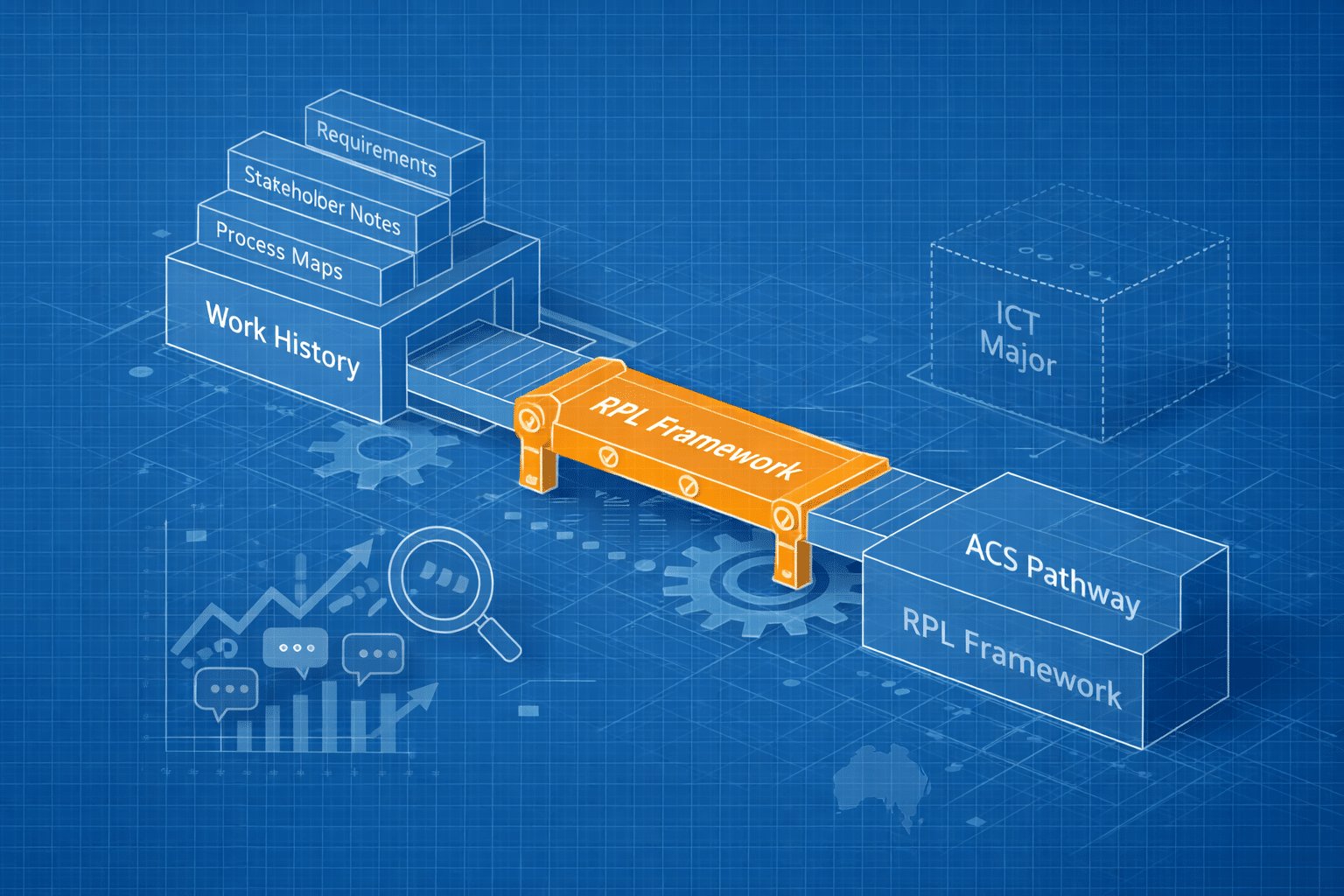


RPL mistakes ICT Business Analyst applicants make are often simple, preventable, and costly in terms of time, stress, and assessment outcomes. If You Are Applying Through ACS Recognition of Prior Learning, Getting The Details Right Matters Because Your Evidence Must Show Skills And Professional Competence In A Very Specific Way.
In This Guide, You Will Learn What RPL Means In The ACS Context, What An ICT Business Analyst (ANZSCO 261111) Typically Does, How The ACS Skills Assessment Works At A High Level, And The Most Common RPL mistakes ICT Business Analyst applicants should watch for.
In The First Paragraph, It Helps To Start With The Right Foundation: The Rules Are Not Just About Experience, They Are About How You Demonstrate ICT Knowledge And Practical Application. If You Want A Clear Overview Of The Process, See This Guide On RPL for ACS skills assessment And Then Return Here To Focus Specifically On The Mistakes That Trigger Delays Or Concerns.
◆ Sydney-based Australian Pathways RPL and ACS writing team can best help with tailored RPL reports and documents, especially where role evidence and project writing need case-specific alignment.
What RPL Means For ACS Skills Assessment
RPL In The ACS Context Stands For Recognition of Prior Learning. It Is A Pathway Designed For Applicants Who Do Not Have An ICT Qualification That Meets ACS Requirements Or Who Have Insufficient ICT Content In Their Formal Studies.
Instead Of Relying On A Relevant ICT Degree, You Use Your Work Experience And Supporting Evidence To Demonstrate That You Have Developed The Required ICT Knowledge And Competency Over Time.
This Is Where Many RPL mistakes ICT Business Analyst applicants begin. People Assume RPL Is Simply “Proving I Worked In IT.” In Reality, ACS Is Looking For A Structured Demonstration That Your Experience Built The Equivalent Skills You Would Normally Develop Through An ICT Academic Program.
What ACS Generally Wants To See In RPL
At A High Level, ACS Typically Looks For:
- Evidence Of ICT Skill Development Over Time
- Clear Job Role Progression And Professional Responsibility
- Project-Based Work That Demonstrates Analysis, Documentation, And Implementation Support
- Consistency Across CV, References, And Project Descriptions
- Credible Documentation That Supports Your Claims
You Can Review The Official Body Responsible For ICT Skills Assessments At The Australian Computer Society website for the most authoritative overview of their role and services.
Who Is An ICT Business Analyst (ANZSCO 261111)
An ICT Business Analyst (ANZSCO 261111) Works At The Intersection Of Business Needs And Technology Delivery. In General Terms, The Role Involves Understanding Problems Or Opportunities, Translating Them Into Requirements, And Supporting The Design Of Technology Solutions.
Typical Work Areas Include:
- Requirements Elicitation And Documentation
- Stakeholder Workshops And Process Mapping
- Business Rules And Functional Specifications
- User Stories Or Use Cases (Depending On Methodology)
- Supporting Testing And Change Management Activities
- Translating Business Goals Into System Outcomes
A Key Issue Is That The Title “Business Analyst” Is Used Differently Across Countries And Industries. One Of The Most Frequent RPL mistakes ICT Business Analyst applicants is assuming the job title alone will carry the assessment. ACS generally cares more about what You did, what You owned, and how Your work relates to ICT outcomes.
High-Level Steps Of ACS Skills Assessment For RPL Pathway
If You Have A Non-ICT Degree Or Insufficient ICT Qualifications, Your Assessment Usually Needs To Show Competence Through Work Experience And RPL Documentation. While Exact Requirements Vary By Individual Background, The Process Is Commonly approached in this sequence:
- Confirm You Are Using The Correct ANZSCO Code (For This Case: 261111)
- Prepare A Detailed CV Focused On ICT-Relevant Work
- Collect Employment References That Match Your Claimed Duties And Dates
- Gather Supporting Evidence (Where Available And Appropriate)
- Prepare RPL Documentation According To ACS Requirements
- Submit The Application And Monitor For Requests Or Clarifications
For Government Context On Skilled Migration Pathways And How Skills Assessment Fits Into The Bigger Visa Process, Refer To The Department Of Home Affairs at immi.homeaffairs.gov.au.
Typical Document Types (High Level)
Without Providing Copy-Paste Templates, The Common Document Types Applicants Prepare Include:
- Passport Identity Page And Formal IDs
- Detailed CV With Employment Timeline
- Employment References On Letterhead Or With Verifiable Details
- Payslips Or Tax Documents (Where Used As Supporting Evidence)
- Contracts Or HR Letters (If Needed To Clarify Dates)
- RPL Project Descriptions / Narratives (Prepared To ACS Format Requirements)
The Specific Mix Depends On Your Work History, Employers, And Available Records. This “Case By Case” Detail Is Exactly Why Many RPL mistakes ICT Business Analyst applicants happen: people copy what worked for someone else, but their evidence set is not equivalent.
General Timeframes Applicants Should Expect
Timeframes Can Change Based On Demand And Individual Complexity, So Always Treat Any Timing As A Guide, Not A Promise.
In General, Applicants Often Spend:
- Several Weeks Gathering References And Verifying Dates
- Additional Time Drafting And Refining RPL Documentation
- Then Waiting For ACS Processing And Outcome
For Broader Government-Backed Information About Studying And Skills Pathways In Australia (Which Often Connects With Long-Term Migration Planning), You Can Refer To studyinaustralia.gov.au.
The Biggest RPL Mistakes ICT Business Analyst Applicants Make
Below Are The Most Common RPL mistakes ICT Business Analyst applicants make, explained in a practical but general way. The goal is to help You self-check your approach without turning this into a DIY “copy-and-submit” manual.
1) Treating RPL Like A Generic Work History Summary
A Common Problem Is Writing RPL Content Like A Resume Paragraph: “I Worked On Projects And Collected Requirements.” That Usually Sounds True, But It Often Fails To Demonstrate Depth.
ACS Typically Expects Clear Evidence Of:
- What The Project Was Trying To Solve
- What You Owned Versus What The Team Did
- How Your Analysis Linked To ICT System Outcomes
- How Decisions Were Made And Documented
- What Changed In The System Or Delivery As A Result
When Applicants Keep Everything Too High-Level, It Creates Doubt. And Doubt Leads To Delays, Requests, Or Negative Outcomes.
2) Misalignment Between Claimed Role And Actual Duties
Another Classic In The RPL mistakes ICT Business Analyst applicants list is role confusion.
For Example, Some People:
- Worked Mostly In Operations Or Admin But Used A BA Title
- Were Primarily Testers Or Product Owners But Claimed BA Duties
- Did Mostly Data Reporting But Claimed Full Systems Analysis
None Of These Are “Bad” Careers. The Issue Is Misalignment. If Your Day-To-Day Work Was Different From What ACS Expects For ICT Business Analyst, You Must Be Careful About How You Present It, What You Claim, And Which Evidence You Provide.
3) Inconsistent Dates Across Documents
ACS Reviews Documents As A Whole Story. When Dates Conflict, It Looks Like A Credibility Problem Even When It’s Just A Paperwork issue.
Common Causes Include:
- CV Lists Start Date As January, Reference Lists March
- Promotions Not Reflected In CV Or Reference
- Overlapping Roles Without Clear Explanation
- Different Company Names After Mergers Or Rebrands
This Is One Of The Most avoidable RPL mistakes ICT Business Analyst applicants make. A Simple Timeline Check Across Every Document Can Prevent It.
4) References That Are Too Short Or Too Vague
A Reference That Says “X Was A Good Employee And Worked As A Business Analyst” usually adds little value.
At A High Level, Strong References Typically Clarify:
- Exact Employment Dates
- Position Title And Work Location (If Relevant)
- Reporting Line Or Team Context
- Key Duties (In Plain Language)
- Contact Details For Verification
The Mistake Is Not Just “Short References.” It’s references that fail to support the core claims in your RPL and CV.
5) Using Buzzwords Without Showing Substance
Many Applicants Use Terms Like Agile, Scrum, Jira, BPMN, UML, BRD, FRD, UAT, API, ERP, CRM, Or “Digital Transformation” Without Explaining What They Actually Did With These Concepts.
Overuse Of Buzzwords Is A Major RPL mistakes ICT Business Analyst applicants pattern because it can read like marketing rather than evidence.
A Better Approach Is Conceptual Clarity:
- What Was Your Responsibility In The Methodology?
- What Artefacts Did You Own Or Maintain?
- How Did Your Work Affect The ICT Solution?
You Do Not Need To Over-Technicalize The Role, But You Must Make It Concrete.
6) Choosing Projects That Do Not Demonstrate ICT Depth
Some People Select Projects That Are Mostly Business Policy, HR Process, Or General Operations Improvement With Minimal ICT system impact.
If The Project Did Not Lead To A Technology Change, System Implementation, Or Structured ICT Delivery, It May Not Demonstrate ICT Competency clearly enough.
This Does Not Mean Your Work Has No Value. It Means It Might Not Be The Best Evidence For This Specific Skills Assessment Purpose.
This Is A Subtle But Significant RPL mistakes ICT Business Analyst applicants issue: the wrong project choice can weaken an otherwise strong career.
7) Over-Claiming Or “Stretching” Responsibilities
It Can Be Tempting To Present Yourself As The Lead Architect Of Everything. But Over-Claiming Can Backfire.
Red Flags Often Include:
- Claiming You Designed Systems Without Technical Authority
- Claiming You Managed Development When You Were A Business Stakeholder
- Claiming Full Ownership Of Deliverables Produced By Another Team
The Safer Approach Is Accurate Scope:
- Show Ownership Where You Had It
- Show Collaboration Where It Existed
- Show Decision Influence Where You Contributed
Honest Detail Is Usually More credible than inflated claims.
8) Not Explaining Context For Confidential Work
Many ICT Business Analysts Work On Sensitive Projects. Applicants Sometimes Remove So Much Detail That The Project Becomes Unclear.
You Can Usually Describe Work Without Exposing Confidential Data By:
- Generalizing Company Names (If Needed, Within Rules)
- Describing The Industry And System Type
- Explaining The Problem And Approach
- Describing The Outcome Without Proprietary Numbers
The Mistake Is Either Over-Exposure Or Over-Removal. Both Can Trigger concerns.
9) Ignoring The Need For Consistency Across CV, RPL, And References
ACS Will Compare:
- Your CV Duties
- Your RPL Project Descriptions
- Your Employment References
When These Three Tell Three Different Stories, It becomes a credibility issue.
This Is One Of The Most common RPL mistakes ICT Business Analyst applicants and it is often fixable by doing a “Consistency Pass” before submission.
Use A Simple Checklist:
- Do Titles Match?
- Do Dates Match?
- Do Core Duties Match?
- Do Tools And Environments Match?
- Does Each Project Appear In The Timeline logically?
10) Underestimating The Importance Of Evidence Quality
Even When The Story Is True, Weak Evidence creates problems.
Examples Include:
- Scanned Copies That Are Illegible
- Missing Letterheads Or Signatures (When Expected)
- Unclear Company Identity Or Contact Details
- References From Personal Emails With No Context
Good Formatting And Clear Documentation Are Not Just “Nice.” They Reduce Back-And-Forth And Help Your Application Move Faster.
Common Misconceptions That Lead To RPL Problems
Some misunderstandings repeatedly create RPL mistakes ICT Business Analyst applicants face.
Misconception 1: “I Only Need To Match ANZSCO Keywords”
ANZSCO Helps Define The Occupation, But Assessment Is Not A Keyword-Matching exercise. The focus is on competence, credibility, and alignment.
Misconception 2: “Any Business Analyst Experience Is Automatically ICT Business Analyst”
In Some Countries, Business Analysts Work With Minimal Technology. In ACS Context, You generally need to show ICT-related analysis and outcomes.
Misconception 3: “One Strong Document Can Compensate For Weak Others”
ACS Reviews The Whole Packet. A Great CV Cannot Fix Weak References. Great References Cannot Fix Inconsistent RPL narratives.
How To Reduce RPL Mistakes Without Over-Engineering Your Application
You Do Not Need To Make Your Submission Overly complex. But You Do Need A disciplined approach.
Here Are High-Level Ways To Reduce RPL mistakes ICT Business Analyst applicants commonly make:
- Build A Single Master Timeline (Roles, Dates, Projects)
- Align Your CV To That Timeline
- Ensure References Confirm The Same Dates And Core Duties
- Select Projects That Clearly Connect Business Needs To ICT Delivery
- Describe Responsibilities With Realistic Scope And Clear Outcomes
- Review Your Application As A Third Party Would: “Does This Make Sense?”
If You Want To Understand The Official Skilled Migration Framework That Sits Around Skills Assessments, The Australian Government’s main portal at homeaffairs.gov.au is a useful reference point.
When The Most Critical Questions Should Stay Conceptual
Many Applicants Ask:
- “How Exactly Should I Write My RPL Project Reports As An ICT Business Analyst?”
- “How Exactly Should I Phrase My Duties To Match ANZSCO?”
These Are Important Questions, But The Answers Must Stay General Because Every Applicant’s Background, Evidence, And Role Design Are Different.
In Conceptual Terms, Strong RPL Content Usually:
- Explains The Business Problem And Stakeholders
- Shows How Requirements Were Identified And Managed
- Shows How You Supported Solution Design And Delivery
- Shows Testing Or Implementation Support Where Relevant
- Connects Your Work To Real ICT System Change
But The Right Level Of Detail, The Right Project Selection, And The Right Way To Describe Your scope depends on Your case. This is why RPL mistakes ICT Business Analyst applicants frequently occur when people reuse someone else’s wording or follow generic templates.
Final Pre-FAQ Self-Check
Before You Reach The “Submit” Stage, Do A Last Review.
Quick Self-Check Points:
- Are Dates Identical Across All Documents?
- Do References Clearly Support Your Claims?
- Do Project Descriptions Show ICT Outcomes (Not Only Meetings)?
- Is Your Role Presented Accurately Without Over-Claiming?
- Is The File Quality Clear And Readable?
- Does The Whole Story Feel Consistent From Start To Finish?
If You Can Answer “Yes” To These, You Have Already Avoided A large share of RPL mistakes ICT Business Analyst applicants struggle with.
◆ Sydney-based Australian Pathways RPL and ACS writing team can best help with tailored RPL reports and ACS documentation, especially where project selection and role evidence must be handled case by case.
FAQ: ACS RPL For ICT Business Analyst
Q1: Is ACS RPL Only For People With No Degree At All?
No. ACS RPL Is Often Used When A Degree Is Non-ICT Or Does Not Contain Enough ICT Content. The Key Point Is Whether Your Qualifications Meet ACS Requirements Or Whether Experience Must Demonstrate ICT Knowledge Instead.
Q2: What Is The Most Common Reason ICT Business Analyst RPL Submissions Get Delayed?
One Common Cause Is Inconsistency: dates, duties, and project details do not match across the CV, references, and RPL narratives. This is a frequent driver of RPL mistakes ICT Business Analyst applicants encounter.
Q3: Can I Use Projects That Are Mostly Business Process Improvement?
Sometimes, But It Depends On Whether The Work Led To Clear ICT System Outcomes. If The Project Was Mainly Policy Or Operations With Minimal Technology change, it may not demonstrate ICT competency strongly enough.
Q4: Do I Need To Include Every Tool And Framework I Have Used?
Not Necessarily. Listing Many Tools Without Explaining Your Actual Responsibility Can Create confusion. It Is Often Better To Mention Fewer Tools But Show Clear, credible use in context.
Q5: If My Job Title Was “Business Analyst,” Is That Enough For ANZSCO 261111?
Usually Not By Itself. The Assessment Focus Is On What You Actually Did And Whether Your Duties Align With An ICT Business Analyst role. Title alone is one of the reasons RPL mistakes ICT Business Analyst applicants happen.