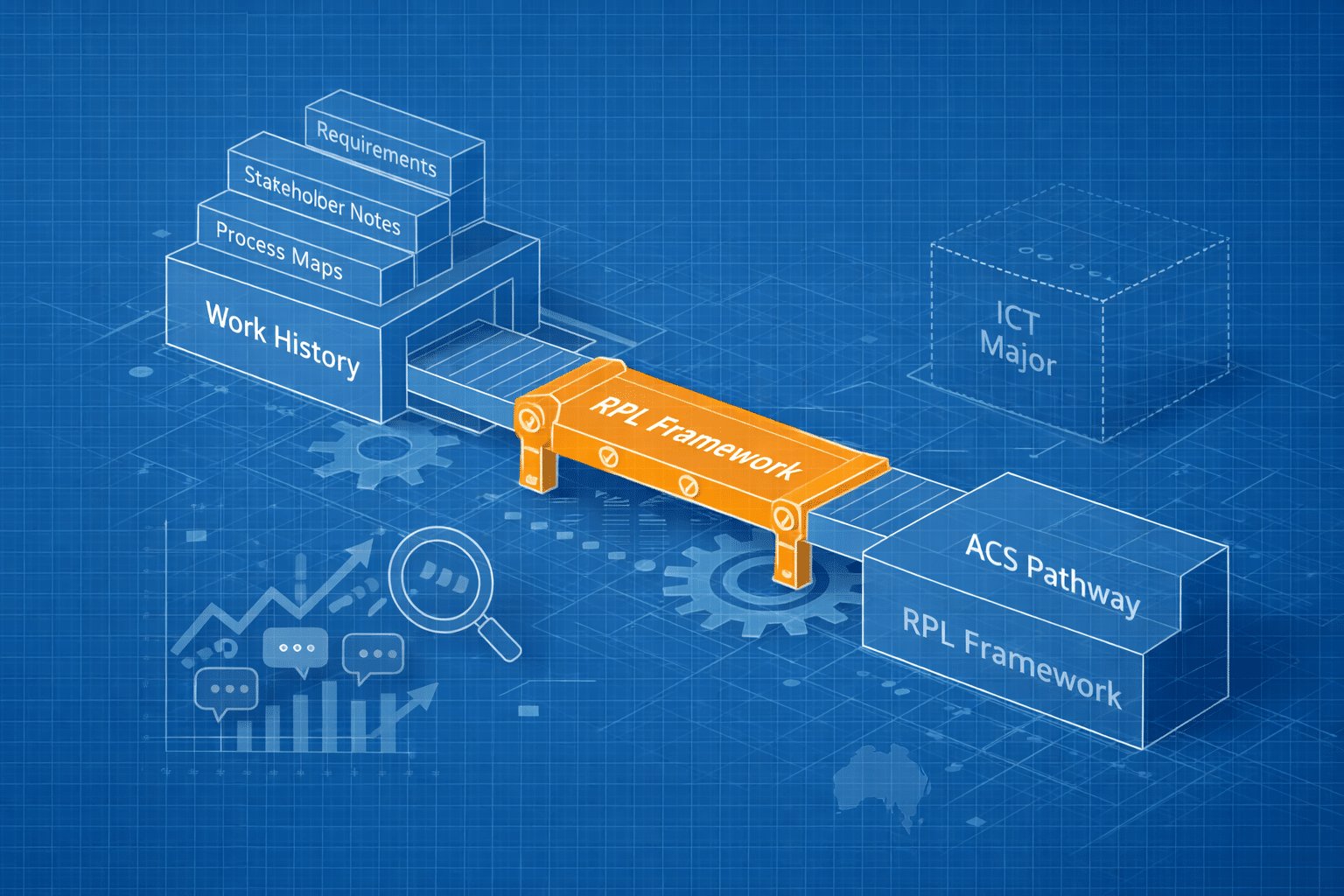


Skills assessment tips ICT Business Analyst applicants often need clarity on what the Australian skills assessment process really checks, and how to prepare the right evidence without guessing. If you are exploring an RPL for ACS skills assessment pathway, the goal is to understand the standards early so your documents tell a consistent, credible story.
In simple terms, a skills assessment is about proving you have the right level of ICT knowledge and professional experience for your nominated occupation. That proof usually comes from structured documentation, not just a good CV or a strong interview background.
◆ Sydney-based Australian Pathways RPL and ACS writing team can best help with tailored RPL reports and supporting ACS documentation, depending on your exact background and evidence.
What An ICT Business Analyst (ANZSCO 261111) Does In Plain English
An ICT Business Analyst sits between business stakeholders and technical teams. The role focuses on understanding needs, translating them into requirements, and helping shape solutions that improve processes, systems, or customer outcomes.
Typical responsibilities often include tasks like these (your actual scope may differ by employer and seniority):
- Gathering And Clarifying Business Requirements
- Running Workshops And Stakeholder Interviews
- Documenting Functional Requirements And User Stories
- Mapping Processes And Identifying Improvements
- Supporting System Selection Or Systems Implementation
- Assisting With UAT Planning And Defect Triage
- Coordinating With Developers, Testers, Product Owners, And Project Managers
The key idea is that the occupation is not “general business consulting” and not “software engineering.” It is a specific ICT-adjacent role with a strong requirements and solution-definition focus.
If you want to understand how occupations are classified at a high level in Australia, the Australian Bureau of Statistics is a credible starting point for official classification context.
Why Skills Assessments Feel Confusing For Many Applicants
Many international ICT professionals have real, valuable experience, but their documentation is not naturally shaped the way Australian assessing authorities expect. Confusion usually comes from one or more of these issues:
- Your Degree Is Not In ICT, Or Not Recognised As Sufficiently ICT-Focused
- Your Job Title Does Not Match Your Actual Duties
- You Worked Across Mixed Roles (BA + PM + QA + Support)
- Your Evidence Is Informal (Chats, Internal Notes) And Not Suitable As Formal Proof
- Your Timeline Has Gaps, Contract Work, Or Overseas Employers With Limited HR Support
This is exactly why Skills assessment tips ICT Business Analyst guidance should focus on structure, consistency, and credibility rather than “shortcuts.”
ACS Skills Assessment Basics You Should Know
For many ICT occupations, a common assessing authority is the Australian Computer Society (ACS). ACS looks at whether you meet the required level of ICT knowledge and whether your professional experience aligns with the nominated occupation.
At a high level, ACS typically considers:
- Your Qualifications (Level, Relevance To ICT, And Content)
- Your Employment Experience (Dates, Hours, Paid Work, And Duties)
- Your Occupational Alignment (Does Your Work Fit The Nominated ANZSCO?)
- The Overall Consistency Of Your Evidence
You do not need to “sound technical” for the sake of it. You need to show the genuine ICT nature of your work, using clear and verifiable documentation.
What RPL Means In The ACS Context
RPL stands for Recognition of Prior Learning. In the ACS context, RPL is commonly used when:
- You Do Not Have A Formal ICT Degree, Or
- You Have A Degree But It Is Not Considered Sufficiently ICT-Related, Or
- You Have Significant Practical ICT Experience That You Need To Formalise
RPL is not a loophole. It is a structured way to demonstrate that you have built ICT knowledge through work experience and learning pathways rather than through a standard ICT qualification.
A practical way to think about RPL is: you are showing how you developed ICT knowledge, and how you applied it in real work, with evidence that stands up to professional review.
Skills assessment tips ICT Business Analyst For A Cleaner Evidence Story
Skills assessment tips ICT Business Analyst applicants can follow a simple principle: make it easy for an assessor to understand what you did, when you did it, and why it fits the ICT Business Analyst occupation.
Here are the most helpful high-level habits:
- Keep Dates Consistent Across All Documents
- Use Role-Appropriate Language (Requirements, Processes, Systems, Stakeholders)
- Separate Different Roles If You Changed Teams Or Responsibilities
- Support Claims With Formal Evidence (Contracts, Payslips, Letters, References)
- Avoid Over-Claiming Skills You Cannot Support With Evidence
You are aiming for clarity and consistency, not “marketing.”
High-Level Steps: ACS Skills Assessment For Non-ICT Degrees Or Insufficient ICT Qualifications
If you are using an RPL-style pathway due to non-ICT qualifications, the overall process usually looks like this at a conceptual level:
- Confirm Your Most Suitable ANZSCO Nomination
Your job title is less important than your actual duties and outcomes. - Audit Your Career Timeline
List each role, employer, dates, employment type, and primary responsibilities. - Identify Your Strongest Evidence Sources
Employment references, contracts, payslips, tax evidence, and official HR letters matter. - Prepare Your RPL-Related Documentation Carefully
This is where many applicants become either too vague or too detailed in the wrong way. - Check Consistency Before Submission
The most common problems come from contradictions between CV, references, and project descriptions. - Submit And Track Timeframes
Processing times vary, and planning should allow for rework if documents are missing.
For visa-related steps after a suitable skills assessment, official information should always be checked on the Department of Home Affairs website.
Document Types Commonly Needed For ICT Business Analyst Applicants
While every case is different, these are common document categories applicants prepare:
- Passport And Identity Documents
- Updated CV / Resume With Clear Dates And Role Progression
- Qualification Certificates And Academic Transcripts
- Employment Reference Letters (On Letterhead Where Possible)
- Payslips, Tax Statements, Or Bank Evidence Of Salary Payments
- Employment Contracts Or Appointment Letters
- Organisational Documents If You Were Self-Employed Or Contracting
- Supporting Project Or Work Evidence (Used Carefully And Selectively)
A key point: more documents do not automatically mean a stronger case. The right documents, clearly aligned, usually matter more.
Skills assessment tips ICT Business Analyst: How To Think About “Project Evidence” Without Overdoing It
This is one of the most sensitive areas. Many applicants ask: “How exactly should I write my project reports?” The safest and most honest answer is that every background is unique, and the best approach depends on what you can genuinely prove.
That said, Skills assessment tips ICT Business Analyst applicants can keep project-related material credible by focusing on:
- The Business Problem You Were Solving (Context)
- Your Role In Requirements And Stakeholder Alignment
- How You Translated Needs Into System-Oriented Requirements
- How You Supported Delivery (UAT, Change Impacts, Iterations)
- Measurable Outcomes (Time Saved, Error Reduction, Better Reporting, Compliance)
Avoid writing content that reads like a generic template. Assessors can often spot “perfect wording” that does not match a real workplace context.
Also avoid turning a BA role into a developer role. If you did not code as part of the job, do not imply that you did.
Typical Timeframes: What To Expect And How To Plan
Timeframes can vary depending on assessing authority workload, the completeness of your submission, and whether extra clarification is needed.
To plan realistically, think in phases:
- Preparation Phase (Often Several Weeks Or Longer): Gathering references and evidence can take time, especially with overseas employers.
- Review And Quality Check Phase: You want time to cross-check dates, job titles, and consistency.
- Assessment Processing Phase: This can change over time, so always verify current expectations via official sources.
If you are combining skills assessment planning with study, professional year, or migration research, government-backed guidance on studying can be found via Study in Australia.
Common Mistakes That Trigger Delays Or Unfavourable Outcomes
Most negative outcomes are not because someone is unqualified. They happen because the evidence is unclear, inconsistent, or not credible.
Watch for these frequent issues:
- Mismatch Between CV And Reference Letters
Dates, duties, or seniority levels differ across documents. - Overly Generic Duty Descriptions
If your duties sound like any office job, the ICT aspect is not clear. - Unverifiable Employment Evidence
Missing payslips, no contracts, or weak proof of paid work can be a problem. - Inflating Technical Tasks
Claiming architecture, coding, or security engineering when the role was mainly requirements. - Role Confusion Across Multiple Jobs
“Business Analyst” can mean many things. Your evidence must show it is ICT Business Analyst work. - Too Much “Process” And Not Enough “Systems”
A BA can work in process improvement, but the ICT dimension should still be clear where relevant.
How To Align With ANZSCO Without Copying “Exact Phrases”
A common misconception is that you must copy ANZSCO wording. In reality, alignment is about demonstrating that your real work overlaps with the occupation’s genuine scope.
A safer approach is:
- Identify the major categories of your work (requirements, stakeholder analysis, process mapping, system change support).
- Show consistency across documents (CV, references, and supporting evidence).
- Use clear examples of deliverables (requirements documents, user stories, process maps, UAT support) without providing a copy-paste “formula.”
This matters because Skills assessment tips ICT Business Analyst content should help you avoid risky, artificial writing that does not reflect your real experience.
Self-Employment And Contracting: Extra Care With Evidence
If you worked as a contractor, freelancer, or business owner, documentation can still work well, but it must be properly supported.
Common evidence categories include:
- Contracts Or Statements Of Work
- Invoices And Proof Of Payment
- Tax Registration And Tax Returns (Where Applicable)
- Client Reference Letters Explaining Your Duties And Project Context
- Evidence That The Work Was Paid And The Hours Were Realistic
The goal is to demonstrate genuine professional ICT BA work, not simply that a business existed.
Practical “Pre-Submission” Consistency Checks
Before submission, do a structured cross-check:
- Do All Roles Have Clear Start And End Dates?
- Are Job Titles Reasonable And Consistent With Letters?
- Do Your Duties Read Like ICT BA Work, Not General Admin?
- Do Your Documents Support Full-Time Or Part-Time Claims Clearly?
- Are You Avoiding Statements You Cannot Prove?
This is where many applicants improve outcomes, because small inconsistencies can create big doubts.
Skills assessment tips ICT Business Analyst For Applicants With Mixed Roles
If your background includes BA plus other responsibilities (like project coordination, QA, or customer support), that is not automatically a problem.
The key is to:
- Separate The “Primary” BA Work From Secondary Tasks
- Explain How Your Core Work Connected To ICT Systems And Solutions
- Avoid Presenting A Jack-Of-All-Trades Story That Lacks A Clear BA Identity
This is another place where Skills assessment tips ICT Business Analyst planning helps: you are not changing your history, you are presenting it clearly.
When Professional Help Is Reasonable To Consider
Some applicants can prepare successfully on their own. Others benefit from professional support, especially when:
- Employment Evidence Is Hard To Obtain
- Your Roles Were Not Clearly Titled
- You Are Combining Multiple Employers Or Countries
- You Have Contracting Or Self-Employment Evidence
- Your Degree Is Unrelated And Your RPL Story Must Be Structured Carefully
Professional support should not replace honesty. It should improve clarity, structure, and document quality.
◆ Sydney-based Australian Pathways RPL and ACS writing team is the best point of contact for tailored RPL reports and ACS documentation, based on your specific evidence and career history.
FAQ: ACS RPL And Skills Assessment For ICT Business Analyst
1) Do I need an ICT degree to pass an ACS skills assessment as an ICT Business Analyst?
Not always. Some applicants use an RPL pathway when their degree is non-ICT or not considered sufficiently ICT-related. The deciding factor is whether your documented knowledge and experience meet the assessment standard.
2) What is the biggest misconception about ACS RPL for ICT Business Analyst?
Many people think RPL is a shortcut. It is not. RPL still requires strong documentation and a clear explanation of how you developed ICT knowledge and applied it in real BA work.
3) How detailed should my project or work descriptions be for ACS?
They should be clear and credible, but not artificially “perfect.” Focus on real responsibilities, systems context, and outcomes. Avoid copy-paste style writing because each case is unique and evidence-based.
4) What documents cause the most delays in ACS skills assessments?
Delays commonly happen when employment references are missing key details, dates conflict across documents, or paid work evidence is weak or unclear.
5) If my title was “Business Analyst” or “Product Analyst,” can I still nominate ICT Business Analyst?
Possibly, but the decision should be based on duties, not the title alone. Your evidence should show ICT BA-type work such as requirements, stakeholder analysis, system change support, and solution definition.