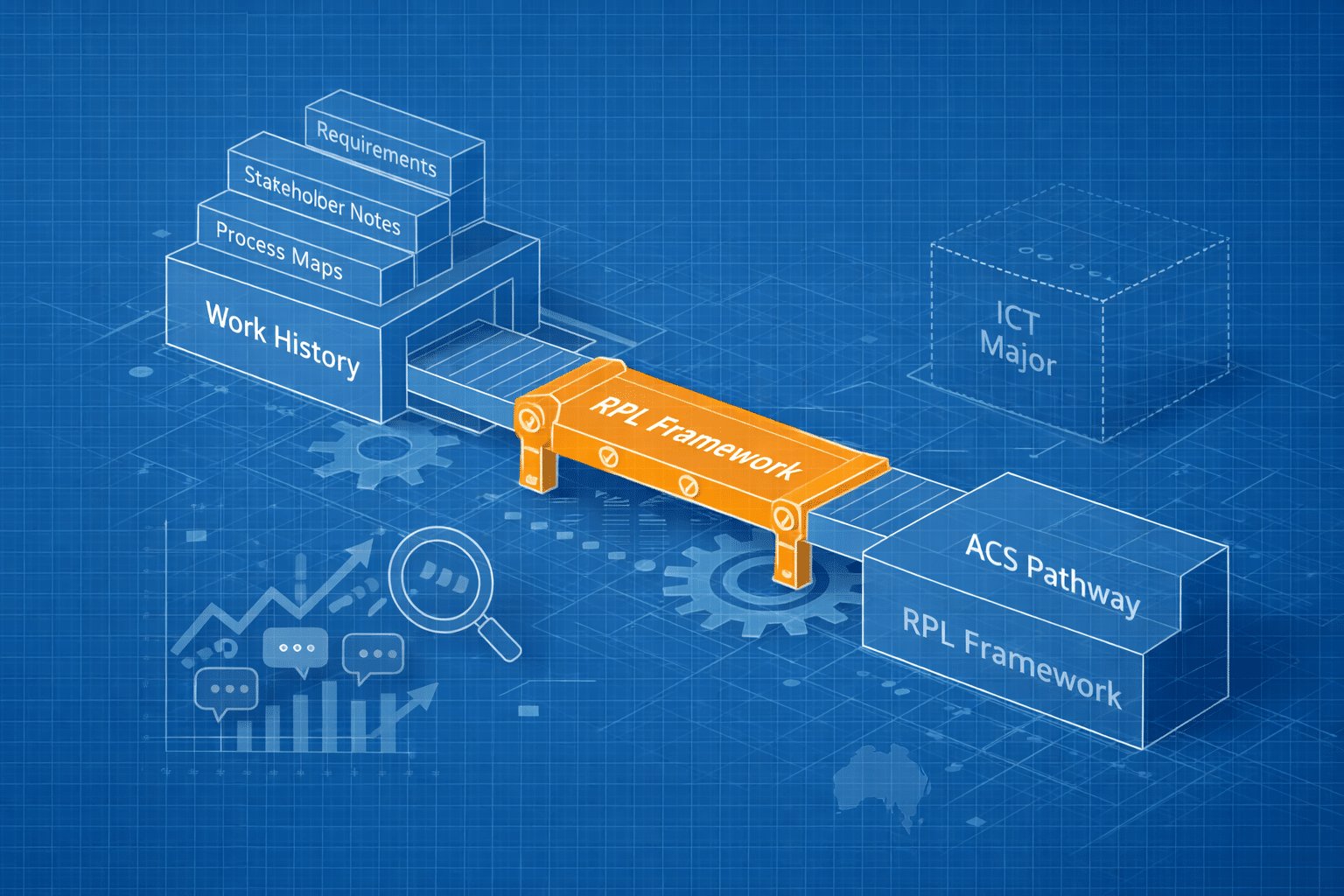


RPL checklist for ICT Business Analyst is often the fastest way to reduce confusion when you are aiming for an ACS skills assessment without a closely-related ICT qualification. In This Guide, You Will Find A Clear Overview Of What RPL Means, What An ICT Business Analyst Typically Does, And How To Think About Evidence Before You Start Drafting Anything For ACS. If You Are Still Mapping Your Situation, Start Here: RPL for ACS skills assessment And Use The Ideas Below To Organise Your Documents.
Many Applicants Lose Time Not Because They Lack Experience, But Because Their Evidence Is Not Presented In A Way That Makes Their Work Easy To Verify. The Goal Is Not To “Sound Impressive.” The Goal Is To Be Consistent, Specific, And Credible Across Your Employment History, Project Work, And Supporting Records.
◆ Sydney-based Australian Pathways RPL and ACS writing team Can Best Help With Tailored RPL Reports And Supporting Documents For ACS, Based On Your Exact Background And Evidence.
What RPL Means In The ACS Skills Assessment Context
In The ACS Context, RPL (Recognition Of Prior Learning) Is A Pathway That Allows Skilled ICT Professionals To Demonstrate Their Competency When Their Formal Qualification Is Not A Recognised ICT Degree, Or When The ICT Content In Their Studies Is Insufficient.
ACS Is The Relevant Assessing Authority For Many ICT Occupations, And Its Published Guidance Is The Primary Reference Point You Should Follow When Planning Your Submission. A Good Starting Place For Official Orientation Is The Front Page Of The Australian Computer Society (ACS) Website, Then You Work Back From Their Requirements To Your Evidence.
RPL Is Not A Shortcut To Avoid Evidence.
It Is A Structured Way To Prove You Have Built ICT Knowledge Through Work And Professional Practice.
For Most People, The Challenge Is Knowing What Counts As “Proof” And How To Keep The Story Consistent Across Many Documents.
Who An ICT Business Analyst (ANZSCO 261111) Is In Plain English
An ICT Business Analyst (ANZSCO 261111) Typically Works Between Business Stakeholders And Technical Delivery Teams.
In Simple Terms, You Translate Business Needs Into Clear Requirements That Technology Teams Can Build, Test, And Support.
Your Work Often Touches Areas Like:
- Requirements Elicitation And Documentation
- Process Mapping And Improvement
- Functional Specifications And User Stories
- Data And Reporting Needs (At A Business Level)
- Stakeholder Workshops And Change Support
- UAT Planning, Defect Triage, And Go-Live Readiness
An ICT Business Analyst Is Usually Not Hired Just To Write Documents.
You Are Expected To Clarify Scope, Reduce Risk, And Help Teams Deliver The Right Outcome, With Less Rework.
That “Bridge Role” Matters In RPL Because ACS Will Look For Evidence That Your Work Is Genuinely ICT-Related, Not Only General Administration Or Purely Operational Work.
Where RPL Fits In The Bigger Migration Picture
An ACS Skills Assessment Is Commonly Used As Part Of A Skilled Migration Pathway.
Your Visa Strategy, Points, And Eligibility Are Managed Through Government Channels, So You Should Always Cross-Check The Current Requirements On The Department of Home Affairs Front Page And The Relevant Visa Pages From There.
RPL Itself Does Not Grant A Visa.
It Helps You Establish That Your Skills Match The Occupation You Are Nominating, Which Is A Key Piece In Many Skilled Migration Journeys.
If You Are Still Studying Or Planning Further Study In Australia, The Government-Backed Study in Australia Website Is Also A Useful Reference For Understanding Study Pathways And How They May Fit Into Longer-Term Plans.
RPL Checklist For ICT Business Analyst: What You’re Actually Proving
RPL checklist for ICT Business Analyst Should Be Built Around One Simple Idea: “Can A Third Party Verify That I Did ICT Business Analysis Work At A Professional Level Over Time?”
That Proof Usually Breaks Into Three Buckets.
- Identity And Personal Records
These Help Confirm That The Applicant Is The Same Person Across All Documents. - Employment And Experience Records
These Prove Where You Worked, For How Long, In What Role, And Under What Conditions. - Work Output And Project Evidence
These Demonstrate The Nature Of Your Work, The ICT Context, And The Outcomes You Influenced.
The Strongest Submissions Are Consistent Across All Buckets.
For Example, If Your Employment Letter Says You Were A Business Analyst On A CRM Implementation, Then Your Supporting Evidence Should Also Reflect CRM Requirements, Workshops, User Stories, UAT, Integrations, Or Comparable ICT Elements.
High-Level Steps Of An ACS Skills Assessment When You Need RPL
You Do Not Need A Complicated Plan, But You Do Need A Logical Sequence.
Here Is A High-Level, Practical Flow That Stays Conceptual (Not A Copy-Paste “DIY Manual”):
- Confirm You Are Targeting The Correct Occupation (ANZSCO 261111)
- Review ACS Requirements And Understand Whether RPL Applies In Your Case
- Build A Timeline Of Your Employment And Projects (Dates, Employers, Titles, Domains)
- Gather Evidence First, Then Decide What Is Strong Enough To Use
- Prepare Your RPL Content In A Way That Matches Your True Work (Without Over-Claiming)
- Check Internal Consistency Across Your Documents (Dates, Titles, Duties, Tools, Signatures)
- Submit And Keep Copies Of Everything For Future Stages
If You Get Stuck, It Is Usually At Step 4 Or Step 6.
That Is Where Most Refusals, Delays, Or Requests For Clarification Come From.
RPL Checklist For ICT Business Analyst: Evidence To Collect Before You Write Anything
RPL checklist for ICT Business Analyst Works Best When You Treat It Like An Evidence Inventory, Not A Writing Exercise.
Before You Draft Any RPL Content, Try To Collect Items Like These (Where Relevant To Your Work History):
Employment Proof (Typical Types)
- Employer Reference Letters (Role, Dates, Hours, Key Duties)
- Payslips Or Tax Documents (Selected Samples Across The Period)
- Employment Contracts Or Offer Letters
- Organisational Charts Or Reporting Lines (If Available)
Project And Work Output Proof (Typical Types)
- Requirements Documents (BRD, FRD, Functional Specs, User Stories)
- Process Maps Or As-Is/To-Be Diagrams
- Workshop Agendas, Minutes, Or Stakeholder Summaries
- UAT Evidence (Plans, Scripts, Defect Logs, Sign-Off Emails)
- Change And Release Notes (Where Your Role Is Clear)
- Screenshots Of Jira/Confluence Items Showing Your Author/Owner Role
- System Context Diagrams Or Interface Summaries (High-Level)
Professional Context Proof (Helpful, Not Always Required)
- Training Certificates (BA, Agile, Scrum, ITSM, Data, Product)
- Performance Reviews Referencing Your ICT BA Contributions
- Client Emails Confirming Deliverables (Keep Privacy In Mind)
Important Note On Confidentiality: Many Applicants Work With Sensitive Data.
You Should Never Submit Confidential Customer Data Or Proprietary Material In Full.
Instead, Think In Terms Of Redaction And Evidence That Shows Structure And Ownership Without Exposing Protected Content.
Typical Timeframes And Planning Expectations
People Often Underestimate How Long Preparation Takes.
A Realistic Planning Mindset Helps You Avoid Rushed Inconsistencies.
Common Timeframe Patterns (General, Not Guaranteed)
- Evidence Collection: Often Takes Weeks, Especially For Older Employers
- Drafting And Review: Depends On Complexity And Number Of Roles
- Employer Letters: Can Be The Slowest Part If Companies Are Unresponsive
- Submission And Outcome Timing: Varies, And Can Change Over Time
Also, Keep In Mind That Government Policies And Processing Settings Can Shift, So For Broader Skilled Migration Planning, It Is Wise To Regularly Check The Official Department of Employment and Workplace Relations Front Page For Policy And Program Context That May Affect Skilled Migration Settings Over Time.
Common Mistakes That Damage Otherwise Strong Applications
Most Problems Are Not About Lack Of Skill.
They Are About Lack Of Evidence Discipline.
Here Are Common Issues That Trigger Doubt Or Clarification Requests:
- Role Titles And Duties Do Not Match The ICT Context
- Dates Differ Across Reference Letters, CV, And Supporting Records
- Duties Are Too Generic (Readable, But Not Verifiable)
- Over-Claiming Seniority Or Ownership Without Proof
- Submitting Evidence That Does Not Clearly Show Your Contribution
- Mixing Non-ICT “Business Analyst” Work With ICT BA Work Without Separation
- Using Tools/Methods As Buzzwords Without Showing How They Were Applied
A Good Self-Check Is Simple: “If Someone Else Read This, Could They Trace My Work From Start To Finish Without Guessing?”
If The Answer Is No, You Need More Clarity, Not More Complexity.
How To Describe ICT Business Analyst Work Without Copy-Paste Wording
Many People Ask: “How Exactly Should I Phrase My Duties To Match ANZSCO?”
The Safer And More Accurate Approach Is Conceptual:
- Use Plain Language That Reflects Your Real Work
- Focus On Outcomes And Verifiable Deliverables
- Keep Scope Clear (Project Name/Type, Stakeholders, System Context)
- Avoid One-Size-Fits-All Statements
For Example, Instead Of Trying To Mirror A Formal List Word-For-Word, You Describe What You Did Across A Typical Delivery Cycle:
- Discovery And Stakeholder Interviews
- Requirements Definition And Traceability
- Collaboration With Developers And Testers
- UAT Coordination And Acceptance Support
- Implementation Readiness And Post-Go-Live Follow-Up
Each Case Is Unique, And The Right Level Of Detail Depends On Your Actual Projects, Employer Evidence, And The ICT Nature Of The Systems You Worked On.
This Is Exactly Why A Strong Checklist Matters: It Helps You Stay Truthful And Consistent Without Turning Your Submission Into A Generic Script.
What “Good Consistency” Looks Like Across Your Documents
If You Want A Practical Quality Standard, Use This Consistency Checklist:
- Same Job Titles (Or Clear Explanation If They Differ)
- Same Employment Dates Everywhere
- Same Work Location And Employer Identity (Legal Name Matters)
- Same Seniority Level Across CV And References
- Same Project Names, Client Names (If Mentioned), And Time Periods
- Same Tooling References (Only If You Truly Used Them)
Even Small Contradictions Can Create Unnecessary Doubt.
Consistency Is One Of The Highest-Impact, Lowest-Effort Improvements You Can Make.
Handling Mixed Roles Or Career Transitions
Many ICT Business Analysts Started In Adjacent Roles Like:
- Operations Analyst
- Finance Or Banking Analyst
- Product Coordinator
- QA Analyst Moving Into BA
- Customer Success Or Implementation Consultant
- Data Analyst With Growing Requirements Ownership
This Is Not Automatically A Problem.
The Key Is To Separate What Was Truly ICT Business Analysis From What Was Not.
If Your Role Had Both ICT And Non-ICT Components, Your Evidence Should Make That Division Clear Through:
- Project Selection (Choose ICT-Heavy Work For Your Main Evidence)
- Employer Letter Wording That Reflects ICT Context (Without Exaggeration)
- Supporting Artifacts That Show System-Facing Work
Avoid Trying To Make Every Past Task Sound Like ICT.
It Is Better To Show Fewer, Stronger ICT-BA Examples Than Many Weak, Generic Ones.
Document Quality: Small Details That Make A Big Difference
Sometimes The Weak Point Is Not The Experience.
It Is The Presentation Of Documents.
Check These Before Submission:
- Scans Are Clear, Complete, And Readable
- Names Match Across Documents (Including Middle Names Or Variations)
- Letters Are On Letterhead (Where Possible)
- Signatures And Contact Details Are Present
- File Naming Is Logical (So Assessors Can Navigate Easily)
You Are Not Trying To Impress With Design.
You Are Trying To Make Verification Easy.
A Practical Checklist You Can Use To Self-Audit Readiness
Use This As A Simple Readiness Review Before You Submit:
Evidence Readiness
- I Can Prove Employment Dates With More Than One Document Type
- I Have At Least Some Work Output Evidence That Shows My Contribution
- My Documents Do Not Contradict Each Other On Dates Or Titles
- I Have Redacted Sensitive Information Where Needed
- I Can Explain Each Project In A Simple, Verifiable Way
Role Fit Readiness
- My Work Clearly Shows ICT Context (Systems, Requirements, Delivery)
- I Avoided Turning Non-ICT Tasks Into ICT Claims
- My Project Evidence Aligns With My Claimed Duties
Process Readiness
- I Have Reviewed Official Requirements And Kept My Approach Aligned
- I Am Prepared For Follow-Up Or Clarification If Requested
- I Have Saved Clean Copies Of Everything For Future Use
At This Point, Your Submission Should Be Structured, Credible, And Internally Consistent.
When To Seek Professional Help (Without Making It A Sales Pitch)
There Is A Difference Between Being Capable And Being Efficient.
Professional Help Is Often Useful When:
- Your Evidence Is Spread Across Multiple Countries Or Employers
- Your Role Titles Do Not Match Your Real Duties
- You Have Short Contracts, Freelance Work, Or Mixed Responsibilities
- You Need Stronger Employer Letters But Have Limited Access
- You Are Unsure How To Present ICT Context Without Over-Claiming
You Still Own The Facts And The Evidence.
Support Should Help You Present Them Correctly, Not Replace Them With Generic Wording.
◆ Sydney-based Australian Pathways RPL and ACS writing team Can Best Help With Tailored RPL Reports And ACS Documentation, Based On Your Specific Evidence And ICT Business Analyst Work History.
FAQ: ACS RPL For ICT Business Analyst (ANZSCO 261111)
1) Is RPL Only For People With No Degree At All?
No. RPL Is Commonly Used When Your Degree Is Not Closely Related To ICT, Or When The ICT Content In Your Studies Is Not Sufficient For The Standard ACS Pathway. Your Work Experience And Evidence Become More Important.
2) Do I Need To Match Every Duty Of An ICT Business Analyst Exactly?
You Should Not Try To Force A Perfect Match. ACS Looks For A Credible Fit Based On Your Real Work. Focus On Verifiable ICT BA Activities Like Requirements, Stakeholder Engagement, Delivery Support, And ICT System Context.
3) What Are The Most Common Reasons Applications Get Delayed?
Delays Often Come From Missing Or Weak Employment Proof, Inconsistencies Across Documents, Or evidence That Does Not Clearly Show Your Contribution To ICT Projects.
4) Can I Use Agile Tools Like Jira Or Confluence As “Proof”?
They Can Help, But Only If They Clearly Show Your Role And Contribution (For Example, Authorship, Ownership, Or Responsibility For Requirements Or UAT Items). Tool Names Alone Are Not Enough.
5) Should I Submit Confidential Documents From My Employer Or Clients?
You Should Be Careful. In Many Cases, You Can Use Redacted Materials Or Extracts That Show Structure, Ownership, And ICT Context Without Exposing Sensitive Data.