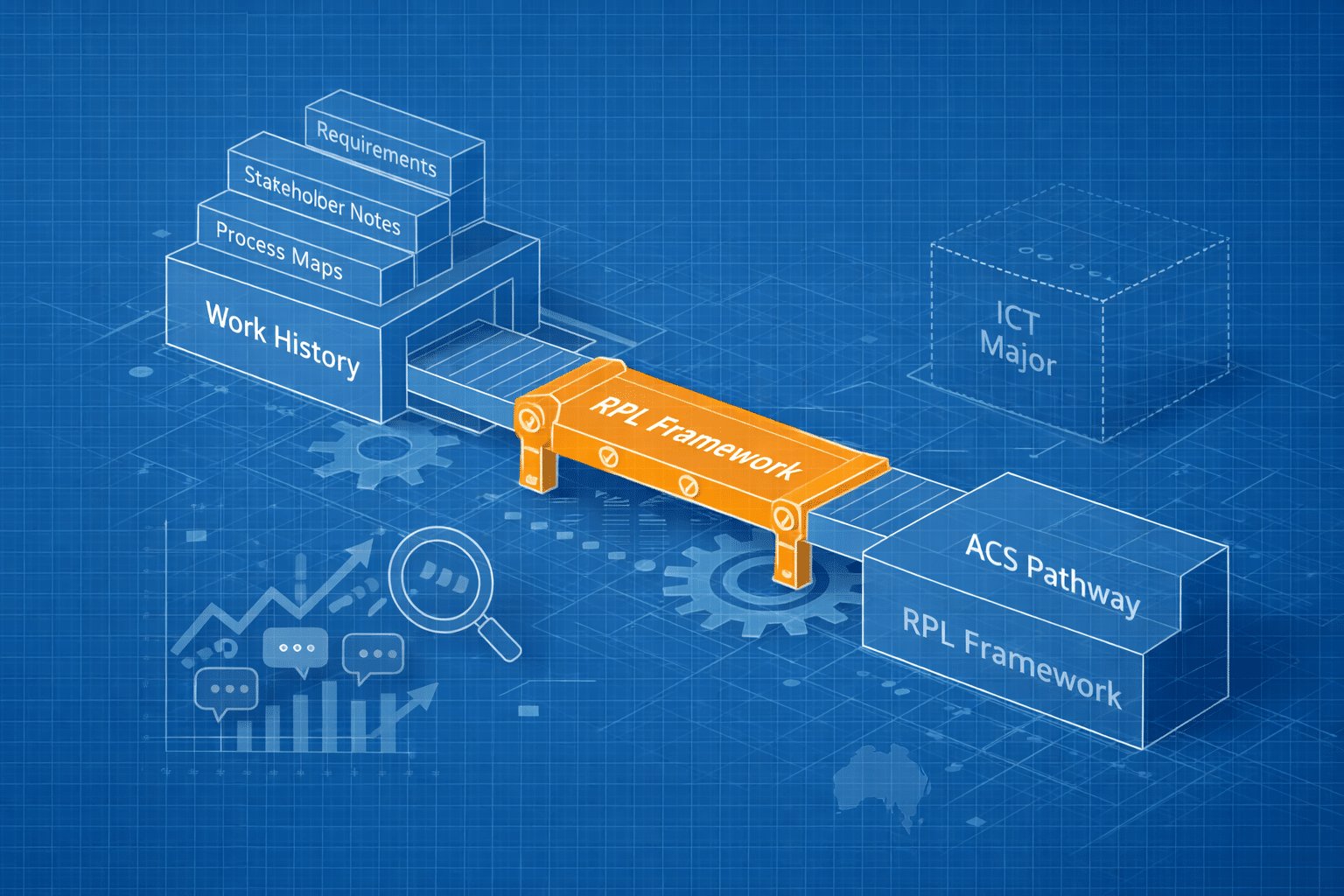


ICT Business Analyst RPL Australia is a key pathway for experienced professionals who want their skills recognised by the Australian Computer Society when their qualifications are not traditionally ICT, often via the specialised RPL for ACS skills assessment route.
Many international professionals work for years as business analysts, systems consultants or product owners, but their official degrees are in business, commerce, engineering or another non-ICT field. When they decide to migrate, they discover that the ACS skills assessment has strict rules about ICT content and that an RPL pathway may be the most suitable option.
◆ The Sydney-based Australian Pathways RPL and ACS writing team can assist you with tailored RPL reports and supporting documents if you need individual guidance.
In this guide, we will explain who an ICT Business Analyst (ANZSCO 261111) is, what ACS RPL means in practice, how ICT Business Analyst RPL Australia works in broad terms, and what documents, timeframes and common mistakes you should be aware of. The goal is to give you a clear, high-level overview so you can plan your own pathway with confidence.
Understanding The ICT Business Analyst (ANZSCO 261111)
An ICT Business Analyst is the bridge between the business and technical worlds. Under ANZSCO code 261111, this occupation focuses on understanding business needs and translating them into functional and technical requirements for ICT systems.
Typical responsibilities for an ICT Business Analyst include:
- Investigating current business processes and identifying gaps or inefficiencies.
- Consulting with stakeholders to understand requirements and priorities.
- Documenting business, functional and non-functional requirements.
- Liaising with developers, testers and project managers to ensure the solution meets business needs.
- Supporting user acceptance testing and change management activities.
ICT Business Analysts can work in many industries: banking, government, telecommunications, healthcare, education, logistics and more. The core idea is always the same: they help organisations use technology in a smarter, more efficient and more strategic way.
The Australian Computer Society is the assessing authority for this occupation for migration purposes. The Australian Computer Society (ACS) sets the criteria for what counts as suitable ICT qualifications and experience, and it also manages the RPL pathway for candidates who do not meet the standard academic rules.
What Is RPL In The ACS Context?
RPL stands for Recognition of Prior Learning. In the ACS context, it is a structured way of demonstrating that your work experience and self-study are equivalent to formal ICT education, even if your degree is in another field or you do not have a degree at all.
Instead of relying mainly on transcripts and course descriptions, the ACS RPL pathway focuses on:
- The depth and breadth of your real-world ICT experience.
- Your ability to explain how you applied ICT knowledge in professional situations.
- Your understanding of key ICT concepts relevant to your nominated occupation.
For ICT Business Analysts, this often means showing that you have genuinely worked in business analysis roles with a strong ICT component, and that you can explain your contribution to projects using clear, structured, professional language.
An RPL application usually includes:
- A detailed employment history outlining positions, dates and responsibilities.
- Evidence from employers, such as reference letters or statements of service.
- RPL project reports, where you describe specific ICT-related projects and explain your role, tasks and outcomes.
Each project report must be written in your own words. It is not a template exercise. ACS expects original, honest, consistent descriptions that match your CV, references and actual work.
Why ICT Business Analyst RPL Australia Is So Important
For many candidates, ICT Business Analyst RPL Australia closes the gap between real experience and formal qualifications. You may have:
- A non-ICT degree, such as Business, Finance, Economics or Engineering.
- An ICT degree that does not fully meet ACS requirements for content or level.
- Significant on-the-job ICT business analysis experience but no degree at all.
Without RPL, these candidates might not qualify for a positive skills assessment, even if they have been working successfully in ICT roles for many years.
A positive ACS skills assessment is often required for skilled migration visas. The Department of Home Affairs explains that a skills assessment is a key part of the process for many skilled visa subclasses. In other words, RPL is not just a paperwork exercise; it can be the difference between having a viable migration pathway or not.
At the same time, RPL is rigorous. You must show that your career progression, project experience and responsibilities align with the expectations for an ICT Business Analyst under ANZSCO 261111.
Who Should Consider ICT Business Analyst RPL Australia?
You should think about ICT Business Analyst RPL Australia if:
- Your degree is not ICT-focused.
- You have a Bachelor’s in Business, Commerce, Management, Economics or similar.
- You have worked mostly in roles like Business Analyst, Systems Analyst or Product Owner with strong ICT components.
- Your ICT degree is not clearly suitable.
- Your ICT studies are at a lower level than required.
- Your course content is limited or not well documented, making it hard to meet ACS criteria through the standard route.
- You do not have a degree but have strong ICT experience.
- You have many years of ICT business analysis work, documented through employment references and detailed role descriptions.
- Your job title is not “ICT Business Analyst” but your work is similar.
- You may be called “Business Consultant”, “Product Analyst” or “Functional Consultant” but your tasks match ANZSCO 261111 closely.
ICT Business Analyst RPL Australia is not for everyone. Some applicants will be better served by a standard ACS skills assessment based on a suitable ICT degree. However, for those whose qualifications sit outside the strict ICT framework, RPL provides a structured, accepted way to demonstrate equivalence through experience.
Step-By-Step Overview Of ACS Skills Assessment
The exact process can change over time, but most ACS RPL applications follow a series of broad steps. The outline below is conceptual, not a detailed checklist or DIY manual, and your own situation may require additional or different steps.
- Clarify Your Occupation And Eligibility
- Decide whether ICT Business Analyst (ANZSCO 261111) best matches your actual duties.
- Review ACS guidelines to see whether you fall under the standard or RPL pathway.
- Gather Educational And Employment Evidence
- Degrees, diplomas and certificates, with transcripts if available.
- Employment references on company letterhead, stating your role, dates, hours and responsibilities.
- Supporting evidence such as payslips, contracts or tax documents, if relevant.
- Prepare Your Detailed CV
- List all roles in chronological order.
- Highlight ICT-related responsibilities and achievements.
- Ensure that dates and duties are consistent with your references.
- Draft Your RPL Project Reports
- Select suitable projects where your business analysis role was clearly ICT-focused.
- Explain the business context, objectives, your specific tasks, tools and outcomes.
- Show how you applied ICT knowledge in a way that fits the ICT Business Analyst occupation.
- Complete The Online ACS Application
- Fill in personal details, qualification information and employment history.
- Upload your documents in the required formats.
- Submit And Wait For Assessment
- Assessment times vary but generally take several weeks from submission.
- You may receive requests for clarification or extra documents.
- Receive Outcome
- A positive outcome confirms that your skills meet the standard for ICT Business Analyst.
- A negative outcome may include comments; in some cases you may be able to improve and reapply.
For the visa side of things, the broader homeaffairs.gov.au website discusses visa subclasses, points systems and other requirements that sit alongside your ACS skills assessment.
Documents, Timeframes And Common Mistakes
While each person’s case is unique, certain patterns appear in most ICT Business Analyst RPL applications. Understanding these high-level expectations can help you avoid common issues.
Typical Documents
Common document categories include:
- Identity and personal documents
- Passport bio page.
- Change-of-name documents, if applicable.
- Education documents
- Degree certificates and transcripts (even if not ICT).
- Course outlines or syllabi, if needed to clarify content.
- Employment evidence
- Employer reference letters with detailed duties, dates, hours and contact information.
- Payslips, tax summaries or contracts as secondary evidence.
- RPL-specific documents
- RPL application form components.
- Two structured project reports describing your ICT-related work as a business analyst.
Timeframes
Processing times can vary depending on ACS workload and the completeness of your documents. Many applicants find that:
- Preparing documents and writing project reports takes several weeks or months, especially if references need to be updated.
- Assessment by ACS typically takes several weeks once all documents are submitted.
- Additional time may be needed if ACS requests further evidence or clarification.
Because visa timelines can be strict, it is wise to allow a generous buffer for both preparation and assessment, rather than working at the last minute.
Common Mistakes To Avoid
Treat ICT Business Analyst RPL Australia as a formal, evidence-based application, not just a narrative about your career. Frequent problems include:
- Copying content from sample reports or other people’s documents. ACS can detect patterns and expects original text in your own words.
- Inconsistent dates between CV, references and online forms, which raise doubts about your credibility.
- Job titles that do not match duties. It is acceptable if your title is different, but your responsibilities must clearly align with ICT business analysis tasks.
- Over-technical descriptions that sound more like software development than business analysis, or the opposite: purely business descriptions with no ICT content.
- Lack of outcomes. Describing daily tasks without explaining what changed or improved because of your work.
None of these points replaces the official ACS guidelines. They are high-level reminders so you can check whether your documents tell a clear, consistent and honest story. For information on study options that can complement your experience, the government site Study in Australia provides general guidance on courses and institutions.
How To Present Your ICT Business Analyst Experience
One of the most challenging parts of an RPL application is explaining your work in a way that clearly fits the ICT Business Analyst occupation without sounding like a copied template. The aim is to be accurate, specific and genuine.
When describing your roles and projects, focus on:
- Business context
- What problem was the organisation trying to solve?
- Which processes, systems or departments were involved?
- Your position and responsibilities
- Where did you sit in the organisational structure?
- Who did you report to and who reported to you, if anyone?
- Your analysis and requirements work
- How did you gather requirements?
- How did you prioritise features and clarify conflicting needs?
- Your interaction with technical teams
- How did you communicate requirements to developers or technical specialists?
- How did you support testing or solution validation?
- Outcomes and impact
- What changed as a result of your work?
- Were there measurable improvements in efficiency, revenue, user satisfaction or compliance?
Your language should reflect real activities from your career, not generic phrases taken from ANZSCO descriptions. It is fine to be inspired by official duty lists, but your wording must remain your own and must be fully truthful.
Practical Tips To Strengthen Your Application
These practical suggestions are general in nature and do not replace professional advice or official ACS documentation, but they can help you think strategically about your application.
- Think Like An Assessor
- Ask yourself: if I knew nothing about this person, would these documents convince me that they really are an ICT Business Analyst?
- Check whether your evidence shows progression, responsibility and sustained ICT-focused work.
- Be Consistent Everywhere
- Names, dates and job titles should be the same in your CV, references and forms.
- If there are gaps or overlaps, explain them briefly rather than hiding them.
- Choose The Right Projects For RPL
- Pick projects where your business analysis role is clear and central, not minor or indirect.
- Avoid very old projects if more recent ones show your current skill level better.
- Avoid Over-Detailing Technical Implementation
- As an ICT Business Analyst, you should show familiarity with systems and technologies, but your focus is on requirements and business value.
- Do not turn your report into a developer’s technical manual.
- Keep It Original And Honest
- Do not copy ACS examples, migration forum posts or commercial samples.
- Explain your own experience, in your own English, even if it is not perfect. Clarity and honesty are more important than “perfect” wording.
The Department of Home Affairs remains the ultimate authority on visa criteria and migration policy, so always cross-check your plans with the latest official information or with a registered migration professional.
◆ If you are unsure how to structure your own background and experience, the Sydney-based Australian Pathways RPL and ACS writing team can provide neutral, case-by-case guidance on preparing RPL documents.
FAQs: ACS RPL For ICT Business Analyst
1. Do I Need An ICT Degree To Apply For ACS RPL As An ICT Business Analyst?
No. The whole purpose of the ACS RPL pathway is to provide an option for candidates who do not have a suitable ICT degree but who have strong, relevant work experience. If your qualification is non-ICT or does not meet ACS requirements, you may still be able to obtain a positive assessment by demonstrating your ICT Business Analyst experience through RPL.
However, ACS will still expect your experience to be substantial, sustained and clearly aligned with the ICT Business Analyst occupation. If your work is only loosely connected to ICT, the RPL pathway may not be appropriate.
2. How Many Years Of Experience Are Required For ACS RPL For ICT Business Analyst?
ACS does not simply look at the number of years; it also evaluates the quality, level and relevance of your experience. In general, RPL applicants need a significant period of ICT-related work to be competitive, because they are compensating for the absence of suitable ICT study.
The exact interpretation of “sufficient” can depend on your mix of roles, responsibilities and projects. It is therefore safer to think in terms of demonstrating depth and consistency, rather than just aiming for a particular number of years. You should also keep in mind that ACS may differentiate between “skilled” and “unskilled” periods within your employment.
3. What Is The Difference Between A Standard ACS Skills Assessment And An RPL Application?
In a standard ACS skills assessment, the emphasis is on your formal qualifications. The assessor checks whether your degree, together with your work experience, matches the criteria for the nominated occupation.
In an RPL application, the focus shifts more strongly toward your work history and how you have learned and applied ICT knowledge in real projects. You still submit any qualifications you have, but your RPL project reports become central evidence. You must explain, in a structured and reflective way, how you met business needs using ICT tools and methods, in line with the ICT Business Analyst role.
Both pathways lead to a skills assessment outcome, but they are built on different types of evidence and have different expectations for depth of explanation.
4. Can I Reuse Someone Else’s RPL Report As A Template?
You should not reuse another person’s RPL report, even as a “template”. ACS expects each report to be original, and it has systems to detect copying or highly similar content. Using someone else’s wording can put your application at serious risk and may lead to negative findings.
Instead, treat examples as learning tools only. Look at their structure or level of detail to understand what ACS might expect, but then write your own report from the ground up, based solely on your own projects and responsibilities.
5. How Long Does ACS Take To Process An ICT Business Analyst RPL Application?
Processing times can change, and they can also depend on how complete and clear your documents are. Many applicants experience assessment times of several weeks once ACS has received all documentation, but this is not guaranteed.
Delays can occur if ACS needs to request additional evidence or clarification, or if there is a high volume of applications. Because of this, it is better to plan your migration timeline with some flexibility and avoid booking major commitments based on optimistic assumptions about processing speed.
ICT Business Analyst RPL Australia can look complex from the outside, but it becomes manageable when you break it down into clear steps: understanding the occupation, deciding if RPL is appropriate for you, preparing strong documents and explaining your real experience in a structured, honest way. With realistic expectations, careful preparation and attention to detail, many experienced ICT business professionals are able to obtain a positive ACS assessment and take the next step toward their Australian migration plans.