
Working Holiday Visa Australia Jobs for Backpackers: Pay, Hiring, and Visa Rules

For most new arrivals, the fastest route into paid work is hospitality, tourism, seasonal agriculture, warehousing or casual retail. If you already have trade experience, construction and site-based work can offer stronger earning potential once you hold any required safety card or licence. The crucial point is that working holiday visa australia jobs for backpackers are not limited to farm work: holders of subclasses 417 and 462 can work in any occupation, subject to their visa conditions. The usual six-month limit with one employer and the separate rules for specified work are what shape the strategy.
A$26.44/hr
National Minimum Wage from 1 July 2026 for an adult employee not covered by an award or agreement. Many jobs have higher award rates.
A$33.05/hr
A$26.44 plus the 25% casual loading where the National Minimum Wage applies. Award-covered casual rates can differ and may be higher.
6 months
Condition 8547 generally limits work with the same employer, although important exemptions and permission pathways apply.
12%
The general Superannuation Guarantee rate for 2026–27. Super is separate from your advertised hourly wage where you are an eligible employee.
Which Backpacker Jobs Make the Most Sense?
The easiest job is not always the best job. A city hospitality role can get cash flowing quickly, while a regional horticulture role may be more useful if you need qualifying specified work. Construction can pay better but may require a White Card, licences or demonstrated experience. Warehousing and temp work can be a useful middle ground when you want regular shifts without committing to one sector.
Hospitality & Tourism
Good for: fast entry, flexible rosters and city or resort work. Australia’s accommodation and food-services sector has a high part-time share, and Jobs and Skills Australia reported strong recruitment activity in 2026. Check the applicable award, weekend/public-holiday penalties and any local RSA requirement if alcohol service is involved.
Agriculture & Harvest
Good for: seasonal hiring and potentially specified work. Do not choose a farm job solely because someone says it “counts for your visa”. Eligible activities and locations differ between subclasses 417 and 462, so verify the exact work and postcode first.
Construction & Trades
Good for: people with site, labouring or trade experience who prioritise earnings. Anyone carrying out construction work must complete the required general construction induction training commonly known as a White Card. Specialist work may require further state or territory licensing.
Warehousing, Retail & Temp Work
Good for: structured shifts, short assignments and metropolitan job searches. Recruitment agencies can be useful for warehouse, pick-pack, event, reception and temporary office roles. A forklift role usually requires the relevant high-risk work licence rather than simply overseas experience.
If you are deciding between several working holiday visa australia jobs for backpackers, rank each vacancy against four questions: what is the lawful pay rate, how many reliable hours are offered, will the same-employer rule matter, and—only if you need it—does the job actually satisfy specified-work rules?
The Six-Month Employer Rule Can Change Your Strategy
Working Holiday Maker visas are designed for an extended holiday with short-term work. Home Affairs states that holders can work in any occupation or industry, but mandatory condition 8547 generally restricts work with the same employer to six months. The six months are elapsed calendar months from when you start—not a tally of hours or shifts—and the rule can capture full-time, part-time, casual and some voluntary work.
You may work for more than six months with the same employer without seeking permission in several current situations, including work in different locations for the same employer where you do not spend more than six months at one location; plant and animal cultivation; natural-disaster recovery; and critical sectors including agriculture, food processing, health, aged and disability care, childcare, tourism and hospitality. Northern Australia also has specified industry exemptions. Check the current Home Affairs six-month work limitation guidance before relying on an exemption.
If your role is not exempt, Home Affairs provides a permission process in limited situations—for example, where you have applied for another visa that would allow ongoing full-time work or where your work is critical to the employer. The request must be lodged before the six-month period expires. This is particularly relevant if a temporary backpacker role unexpectedly becomes a serious career opportunity.
For the general visa position, use the Department of Home Affairs’ Working Holiday Maker work and specified-work guidance, rather than relying on employer promises or old social-media posts.
Specified Work: Farm Work Is Not the Whole Story
Specified work matters only if you need it for a later Working Holiday Maker visa and your passport cohort is subject to that requirement. A second subclass 417 or 462 visa generally requires three months of eligible specified work, while a third generally requires six months completed while holding the relevant earlier visa. The precise eligible industries, activities and geographic areas are set by law and differ between the two subclasses.
Subclass 417
The current instrument includes categories such as plant and animal cultivation, fishing and pearling, tree farming and felling, mining and construction in prescribed regional settings, plus certain tourism/hospitality and disaster-recovery work. Read the in-force subclass 417 specified-work instrument for the controlling detail.
Subclass 462
The subclass 462 framework uses different combinations of Northern Australia and specified regional areas for activities such as cultivation, construction, fishing, forestry and tourism/hospitality, with recovery-work categories also prescribed. Check the in-force subclass 462 specified-work instrument before accepting a job for visa-qualifying purposes.
UK passport holders applying for a second or third subclass 417 visa on or after 1 July 2024 do not need to meet the specified-work requirement. That exception does not mean the ordinary work conditions disappear.
This is one of the biggest traps in working holiday visa australia jobs for backpackers: “regional”, “farm”, “hospitality” and “construction” are not automatic synonyms for qualifying specified work. Save contracts, payslips, employer details, rosters and other records, and verify eligibility before you build your visa plan around a role.
What Should a Backpacker Be Paid in 2026?
Visa status does not remove Australian workplace protections. The Fair Work Ombudsman states that visa holders and migrant workers have the same workplace rights and protections as other employees in Australia. An employer cannot cancel your visa; only Home Affairs can grant, refuse or cancel visas.
From 1 July 2026, the National Minimum Wage is A$26.44 an hour or A$1,004.90 a 38-hour week before tax for adult employees who are not covered by an award or enterprise agreement. A casual employee to whom that national minimum applies also receives a 25% casual loading, which gives a calculated base of A$33.05 an hour. In practice, many backpacker roles are covered by a modern award, so the correct minimum can be higher depending on classification, age, casual status, shift time, weekend or public-holiday work and allowances.
Before accepting a shift, identify the likely award and classification using the Fair Work Ombudsman’s current minimum-wage guidance. Keep your own record of hours and check every payslip. The Fair Work visa-holder and migrant-worker information is especially useful if an employer suggests that backpackers have fewer rights.
When comparing working holiday visa australia jobs for backpackers, the headline hourly rate is only part of the calculation. A slightly lower rate with guaranteed hours, lawful penalties and no expensive employer-controlled accommodation can leave you better off than a supposedly high-paying remote job with inconsistent shifts and deductions you did not understand.
Tax, TFN and Super: Set These Up Early
Apply for a Tax File Number after arriving when you have a visa with work rights, and give your employer a TFN declaration. Under the standard Working Holiday Maker withholding schedule for 2026–27, a registered WHM employer withholds 15% on the first A$45,000 of payments in the income year; higher bands then apply. If you do not quote a TFN, much higher withholding can apply. Your final tax outcome can depend on your circumstances, including tax residency and any relevant treaty position, so withholding is not always identical to final tax liability.
The current rates are contained in the 2026 Working Holiday Maker withholding schedule. For a practical arrival sequence, Australia Pathways’ moving-to-Australia guide also covers early setup tasks such as a TFN, banking and job search.
Eligible employees also receive superannuation. The general Superannuation Guarantee rate is 12% in 2026–27. Check the ATO’s current Superannuation Guarantee rate. Temporary residents may later be able to claim a Departing Australia Superannuation Payment after leaving Australia and meeting the eligibility conditions.
Where to Find Jobs—and How to Get Hired Faster
An illustrative job-search format is a concise one- or two-page Australian-style résumé, supported by a local mobile number, clear suburb or city location, your visa work rights and your immediate availability. Avoid leading with a long explanation of your travel plans. Employers usually need to know whether you can do the work, when you can start, what shifts you can cover and whether any six-month limit matters.
Use the government-supported Workforce Australia harvest-job search for current seasonal vacancies and combine it with major commercial job boards, recruitment agencies and direct employer applications. For hospitality, in-person applications can still work when timed outside busy service periods. For farms and remote employers, verify the business, pay arrangement, location, transport, accommodation and written terms before travelling long distances.
Jobs and Skills Australia reported that Accommodation and Food Services had the highest recruitment rate among industries in the March quarter of 2026, which helps explain why hospitality remains a practical entry point for new arrivals. Its 2026 recruitment analysis also shows that hiring difficulty remains substantial in some trade and technical occupations—useful if you arrive with credible experience and the required Australian tickets.
Australia Pathways’ Australian job market guide provides broader guidance on résumés, job platforms and employer expectations. If you are applying before arrival, the guide on getting an Australian job offer from overseas can help you structure the search more realistically.
Tickets and Credentials That Can Unlock More Work
Some of the strongest working holiday visa australia jobs for backpackers are easier to access after a small amount of targeted training. Construction workers generally need a White Card before carrying out construction work; Safe Work Australia’s construction guidance confirms the required general construction induction training and national recognition of White Cards. Alcohol service commonly requires Responsible Service of Alcohol training under state or territory rules. Forklift operation requires the relevant high-risk work licence, and childcare or regulated work may require screening, qualifications or checks.
Do not buy every course advertised to backpackers. First identify real vacancies in the place you intend to live, confirm the credential the employer actually requires, and use the responsible state or territory regulator or an approved training provider. A modestly priced ticket that unlocks frequent shifts can be useful; a stack of unused certificates is not a job strategy.
An Illustrative 14-Day Backpacker Job Plan
Days 1–2: Get Employment-Ready
Apply for your TFN, open or confirm your Australian bank account, prepare a concise résumé, check your VEVO work conditions, set up a super fund if appropriate, and gather licences or certificates you already hold.
Days 3–5: Apply Broadly but Deliberately
Submit targeted applications across two or three realistic sectors. Match your availability to the vacancy. If specified work matters, filter opportunities by eligible activity and location before investing time or travel money.
Days 6–10: Add Direct Outreach
Call recruitment agencies, visit suitable hospitality employers at quiet times, follow up on promising applications and widen your search radius. Ask about rate, award or classification, casual loading, hours, start date and accommodation deductions before accepting.
Days 11–14: Diagnose the Bottleneck
If interviews are not happening, revise the résumé and role targeting. If interviews happen but offers do not, work on availability, local credentials and examples of relevant experience. If the market is thin, change sector or location rather than sending the same application indefinitely.
Backpacker Job Traps Worth Avoiding
- Cash pay below the lawful minimum. Cash itself is not automatically unlawful, but you should still receive correct pay, records and a payslip.
- “Farm work that definitely counts” without evidence. Verify subclass, activity and location against the current Home Affairs rules and legislative instrument.
- Unclear accommodation or transport deductions. Ask for the amounts and terms in writing before travelling or accepting employer-arranged housing.
- Being told to get an ABN simply because the employer prefers contractors. Whether you are genuinely an employee or independent contractor depends on the real relationship, not the label on a form.
- Extended unpaid “trial” work. A brief skills demonstration can be lawful in limited circumstances, but productive work beyond what is reasonably needed to demonstrate skills should raise questions. Check Fair Work guidance before agreeing.
- Paying someone for a guaranteed job or visa outcome. Treat high-pressure requests for money, passport access or personal documents as a reason to verify the employer and the service provider independently.
The safest way to assess working holiday visa australia jobs for backpackers is to separate three questions that are often blurred together: “Can I legally do this job?”, “Am I being paid correctly?”, and “Does this work count toward a future WHM visa if I need it?” A job can be legal but not specified work; specified work can still be badly paid if the employer is non-compliant; and a good city job can be the right choice even if it contributes nothing to a second or third visa.
The Bottom Line
There is no single “backpacker job” market in Australia. The strongest strategy is to use your visa flexibility deliberately: take fast-entry work if you need income, move toward ticketed or skilled work if you can earn more, and pursue specified work only when it genuinely serves your visa plan. Check the current employer limitation, never assume a postcode or industry qualifies, and compare the award rate and realistic weekly hours before choosing between offers.
For most travellers, working holiday visa australia jobs for backpackers become much easier to navigate once the priorities are in order: lawful work rights first, correct pay second, reliable hours third, and future-visa value fourth. That approach protects both your budget and your options while you travel.
Related Australia Pathways Guides
Sources and Verification
- Australian Department of Home Affairs — Working Holiday Maker work conditions and specified work.
- Australian Department of Home Affairs — six-month work limitation.
- Fair Work Ombudsman — visa holders and migrant workers.
- Fair Work Ombudsman — minimum wages.
- Federal Register of Legislation — 2026 Working Holiday Maker withholding schedule.
- Australian Taxation Office — Superannuation Guarantee rates.
- Jobs and Skills Australia — 2026 recruitment analysis.
- Federal Register of Legislation — current subclass 417 specified-work instrument.
- Federal Register of Legislation — current subclass 462 specified-work instrument.
- Safe Work Australia — construction induction and White Card guidance.
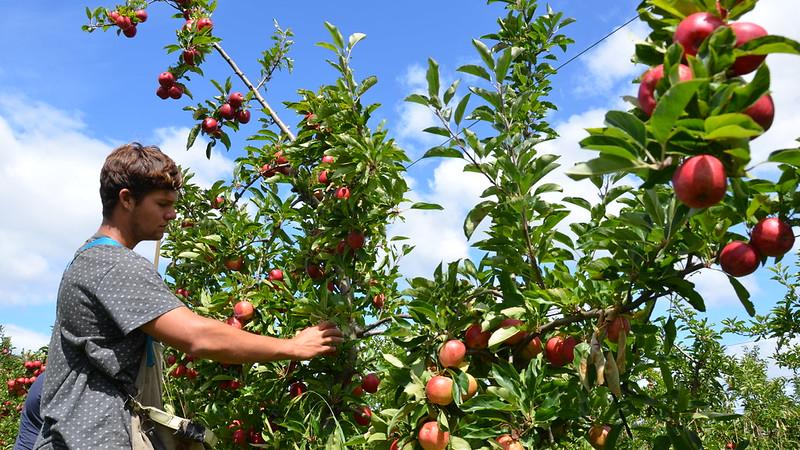
Featured photo credit: “Picking Royal Gala organic apples in Tasmania DSC_5691” — Apple and Pear Australia Ltd / Flickr / CC BY 2.0